





Instead of reconstructing scar-care instructions at every visit, use a clinician-approved checklist that separates healed-scar care from wound care and eczema management. This 2026 guide to scar care for home health aides shows you how to prepare, assist within your authorized role, document skin changes, and hand off concerns without treating an eczema flare as a scar problem.
- Scar care for home health aides starts with clinician clearance, intact skin, and an authorized care plan.
- Rejûvaskin silicone scar products suit healed-scar care, not open wounds or active eczema treatment.
- Keep eczema cleansing and moisturizing separate from silicone application; follow each product’s directions.
- Document what you observe and report changes rather than diagnosing infection or changing treatment.
Why this matters
A healed surgical scar and an eczema patch need different care. Silicone belongs on appropriately healed, intact skin; broken, weeping, or newly inflamed skin needs assessment before you continue a scar product.
Eczema also complicates the picture. Itching, scratching, dryness, and product irritation can affect skin around a scar, so the handoff must describe both areas rather than simply recording that the scar looks red. Start with the distinction between eczema and its triggers in What Causes Eczema: Parents and Patients.
Rejûvaskin silicone scar care is best suited to people with healed scars whose clinicians have approved silicone use. It is not a substitute for prescribed eczema treatment, wound assessment, or infection management.
For a 2026 home-care plan, the practical goal is consistency: the right task, on the right skin, with a clear stopping rule. Your agency’s policies, state requirements, training, and patient-specific instructions determine which tasks you can perform.
Before you start
- Confirm authorization and clearance. Have the current care plan, supervising clinician’s contact information, and explicit instructions about the scar site. Confirm whether you are authorized to apply products, assist the patient, or provide reminders only.
- Gather the actual supplies. Keep the approved cleanser, moisturizer, scar product, clean towel, hand-hygiene supplies, and documentation method available. Read the package directions; different silicone products do not share one universal schedule.
- Catch the eczema gotcha early. A closed incision does not automatically mean the surrounding skin tolerates silicone or adhesive contact. Report active eczema, cracking, weeping, or a previous product reaction before starting; do not improvise by putting a sheet over inflamed skin.
Do not select a scar treatment because it is already in the home. Verify that the clinician approved that product for that site, and that the instructions remain appropriate after any change in the skin.
Care-plan setup
Establish the instructions before touching the scar
- Identify the site. Match the patient, body location, and planned task to the care plan. Obtain consent and protect privacy before exposing the area.
- Confirm the healing stage. Check that the clinician has cleared the site for scar care. Do not remove dressings, disturb surgical adhesive, or decide that a wound is healed because it appears dry.
- Separate the tasks. List scar-product assistance, eczema cleansing, moisturizing, and prescribed treatments as distinct activities. Ask the supervising clinician to resolve overlapping instructions.
- Record the stopping rules. Know whom to contact for new irritation, wound opening, drainage, worsening pain, or treatment refusal. Identify the agency’s urgent and emergency escalation routes.
Expected result: You can explain what is authorized, where it belongs, and what requires a call before you begin.
Build a reusable visit record
For your 2026 visit template, use simple labels such as Site, Skin observations, Patient report, Care completed, and Notification. These are suggested documentation headings, not required fields in a particular record system.
Record observations without turning them into diagnoses. Describe where redness appears, whether the skin is intact, and what the patient says about discomfort; do not label redness as infection or eczema unless that diagnosis is already established.
Keep the baseline descriptive enough for another aide to recognize a change. If your agency permits photographs, follow its consent, storage, and privacy procedures; never use a personal phone outside those procedures.
Skin check and cleansing
Check the scar and surrounding eczema-prone skin
- Clean your hands. Follow agency infection-control procedures and use gloves when the task requires them. Gloves do not replace hand hygiene.
- Ask about symptoms. Check for new itching, burning, pain, drainage, or discomfort since the last visit. Ask whether the patient used additional products between visits.
- Observe both areas. Look at the scar and nearby skin for openings, moisture, rash, blistering, or spreading redness. Compare with the documented baseline rather than relying on memory.
- Pause when findings change. Follow the care plan’s reporting instructions before applying silicone to questionable skin. Do not scrub away crusts or cover drainage with a scar sheet.
Expected result: The skin is either ready for the authorized routine or the concern has been escalated before product application.
Clean gently without turning bathing into treatment
For eczema-prone skin, use lukewarm water and a mild cleanser rather than a scrub or deodorant soap. Fragrance-free labeling matters: an unscented product can still contain fragrance used to mask another odor.
When bathing is part of the approved plan, keep baths or showers short. Common dermatology guidance recommends 5–10 minutes in warm, not hot, water, followed by gentle patting rather than rubbing.
For eczema-prone areas, applying moisturizer within 3 minutes after bathing helps retain moisture. Keep that step separate from the scar-product site when silicone directions require clean, dry skin, and ask the clinician how to manage overlap.
Rejûvaskin Eczema Body Wash contains 2% colloidal oatmeal and sodium hypochlorite and is formulated for dry, sensitive, eczema-prone skin. Use it according to its labeling and the approved plan; its sodium hypochlorite content is not an instruction to prepare a bleach bath or add household bleach.
Expected result: Cleansing leaves the skin clean without unnecessary friction, and eczema moisturizing does not conflict with scar-product instructions.
Scar-product application and documentation
Match the approved format to the task
Silicone gel and silicone sheets are different formats, not interchangeable instructions. Use the format named in the care plan, and follow its application, cleaning, removal, and replacement directions.
| Approved option | Best for | Practical advantage | Limitation to plan around |
|---|---|---|---|
| RejûvaSil Silicone Scar Gel | Clinician-approved gel care for healed post-operative or facial scars | Clear silicone gel provides a non-surgical scar-care format | Requires application and drying according to directions; it is not an eczema treatment |
| Scar Fx Silicone Sheet - 1.5 x 3 inches | Clinician-approved sheeting when the size fits the healed scar | Provides a silicone sheet format for scar management | Fit, skin tolerance, cleaning, and wear instructions need attention; do not place over active eczema |
Do not interpret a scar product’s intended benefit as permission to use it on every mark. Eczema-related discoloration, an open scratch, and a healed surgical scar are not equivalent treatment targets.
These products provide scar-care options, not a cure for eczema. The clinician’s plan determines whether either belongs in the patient’s routine.


Complete the approved routine
- Prepare the site. Follow the selected product’s directions for clean, dry, intact skin. Do not layer unapproved moisturizer, medication, or gel beneath a sheet.
- Apply or assist as authorized. Follow the labeled amount, placement, and schedule. Do not add massage, compression, longer wear, or extra applications unless specifically directed.
- Check comfort. Ask about burning, pulling, or itching. Follow the product’s removal instructions and agency reporting process if a reaction develops.
- Document the visit. Record the product used, site, care completed or declined, patient response, and any communication with the supervising clinician.
Expected result: The record shows what happened, not merely that scar care was done.
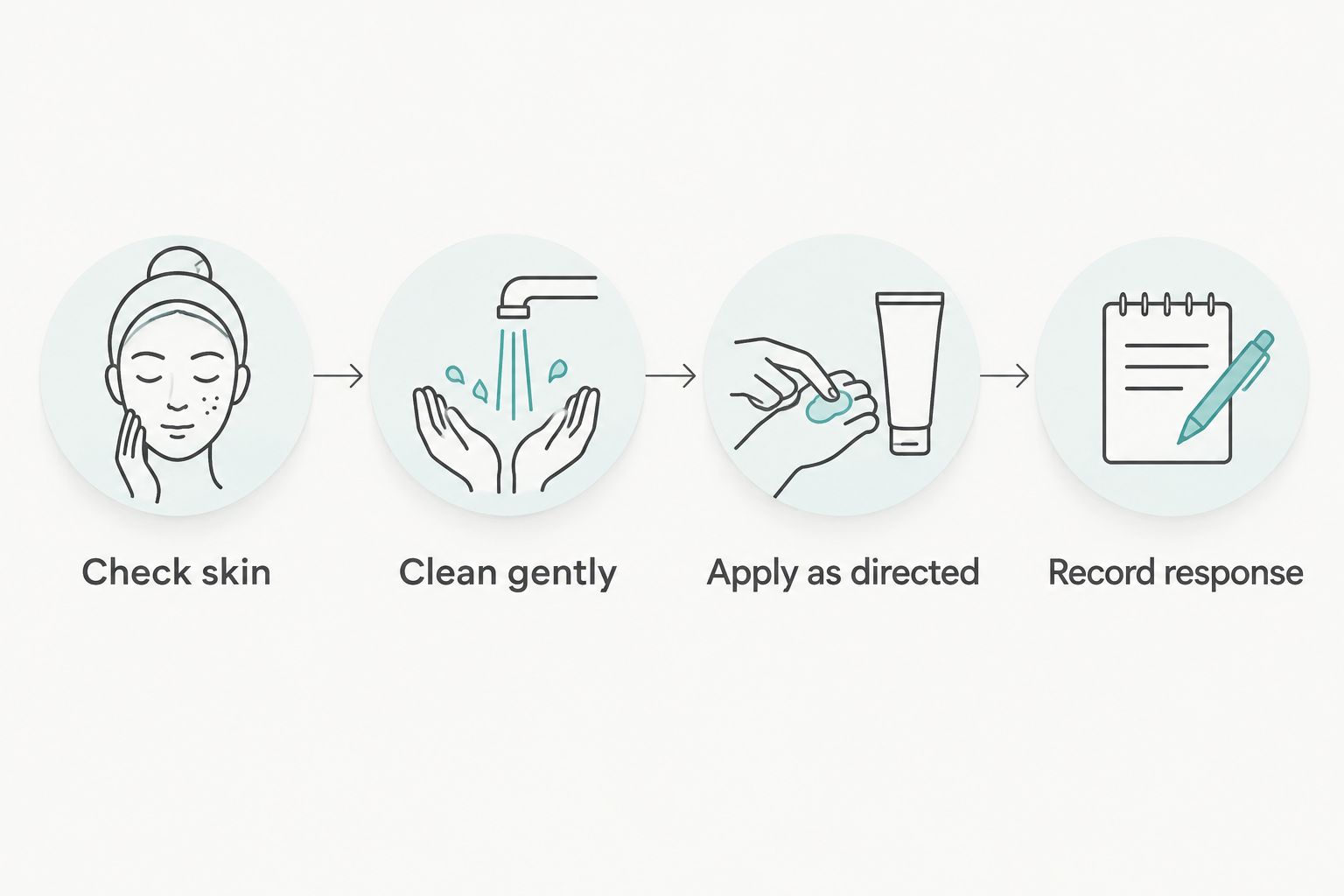
Use the same sequence across your 2026 visits: Check skin, Clean gently, Apply as directed, and Record response. Consistency makes omissions easier to spot without encouraging an aide to make treatment decisions.
When eczema changes between visits
An eczema flare changes the workflow even when the scar itself remains closed. Do not continue automatically because the previous visit was uneventful.
- Identify what changed. Record the location of itching, dryness, rash, cracking, or weeping. Ask about new products, clothing friction, or changes to the prescribed routine without assuming a cause.
- Pause the affected scar-care task. Avoid applying silicone over actively inflamed or broken skin while you seek instructions. Do not stop prescribed medicines or change their use independently.
- Contact the supervising clinician. Describe the skin findings, symptoms, product exposure, and last application. Ask whether to hold, resume, or modify the scar-care task.
- Update the handoff. Record the instructions received and make sure the next caregiver can see them. A verbal message alone leaves room for conflicting care.
Expected result: The team responds to the changed skin condition rather than repeating an outdated routine.
For patients with both eczema and a surgical scar, keep separate documentation entries for each concern. Improvement in the scar’s appearance does not establish that eczema is controlled, and reduced itching does not establish that a wound is healed.
Troubleshooting
A silicone sheet lifts or rolls
Check whether the skin was prepared according to directions and whether clothing is rubbing the edge. Do not solve poor adhesion with extra tape, tighter wrapping, or an unapproved adhesive; ask the supervisor about fit or an alternative format.
Gel stays wet or transfers onto clothing
Compare the application with the package directions, including the amount used and drying instructions. Do not cover damp gel with a silicone sheet or compensate by applying another layer; clarify the routine if the problem continues.
Itching or redness appears after application
Treat new irritation as a reason to pause and report, not proof that the scar product is working. Follow removal directions, describe the reaction, and ask the supervising clinician whether the product should remain on hold.
The site opens, drains, or becomes increasingly painful
Stop routine scar-product application and seek prompt clinical direction. Spreading redness, warmth, swelling, pus, or fever can indicate a complication; follow agency escalation procedures, and obtain emergency help for severe or rapidly worsening illness.
The patient refuses or forgets care
Ask whether discomfort, confusing instructions, or difficulty handling the product is the barrier. Document missed or declined care honestly, notify the appropriate team member, and never double the next application to make up for it.
Customize your workflow
Build the 2026 handoff around the patient’s actual daily routine. A bathing visit, a dressing change performed by a nurse, and independent self-care between visits require different coordination; they should not produce competing instructions for the same site.
For eczema-prone skin, keep the routine easy to distinguish: cleansing, moisturizing, prescribed eczema treatment, and healed-scar care each need their own instructions. Ask the clinician to specify where products belong when those areas overlap.
Include outdoor protection in the discussion with the care team. Clothing and shade can protect a healed scar without adding another topical product; confirm sunscreen suitability when eczema or irritation affects the area.
FAQ
Can a home health aide apply scar gel?
A home health aide can assist with scar gel only when the task is permitted by applicable rules, agency policy, training, and the patient’s care plan. Confirm authorization with the supervising clinician before starting.
When can scar care begin after surgery?
Scar care begins when the treating clinician clears the healed site for the selected product. Do not use silicone on an open, draining, or incompletely healed incision.
Can silicone scar sheets go over eczema?
Do not place silicone scar sheets over active eczema or broken skin without specific clinical direction. Report the affected area and ask how scar care should change while the skin is inflamed.
Is silicone gel better than silicone sheets for sensitive skin?
Neither format is automatically better for every person with sensitive skin. The clinician should consider the scar location, skin condition, previous reactions, and ability to follow the product’s directions.
Should an aide massage a surgical scar?
An aide should not add scar massage unless it is specifically authorized and taught within the care plan. Scar location, healing stage, and surgical restrictions affect whether massage is appropriate.
Does an eczema body wash replace scar treatment?
An eczema body wash does not replace a prescribed or clinician-approved scar-care routine. Cleansing eczema-prone skin and managing a healed scar are separate tasks.
What should an aide document after scar care?
Document the site, observed skin condition, patient-reported symptoms, product used, care completed or declined, and response. Record concerns reported to the supervisor and the instructions received.
When should an aide call the nurse about a scar?
Call the supervising nurse for new skin breakdown, drainage, worsening pain, spreading redness, or a suspected product reaction. Follow the agency’s urgent or emergency process when symptoms are severe or rapidly worsening.
One last thing
A complete checklist can end with no product applied. Recognizing new eczema, a wound opening, or an unclear instruction—and reporting it before continuing—is part of safe scar care, not a failed visit.
Make the reason visible in the record. The next caregiver needs to know whether care was completed, declined, or held for clinical advice.