





Radiation dermatitis usually heals over the weeks after radiotherapy ends, but the reaction can worsen before it improves. Dryness and mild irritation generally settle sooner than open, weeping skin; discoloration can remain after the surface has healed. This 2026 guide explains what recovery looks like, how eczema changes your care questions, and when you need your radiation team’s help.
- How long does radiation dermatitis take to heal? Usually weeks after treatment; open or weeping skin needs closer monitoring.
- Rejûvaskin Skin Recovery Cream supports radiation-related skin care; ask your oncology team whether it fits your treatment plan.
- Eczema and radiation dermatitis can coexist, but they do not automatically need the same treatment.
- Call your radiation team about worsening pain, spreading redness, drainage, fever, or newly broken skin.
Why this matters
Your last radiation appointment is not necessarily the day your skin reaction peaks. Radiation affects the treated skin over time, so irritation can continue after treatment stops. A temporarily worse appearance does not, by itself, establish an infection or mean treatment has gone wrong.
If you already have eczema, familiar symptoms can make the situation harder to judge. Itching, dryness, and inflammation overlap, but a reaction within the radiation field needs assessment in the context of your cancer treatment—not just your usual eczema routine.
Rejûvaskin offers condition-focused skin care, but your radiation oncology team determines the treatment for damaged or broken skin. Keep that distinction clear when choosing supportive products.
How long does a radiation skin reaction take to heal?
An acute radiation skin reaction usually settles over the weeks following treatment. The useful starting point is the end of radiotherapy, not the day irritation first appeared. Your radiation team can give a more relevant estimate after examining the area and checking whether the skin remains intact.
Macmillan Cancer Support’s patient guidance on radiotherapy skin reactions describes this same general pattern: skin reactions can continue after treatment and usually improve over the following weeks. That describes acute recovery, not a deadline for every symptom to disappear.
| Skin presentation | What recovery involves | What you should do |
|---|---|---|
| Dry, itchy, intact skin | Irritation eases and the skin becomes more comfortable | Follow your team’s cleansing and moisturizing instructions |
| Dry peeling | Loose surface skin sheds while the underlying skin recovers | Avoid picking, rubbing, or exfoliating |
| Open or weeping skin | The damaged surface needs wound assessment and protection | Contact your radiation team for dressing instructions |
| Persistent color change | Pigment changes can outlast soreness and peeling | Protect healed skin and discuss persistent changes at follow-up |
These presentations are not interchangeable stages that everyone passes through. Some people have mild dryness without peeling; others develop more significant reactions in the treated area.
Judge recovery by improving comfort and skin integrity, not by color alone. A darker patch can remain after tenderness and peeling have resolved, while a small raw area still needs attention even if the surrounding skin looks better.
Dry, intact skin: focus on comfort and protection
Dry, intact skin usually needs gentle cleansing, an approved moisturizer, and less friction. The benefit of this approach is simplicity: you support comfort without repeatedly introducing products to an already sensitive area.
The limitation is that moisturizer alone does not treat every cause of inflammation. Tell your team if itching disrupts sleep, tenderness increases, or the area stops improving. Do not assume a stronger moisturizer is the answer to every change.
Open or weeping skin: get a wound-care plan
Open or weeping skin needs a different plan from dry skin. Your radiation team should assess the area and explain whether you need a dressing, how to cleanse it, and which products belong on the surrounding intact skin.
Dressings can protect vulnerable tissue, but the wrong adhesive or an unsuitable product can irritate it further. Do not put a cosmetic cream, scar sheet, or household dressing onto a raw radiation reaction without instructions.
Why radiation dermatitis healing time varies
The appearance of the reaction matters more than a generic countdown. These factors help explain why your recovery differs from someone else’s:
- Depth of skin damage. Intact, dry skin and an open, weeping surface have different care needs.
- Treatment location. Skin folds and areas where clothing rubs are harder to keep comfortable.
- Radiation treatment details. The treated area, dose, and schedule influence the skin reaction; your radiation team interprets these together.
- Other cancer treatments. Treatments given alongside radiation can affect skin sensitivity and recovery.
- Existing skin conditions. Eczema or contact dermatitis can add irritation and complicate product selection.
- Infection or repeated irritation. Infection, scratching, friction, and reactions to products can interfere with recovery.
You cannot change the radiation already delivered, but you can report symptoms promptly and reduce avoidable irritation. Bring your actual products to an appointment rather than relying on descriptions such as gentle, natural, or sensitive-skin friendly.
Is this radiation dermatitis or an eczema flare?
Radiation dermatitis generally follows the treated area. Eczema can occur elsewhere and often has a familiar pattern for someone with an established diagnosis. Location helps, but it does not replace an examination: eczema, contact allergy, and radiation injury can overlap.
| Condition | Useful clue | Best next step | Important limitation |
|---|---|---|---|
| Radiation dermatitis | Symptoms develop in skin exposed to radiation | Ask your radiation team to assess the treatment field | Appearance alone does not establish severity |
| Eczema flare | Symptoms resemble your established eczema pattern | Discuss your existing eczema plan with your clinician | Your usual treatment is not automatically suitable for irradiated skin |
| Contact dermatitis | Irritation follows exposure to a product or adhesive | Report the exposure and ask what to stop using | Timing alone does not identify the responsible ingredient |
Do not treat a new radiation-field rash as ordinary eczema without checking. A prescription you use elsewhere on your body might need different instructions on treated skin, particularly if the surface is broken.
If you have eczema, tell the team what normally triggers it and which treatments you already use. Include fragranced washes, laundry products, topical medicines, and dressing adhesives in that conversation. A familiar product can still be uncomfortable on newly irritated skin.
How should you care for the skin while it heals?
Keep the routine gentle and follow the instructions specific to your treatment site. The goal is to avoid extra injury while your team manages inflammation or wound care.
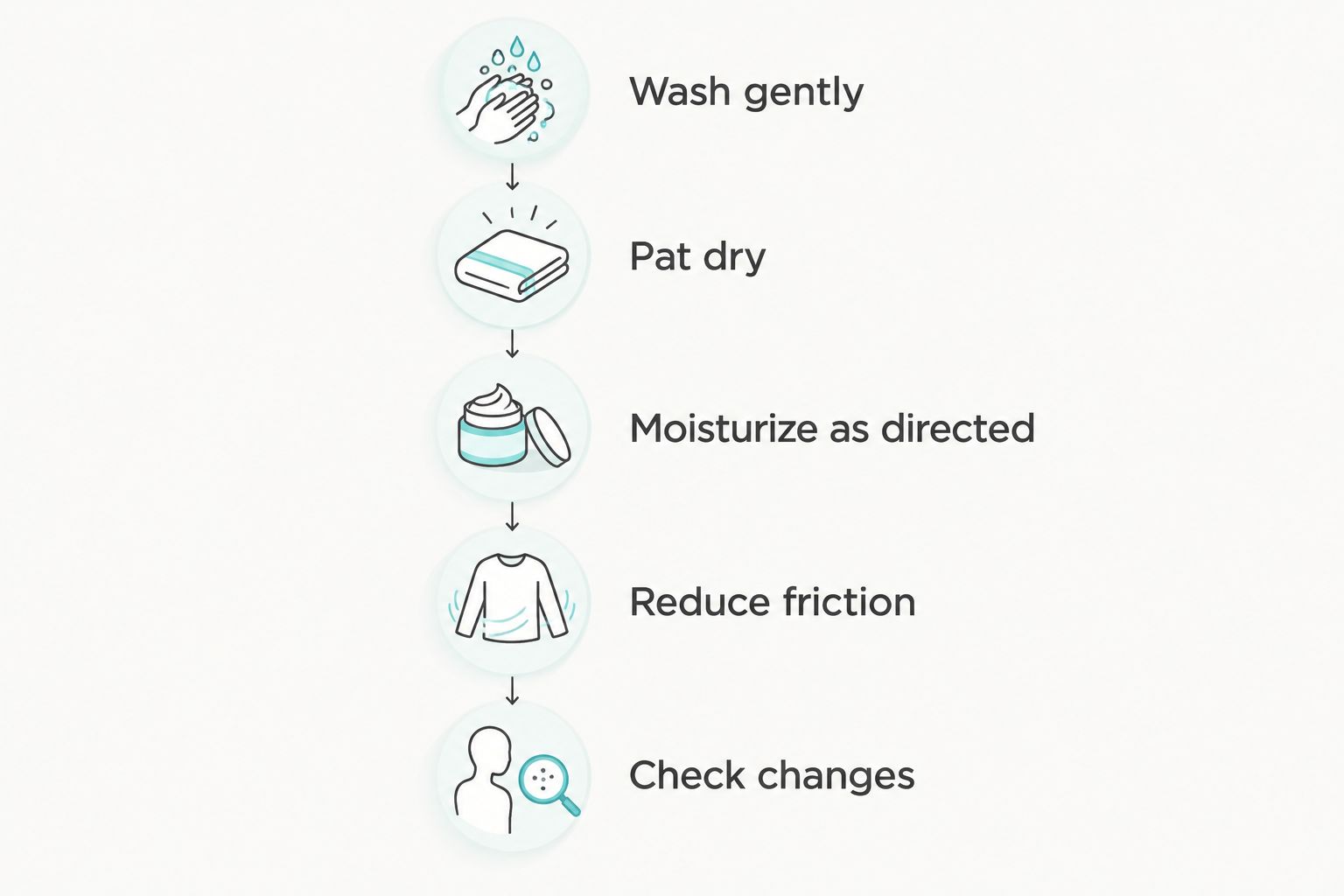
- Wash gently. Use lukewarm water and the cleanser your team recommends. Do not scrub the treated area or use an exfoliating cloth.
- Pat dry. Use a soft towel without rubbing. Pay attention to folds, where moisture and friction can collect.
- Moisturize as directed. Apply only products approved for the condition of your skin. Instructions for intact skin do not automatically apply to open areas.
- Reduce friction. Choose comfortable clothing and avoid seams or tight bands rubbing the treatment field.
- Check changes. Note pain, peeling, drainage, and new areas of damage. Report deterioration instead of covering it with another product.
A useful 2026 treatment diary records when radiotherapy ended, where symptoms occur, and what changed after each product or dressing. Brief notes help you describe the pattern accurately at your next appointment.
Avoid adding exfoliating acids, retinoids, fragranced products, or adhesive scar treatments to the irritated field on your own. More steps do not mean better care. If an approved product burns or makes symptoms worse, stop applying it and contact your team for instructions.
Where supportive skin care fits
Rejûvaskin Skin Recovery Cream is best suited to consumers seeking supportive skin care developed for radiation relief. Its stated purpose is to fortify, soothe, and nourish damaged skin; it is not a substitute for an oncology assessment or prescribed wound care.
Discuss Skin Recovery Cream with your radiation team before adding it to your routine. Ask where to apply it, whether the surface must be intact, and how its use fits around treatment appointments or dressings. No supportive cream establishes an individual healing deadline.
What should you ask at your follow-up appointment?
At your 2026 follow-up, describe symptoms rather than asking only whether the area looks normal. Pain, moisture, and the condition of the skin surface give your clinician more useful information than color alone.
Bring these questions:
- Is the skin intact, or does any area need wound care?
- Which cleanser and moisturizer should touch the treatment field?
- Should you continue your eczema prescription on this area?
- What should you do if a dressing sticks or the skin starts weeping?
- Which changes require a same-day call?
- When should you arrange another skin check?
Ask for written instructions if several products or dressings are involved. Keep a clear separation between care for an open area, care for surrounding intact skin, and your usual eczema treatment elsewhere.
When should you contact your radiation team?
Contact your radiation team promptly about new open skin, increasing pain, unexpected drainage, or symptoms that worsen after they had started improving. Do not wait for a scheduled appointment if the care plan no longer matches what you see.
Fever, rapidly spreading redness, increasing warmth, swelling, pus, or feeling unwell need urgent clinical advice. Follow your oncology service’s emergency instructions, especially if you have also received treatment that affects your immune system.
Long-lasting thickening, persistent wounds, or new changes well after treatment also need assessment. They should not be managed indefinitely as a slow version of an ordinary acute reaction.
Will the discoloration disappear when the soreness stops?
Discoloration can last longer than soreness or peeling. Healing of the surface and recovery of your usual skin color are separate processes, so a lingering darker or lighter patch does not automatically mean the skin remains open or inflamed.
Protect the area from sun exposure with clothing and shade. Once the skin has healed and your team approves sunscreen, general American Academy of Dermatology guidance is to use a broad-spectrum, water-resistant sunscreen with SPF 30 or higher and reapply every 2 hours outdoors, as well as after swimming or sweating.
Do not apply sunscreen to raw or weeping skin without guidance. If you also have eczema, use a product your skin tolerates and tell your clinician about stinging or irritation rather than repeatedly trying new formulas on the treatment field.
FAQ
How long does radiation dermatitis take to heal after my last treatment?
Radiation dermatitis usually heals over the weeks after your last treatment, but severity changes the timeline. Open or weeping skin needs assessment and a wound-care plan rather than a general recovery estimate.
Why is my skin worse after radiation has finished?
Skin reactions can continue to develop after radiotherapy ends because the effects on treated skin persist beyond the final appointment. Tell your radiation team about worsening symptoms, especially new breakdown or increasing pain.
Can radiation treatment trigger my eczema?
Radiation can irritate the treated skin, and eczema can coexist with that reaction. Ask your clinician to distinguish the conditions before applying your usual eczema treatment to the radiation field.
Can I use my eczema cream on a radiation rash?
Use an eczema cream on a radiation rash only after your radiation team confirms it is appropriate. The instructions depend on the medicine, the treatment site, and whether the skin is intact.
Can Rejûvaskin Skin Recovery Cream make radiation dermatitis heal faster?
Rejûvaskin Skin Recovery Cream is developed for supportive radiation-related skin care, not an individual healing deadline. Ask your oncology team whether it fits your care plan and where to apply it.
What should I put on weeping skin after radiotherapy?
Your radiation team should choose the care plan for weeping skin after radiotherapy. Do not assume your regular moisturizer, scar treatment, or household dressing is suitable for an open area.
What should my 2026 radiation skin-care plan include?
Your 2026 radiation skin-care plan should include approved cleansing and moisturizing instructions, guidance for broken skin, and a clear contact route for worsening symptoms. If you have eczema, include instructions for your existing medicines.
One last thing
Comfort and an intact surface are better recovery markers than an immediate return to your usual skin color. Keep your 2026 discharge instructions until the reaction has settled, and ask for a reassessment if the skin breaks down again after improving.
For eczema-prone skin, the most useful habit is restraint: keep tolerated products consistent and ask before treating the radiation field differently.
Related guides
- Mineral sunscreen for eczema-prone skin
- Facial cleanser for combination skin — general facial cleansing, not care instructions for an active radiation reaction.