





Instead of repeating scar-sheet placement and garment checks from memory, use a compression garment scar sheet protocol that confirms healed skin, checks fit with silicone in place, and records the patient's response. This 2026 guide focuses on fitting patients with eczema-prone or sensitive skin without treating scar sheets as eczema therapy.
- A compression garment scar sheet protocol needs clinician clearance, product instructions, and a fit check with silicone in place.
- Rejûvaskin Scar Fx sheets suit fitters seeking silicone scar coverage; they are not eczema treatments.
- Do not cover open, weeping, infected, or actively inflamed eczema with a scar sheet.
- Stop for skin breakdown; urgent symptoms such as numbness or color changes require prompt assessment.
Why this matters
A garment that fits without a scar sheet still needs assessment with the intended sheet underneath. Folds, overlapping edges, and movement can change local contact and create uncomfortable pressure points. For eczema-prone patients, sweat, friction, and prolonged occlusion also deserve attention.
Itching alone does not identify the cause. Scar discomfort, eczema, irritation, and contact allergy need different responses; the guide to scar itching during healing provides related context, not clearance to continue an uncomfortable fitting.
Rejûvaskin Scar Fx silicone sheets are best for fitters seeking scar coverage, not treatment for active eczema. Keep that distinction in the fitting record and patient instructions. A scar-management product does not replace the patient's prescribed eczema treatment.
Before you start
- Obtain the clinical plan. Confirm that the treating clinician has cleared silicone use on fully closed skin and authorized the intended compression. Establish who handles eczema flares, wound concerns, and garment adjustments.
- Have the actual fitting materials ready. Bring the prescribed garment, intended sheet, current manufacturer instructions, measuring tools, and a way to record placement. Check cleaning, reuse, cutting, and wear instructions rather than transferring directions from another product.
- Resolve the hidden compatibility issue first. Ask about creams, ointments, dressings, adhesives, and skin allergies. Products underneath a sheet can affect adhesion and moisture; do not discontinue prescribed eczema medication or cover it with silicone without clinician direction.
This protocol supports fitting decisions, not diagnosis or prescribing. If clearance is unclear, pause the silicone portion of the appointment rather than inventing a wear schedule.
Skin assessment and treatment boundaries
Use this first configuration unit to establish whether the planned scar-sheet fitting should proceed. Your 2026 fitting record should separate scar condition, surrounding eczema, and the compression prescription instead of combining them under a single skin-status note.
- Confirm the treatment site. Identify the scar and examine the intended contact area. Silicone scar sheets belong on fully closed skin, not an open incision or draining wound.
- Record the skin baseline. Note existing dryness, itching, redness or other discoloration, tenderness, and any visible eczema. Ask the patient where symptoms occur before adding either layer.
- Check for reasons to pause. Do not place a sheet over broken, weeping, infected, or actively inflamed eczema. Refer uncertain findings to the treating clinician; do not assume every itchy patch is ordinary scar healing.
- Confirm the treatment boundary. Document which area receives silicone and which areas follow the eczema care plan. Ask for instructions when these areas overlap.
- Record the authorized wear plan. Copy the clinician's directions and applicable product instructions. Do not add a universal pressure target, overnight requirement, or progression schedule.
Expected result: You have a clearly identified, eligible scar site and written directions for both compression and skin care. Unresolved skin findings have an owner and a next action before fitting continues.
Sheet selection and garment fit
Choose coverage by scar geometry and the intended garment, not by assuming that a larger sheet delivers a stronger result. Sheet dimensions describe coverage; they do not establish therapeutic pressure or guarantee tolerance.
The following Rejûvaskin scar-sheet options illustrate different coverage shapes. Both require the same clinical clearance and an individual fit check.
| Sheet option | Best for | Practical advantage | Limitation |
|---|---|---|---|
| Scar Fx Silicone Sheet - 1.5 x 3 | A localized scar area that fits within its dimensions | A defined, smaller coverage area for placement planning | Not enough coverage for every scar; a garment check remains necessary |
| Scar Fx Silicone Sheet - 1 x 22 | A long, narrow scar area that fits within its dimensions | An elongated format for planning linear coverage | Long placement needs checking for folds, movement, and contact at garment seams |
The smaller format measures 1.5 inches by 3 inches; the elongated format measures 1 inch by 22 inches. Verify the actual scar measurements and manufacturer directions before choosing or altering a sheet. Neither format is an eczema dressing.
- Map the intended placement. Identify the scar, nearby folds, garment seams, and areas the patient reports as sensitive. Check whether the proposed sheet position crosses a joint or high-movement area.
- Prepare the contact area. Follow the sheet instructions for skin preparation. Avoid improvising with alcohol, fragranced wipes, or additional adhesives on eczema-prone skin.
- Apply the intended sheet. Follow its directions and keep the sheet flat. Do not create overlapping layers or add padding to solve a fit problem without authorization.
- Fit the prescribed garment over the sheet. Use the garment's fitting instructions and prescribed configuration. Do not tighten the garment to compensate for sheet movement.
- Check rest and movement. Ask the patient to perform movements relevant to the treated area. Recheck seams, edges, bunching, discomfort, and garment position after movement.
Expected result: The intended sheet lies flat under the garment without a new pressure point, movement restriction, or patient-reported discomfort. A failed check leads to reassessment, not a tighter garment.


Patient handoff and reassessment
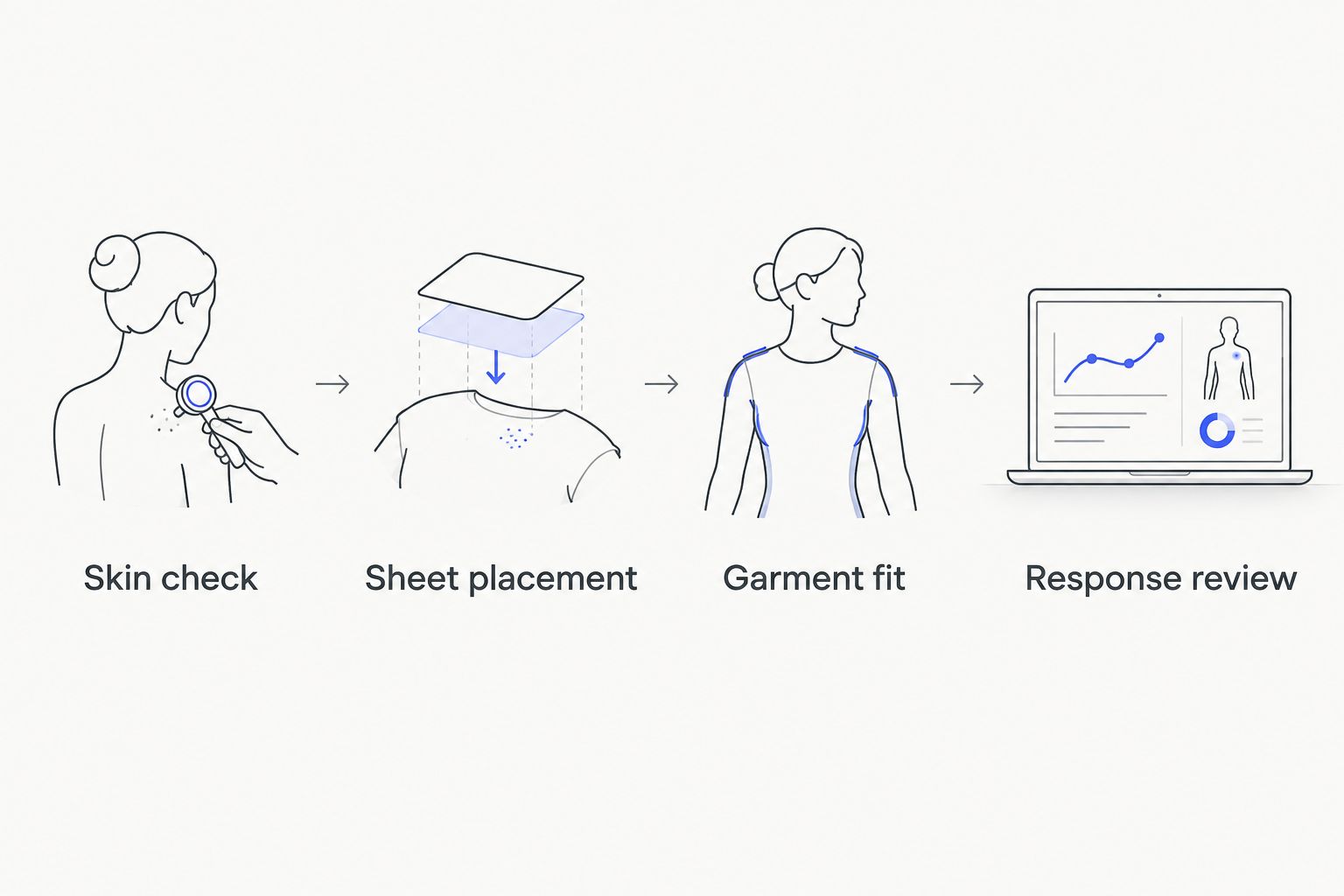
A successful appointment includes a repeatable home routine. For your 2026 protocol, give the patient written instructions that match the approved plan and ask the patient to demonstrate the process before leaving.
- Skin check: Show the patient which skin changes to inspect before application and after removal. Explain that new symptoms should not automatically be attributed to the scar.
- Sheet placement: Have the patient demonstrate the approved position without stretching, folding, or stacking the sheet. Record the orientation so another fitter can reproduce it.
- Garment fit: Ask the patient to put on the garment and repeat the relevant movements. Confirm that home application reproduces the assessed fit.
- Response review: Write down cleaning instructions, the authorized wear plan, reassessment arrangements, and whom to contact. Include separate instructions for routine irritation and urgent symptoms.
Expected result: The patient can repeat the approved sequence and explain when to stop. The next clinician or fitter can identify exactly which product, placement, and garment configuration were used.
Record the patient's words alongside visible findings. A complaint such as burning under the lower edge helps locate a problem more precisely than a general note that the garment was tolerated.
Repeat the workflow when eczema or garment fit changes
A second workflow is necessary when a previously tolerated combination becomes uncomfortable. Your 2026 protocol should trigger reassessment after an eczema flare, a garment replacement, a sheet-format change, or a meaningful change in swelling or body measurements.
- Identify what changed. Compare the current garment, sheet, placement, skin care, and skin condition with the last documented fitting. Ask about laundry products and new topical treatments.
- Recheck skin eligibility. If eczema has become active beneath the planned sheet area, pause sheet application there and obtain clinical direction. Do not cover the rash to prevent scratching.
- Reassess the assembled combination. Once the skin is cleared, repeat the fit check with the intended sheet and garment together. A previous garment assessment does not validate a new configuration.
- Issue updated instructions. Replace outdated placement notes and wear directions. Make the approved version easy for the patient and care team to identify.
Expected result: The revised plan reflects the patient's current skin and equipment rather than relying on an earlier fitting. Change one authorized element at a time so the response remains interpretable.
Troubleshooting
The sheet rolls or bunches under the garment
Remove the garment and inspect the placement. Reapply according to the sheet instructions, then repeat the movement check. Persistent bunching requires a coverage or garment review; additional compression is not the default fix.
Skin looks white, soggy, or newly irritated
Remove the sheet and inspect the skin. Moisture trapped under an occlusive layer can contribute to maceration; do not immediately cover the area again. Obtain clinical advice for skin breakdown, persistent irritation, or uncertainty about restarting.
Itching or a rash appears in the contact area
Pause sheet use on the affected area and contact the treating clinician. Eczema, irritant reactions, and contact allergy can overlap in appearance. Do not diagnose a silicone allergy from the outline alone or add medication beneath the sheet without instructions.
The patient develops numbness, unusual coldness, or color changes
Remove the compressive garment promptly and seek urgent medical assessment. New severe pain also needs prompt attention. Do not ask the patient to tolerate these symptoms while waiting for a routine fitting appointment.
The sheet no longer stays in position
Check the cleaning, drying, and reuse instructions and inspect the sheet's condition. Review whether a newly introduced topical product is interfering with contact. Replace or change the configuration only according to product guidance and the clinical plan, not with improvised adhesive.
Customize your workflow
Build separate record entries for the scar, eczema, silicone placement, and garment fit. This prevents a note about improved scar comfort from hiding worsening surrounding dermatitis.
Include the product identity, garment identity, scar location, baseline symptoms, approved directions, movement findings, and escalation contact. Record the reason for every change. A photograph can support placement documentation when consent and your organization's privacy procedures permit it.
For eczema-prone patients, coordinate cleansing and moisturizing with the clinician's instructions and the sheet's preparation requirements. Do not insert a new cleanser, ointment, or fragranced laundry product simply because the fitting has become uncomfortable. First identify the problem.
FAQ
What's the safest compression garment scar sheet protocol for eczema-prone skin?
Start with clinician clearance, fully closed skin, and a fit check using the intended sheet beneath the prescribed garment. Do not place a scar sheet over active eczema, and provide clear instructions for stopping and seeking advice.
Can I put silicone scar sheets over an eczema flare?
Do not apply silicone scar sheets over actively inflamed, broken, or weeping eczema. Ask the treating clinician how to manage the flare and when scar-sheet use can resume.
Should a compression garment feel tighter after adding a scar sheet?
Do not use a tighter sensation as evidence that treatment is working. Reassess the garment with the sheet in place and resolve new discomfort, folds, or pressure points before continuing.
How many hours should patients wear silicone sheets under compression?
Use the treating clinician's authorized plan and the specific product instructions. There is no single wear schedule suitable for every scar, garment, and eczema-prone patient.
Can moisturizer or eczema medication go underneath a silicone sheet?
Use a topical product beneath a silicone sheet only when the treating clinician and product instructions permit that combination. Do not stop prescribed eczema medication to improve sheet adhesion without medical direction.
Does a silicone compression wrap replace a prescribed compression garment?
A silicone compression wrap is not automatically interchangeable with a prescribed garment. Changing the compression system requires assessment and authorization from the treating team.
When should a fitter stop the appointment and refer the patient?
Stop for open skin, suspected infection, active eczema at the contact site, or unresolved skin irritation. Numbness, unusual coldness, color changes, or severe new pain require prompt medical assessment.
One last thing
The final check belongs after movement, not just after application. A flat sheet and comfortable garment at rest do not establish that the combination stays comfortable during daily activity. Make that movement check a required sign-off in your 2026 protocol, and repeat it whenever the placement or garment changes.