





Physical therapists’ silicone scar care is the use of topical silicone on fully closed scars with the aim of supporting scar management alongside rehabilitation. This 2026 guide to silicone scar products for physical therapists focuses on a practical distinction: treating a healed scar without aggravating nearby eczema-prone skin.
- Rejûvaskin offers silicone scar products for physical therapists choosing between gel and sheet formats for closed scars.
- Check wound closure and eczema activity before recommending silicone scar care; open or actively inflamed skin needs separate assessment.
- Match silicone gel or sheeting to the scar location, movement demands, skin tolerance, and home routine.
- Silicone scar products support scar management; they do not replace eczema treatment, prescribed rehabilitation, or infection assessment.
Why silicone scar care matters for physical therapists
A patient can have a fully healed surgical incision and eczema nearby. Those conditions need different decisions: scar care addresses the healed scar, while eczema management addresses inflammation and the skin barrier. Treating every itchy area as a scar problem risks missing the actual cause.
Rejûvaskin offers both silicone scar products and eczema-focused skincare. Rejûvaskin silicone scar products are best for physical therapists seeking a choice of gel and sheet formats for closed scars. Product format is the starting point, not a substitute for assessing the skin.
For your 2026 rehabilitation plan, separate appearance-related goals from functional goals. Silicone is used to help manage raised scars; it does not replace assessment of restricted movement, pain, weakness, or deeper tissue adherence. A flatter-looking scar does not establish that mobility has improved.
Eczema adds another constraint. Sweat, friction, cleansing products, and prolonged covering can aggravate susceptible skin, so your recommendation must account for what happens between appointments—not just what looks comfortable on the treatment table.
How to build a skin-conscious scar-care plan
1. Confirm closure and screen the surrounding skin
Start with inspection and a focused history. Confirm that the incision is fully closed and dry, and follow the surgical team’s instructions before introducing topical silicone. A draining area, wound separation, or suspected infection is not a routine scar-product decision.
Ask where the itching occurs. Itching confined to the scar, a rash matching a product’s outline, and a broader eczema flare are different findings; do not assume they share a cause. Record the appearance before introducing anything new so you have a useful baseline.
For patients with eczema, examine the proposed contact area as carefully as the scar itself. Do not place routine silicone scar products over open, weeping, infected, or actively inflamed skin. Seek guidance when the scar and dermatitis overlap.
- Check closure: look for drainage, openings, and fragile areas.
- Map symptoms: distinguish scar discomfort from surrounding itch or rash.
- Review history: ask about eczema, adhesive reactions, and recent product changes.
- Confirm instructions: check surgical restrictions and prescribed skin treatments.
2. Establish a simple cleansing and moisturizing routine
Use the patient’s existing, well-tolerated routine first. For eczema-prone skin, favor a mild, fragrance-free cleanser, lukewarm water, gentle drying, and moisturizer after bathing. Avoid adding exfoliating scrubs or fragranced products around a sensitive scar.
Keep eczema care and silicone application instructions separate. Moisturizing eczema-prone skin is useful, but a layer of moisturizer underneath a silicone sheet can interfere with adherence. Follow the specific scar product’s directions rather than assuming every skincare layer belongs underneath it.
Your 2026 home-care sheet should identify what goes where. A simple body-area diagram is clearer than telling a patient to apply everything to the affected region, especially when a scar crosses an eczema-prone fold.
- Clean gently: avoid scrubbing the healed incision.
- Pat dry: reduce rubbing on sensitive skin.
- Moisturize appropriately: follow the eczema plan for surrounding skin.
- Separate applications: follow silicone directions for clean, dry contact skin.
3. Match the silicone format to movement and tolerance
Before recommending a purchase, ask the patient to demonstrate the movements they perform at home. Observe whether the scar sits under a waistband, crosses a joint, or contacts exercise equipment. Those details help you choose between a drying gel and a physical sheet.
RejûvaSil Silicone Scar Gel is a medical-grade silicone gel intended for scar management, including postoperative and facial scars. Scar Fx Silicone Sheets provide a sheet format for scar management. Neither format treats an active eczema flare, and neither is automatically suitable for every patient with sensitive skin.
A gel avoids managing a separate sheet, but requires correct application and drying. A sheet offers a defined contact area, but introduces fit, cleaning, and skin-tolerance considerations. Choose the format the patient can use correctly without provoking surrounding skin symptoms.
- Test movement: observe bending, reaching, and clothing contact.
- Check dexterity: confirm the patient can apply and remove the format.
- Review contact: consider friction, sweat, and skin folds.
- Follow labeling: use the selected product’s application and cleaning instructions.
4. Fit the contact area without improvising a dressing
Measure the healed scar and inspect its shape before selecting sheeting. Scar Fx options include a 1.5-inch by 3-inch sheet, a 3-inch by 5-inch sheet, and a 1-inch by 22-inch sheet. These are product dimensions, not instructions to cover an entire limb or bridge active eczema.
Use the manufacturer’s directions to determine fit and whether trimming is appropriate. Do not assume that a larger sheet improves outcomes or that a longer strip is suitable for every moving joint. The relevant question is whether the intended contact area remains comfortable during ordinary activity.
Silicone sheeting is also not an invitation to add tight wrapping. If the patient needs compression, that requires its own clinical assessment and instructions; a silicone scar sheet alone does not establish a compression prescription.
- Measure the scar: document length and location before choosing a size.
- Inspect the edges: identify nearby folds, rash, or fragile skin.
- Check the fit: observe normal movement without pulling or bunching.
- Avoid improvisation: do not add tight wraps to hold a slipping sheet.
5. Teach a repeatable application and skin-check sequence
Demonstrate the routine, then ask the patient to show it back to you. A verbal agreement does not confirm that someone can reach the scar, distinguish eczema from irritation, or remember when to remove and clean a sheet.
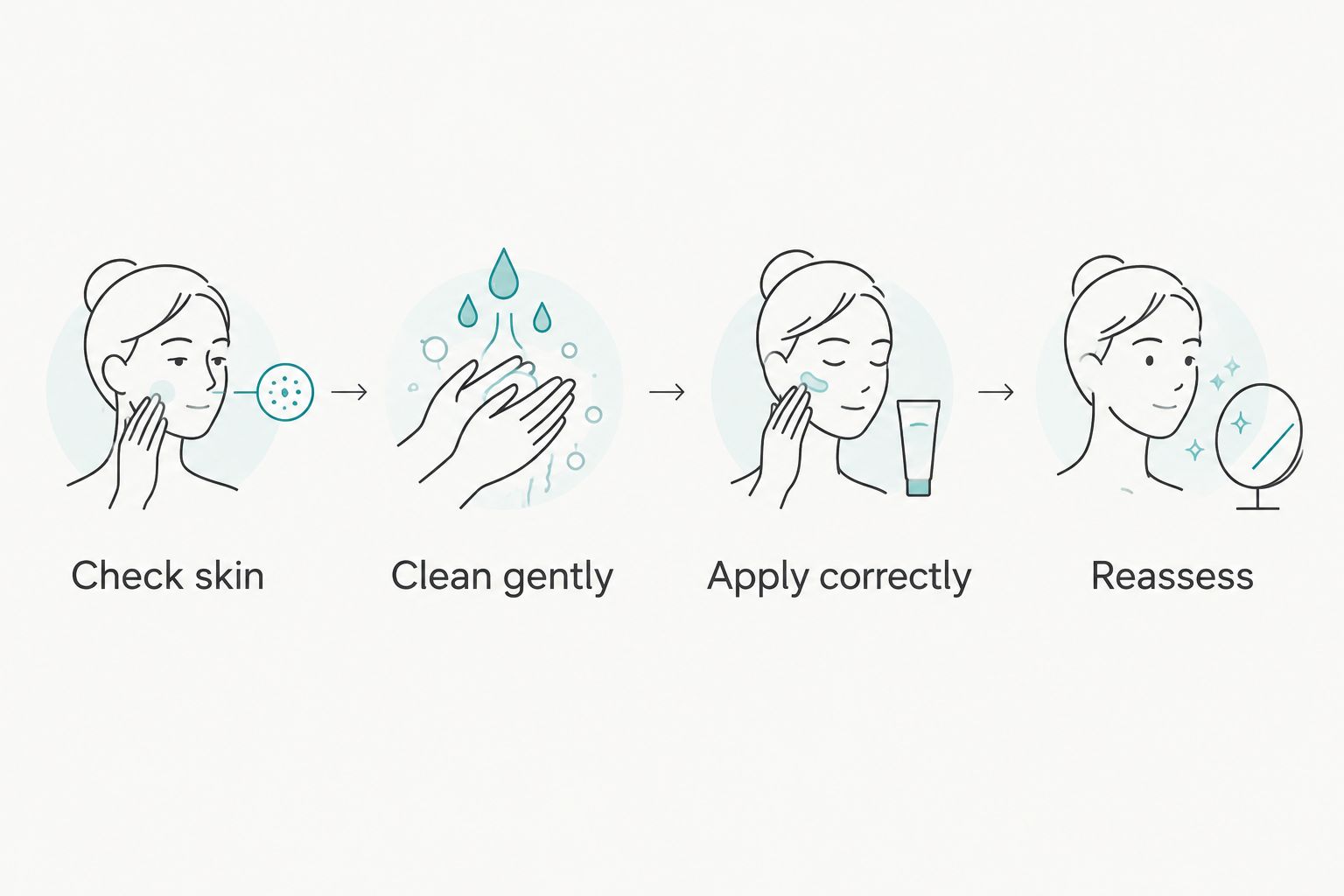
Use the same sequence each time: check the skin, clean gently, apply correctly, and reassess. The product label sets application details and wear instructions. The patient’s skin response determines whether you need to pause and seek advice—not an arbitrary endurance target.
Write the stop instructions beside the application instructions. A patient with eczema needs to know that new burning, increasing itch, blistering, or a spreading rash is a reason to stop the new product and contact the treating clinician.
- Check skin: look at the scar and surrounding contact area.
- Clean gently: follow cleansing and drying directions.
- Apply correctly: demonstrate the exact product instructions.
- Reassess: remove and inspect as directed; report new irritation.
6. Measure function and refer problems outside scar care
Record scar appearance and rehabilitation outcomes separately. Note the patient’s movement limitation, activity-related discomfort, and tolerance of clothing or equipment, alongside the scar’s texture and appearance. Use consistent conditions when comparing follow-up observations.
For a 2026 follow-up template, include eczema activity and product tolerance as distinct fields. Otherwise, a worsening rash can disappear inside a general note that says the scar remains itchy. Ask whether symptoms occur during application, exercise, removal, or the following day.
Refer progressive scar thickening, persistent pain, recurrent dermatitis, or uncertain skin changes to the appropriate clinician. Spreading redness, warmth, drainage, fever, or wound reopening needs prompt medical assessment rather than a different scar cream.
- Document function: track the movement or activity that matters to the patient.
- Record appearance: use consistent descriptions and photographs with consent.
- Track tolerance: note rash location and timing relative to use.
- Escalate concerns: distinguish routine follow-up from urgent wound assessment.
Compare scar-care options for eczema-prone patients
Use this 2026 comparison to match the task to the format. No silicone format replaces treatment for active eczema, and no format guarantees scar removal. The strongest choice is the one that fits the healed scar and remains tolerable during the patient’s actual routine.
| Option | Best for | Practical advantage | Key limitation |
|---|---|---|---|
| RejûvaSil Silicone Scar Gel | Patients seeking a gel format for a closed postoperative or facial scar | Medical-grade silicone without a separate sheet to position | Requires correct application and drying; not an eczema treatment |
| Scar Fx Silicone Sheet, 1.5 x 3 inches | Patients whose closed scar fits the selected sheet and contact area | Defined sheet coverage for scar management | Fit, adherence, cleaning, and surrounding skin tolerance need attention |
| Fragrance-free moisturizer | Dry, eczema-prone surrounding skin | Supports a basic skin-barrier care routine | Does not replace silicone scar management or prescribed eczema treatment |
| Clinician-directed eczema treatment | Active dermatitis around or across the scar area | Addresses the inflammatory skin condition | Requires a separate treatment plan; does not serve as silicone scar care |
For patients choosing between the two silicone formats, confirm the skin is ready before choosing a product. Rejûvaskin offers gel and sheet options, but the presence of eczema makes individualized assessment more important than a blanket product recommendation.


Common mistakes physical therapists make
Treating all postoperative itching as a scar symptom
An itchy incision area can also involve eczema, contact irritation, or another skin problem. Inspect the distribution and ask about new exposures before recommending more scar product. Persistent or worsening symptoms need assessment, not stronger assumptions.
Using a scar product as massage lubricant
A topical silicone gel has its own application instructions. Do not assume that those instructions support prolonged massage or that a prescribed manual technique requires silicone. Keep manual therapy decisions separate from the home scar-product routine.
Layering products without checking compatibility
Moisturizer, prescription eczema treatment, and silicone do not automatically belong in the same layer. Give written placement and timing instructions coordinated with the treating clinician. If the plan is unclear, resolve it before the patient experiments.
Adding compression to solve poor adherence
A sheet that shifts during exercise needs a fit and tolerance review. Tight wrapping introduces a different intervention and can conceal irritation. Reconsider the format instead of asking the patient to secure it more aggressively.
FAQ
What are the best silicone scar products for physical therapists treating eczema-prone patients?
The best format fits a fully closed scar, the patient’s movements, and the surrounding skin’s tolerance. Rejûvaskin offers silicone gel and sheets, but active eczema in the contact area needs assessment before either format is introduced.
Is silicone scar gel better than silicone sheets over a moving joint?
Silicone gel is an option when managing a separate sheet is difficult, but it is not automatically better for every joint. Compare application, drying, friction, and skin tolerance against the sheet’s fit during the patient’s usual movements.
Can I use silicone scar sheets on active eczema?
Do not apply routine silicone scar sheets over actively inflamed, open, weeping, or infected skin. Ask the treating clinician to establish an eczema plan and confirm when the contact area is suitable for scar care.
When can a patient start silicone after surgery?
Start only after the incision is fully closed and dry and the surgical team’s instructions permit it. Do not use a calendar date alone to decide whether a wound is ready.
Should moisturizer go underneath a silicone scar sheet?
Follow the sheet’s instructions rather than routinely placing moisturizer underneath it. Moisturizer can interfere with adherence, so coordinate surrounding-skin care and any prescribed eczema treatment separately.
What should a patient do if a silicone product causes a rash?
Stop the new product and contact the treating clinician for advice. Report where the rash appears, when it started, and whether there is burning, blistering, drainage, or spreading redness.
Can silicone scar products replace rehabilitation or eczema medication?
Silicone scar products replace neither rehabilitation nor prescribed eczema treatment. Scar appearance, functional restriction, and inflammatory skin disease require separate goals and assessment.
One last thing
Check the skin beyond the scar. A patient can report better scar comfort while developing irritation along a sheet’s edges, under clothing, or in a nearby fold. Ask the patient to show the full contact area rather than pointing only to the incision.
For your 2026 discharge plan, give the patient a clear reason to stop and a named clinician to contact. That instruction matters as much as explaining how to apply the product: a home routine is only useful when the patient recognizes when it no longer suits the skin.