





Wear a silicone scar sheet each day for the duration specified in that sheet’s instructions, and increase wear gradually if the instructions call for it. Remove it for cleaning and skin checks; if you have eczema-prone skin, stop wearing it over an active flare or irritated area. This 2026 guide explains how to build a consistent routine without treating longer wear as better care.
- How long to wear silicone scar sheet each day depends on the sheet’s instructions and your skin’s tolerance.
- Use silicone scar sheets on fully closed skin, not open wounds or active eczema.
- Rejûvaskin scar care is a condition-focused option; eczema-prone skin still needs a separate flare-management plan.
- Remove the sheet for cleaning and check for persistent redness, itching, or softened, soggy skin.
Why this matters
Your daily wear target should support scar care without creating a new skin problem. Silicone sheeting keeps the covered skin hydrated, but sweat, friction, and prolonged moisture can make an already sensitive area uncomfortable. Eczema-prone skin needs particular attention because itching beneath a sheet is not something to push through.
Rejûvaskin’s Scar Fx silicone sheet, 1.5 x 3 is designed for scar management. Its purpose is different from treating an eczema flare, and your scar-care schedule should respect that distinction.
How long should you wear a silicone scar sheet daily?
Follow the daily wear schedule printed on your specific silicone sheet’s packaging. Do not transfer a schedule from another brand, a different dressing, or a social-media routine. Your surgeon’s instructions also matter, especially after a recent procedure or if the surrounding skin is fragile.
Use this sequence before you extend wear:
- Check healing. Start only when the wound is fully closed and your clinician has cleared scar treatment when needed.
- Read instructions. Confirm the recommended daily duration, cleaning method, and any gradual introduction schedule.
- Prepare skin. Apply the sheet to clean, dry skin without layering unapproved products underneath.
- Check tolerance. Remove the sheet and inspect the entire covered area, including its edges.
- Adjust care. Continue according to the instructions if the skin remains comfortable; stop and reassess if irritation develops.
A full day on the clock does not prove that your skin tolerated treatment. What matters is following the correct instructions while keeping the scar and surrounding skin intact.
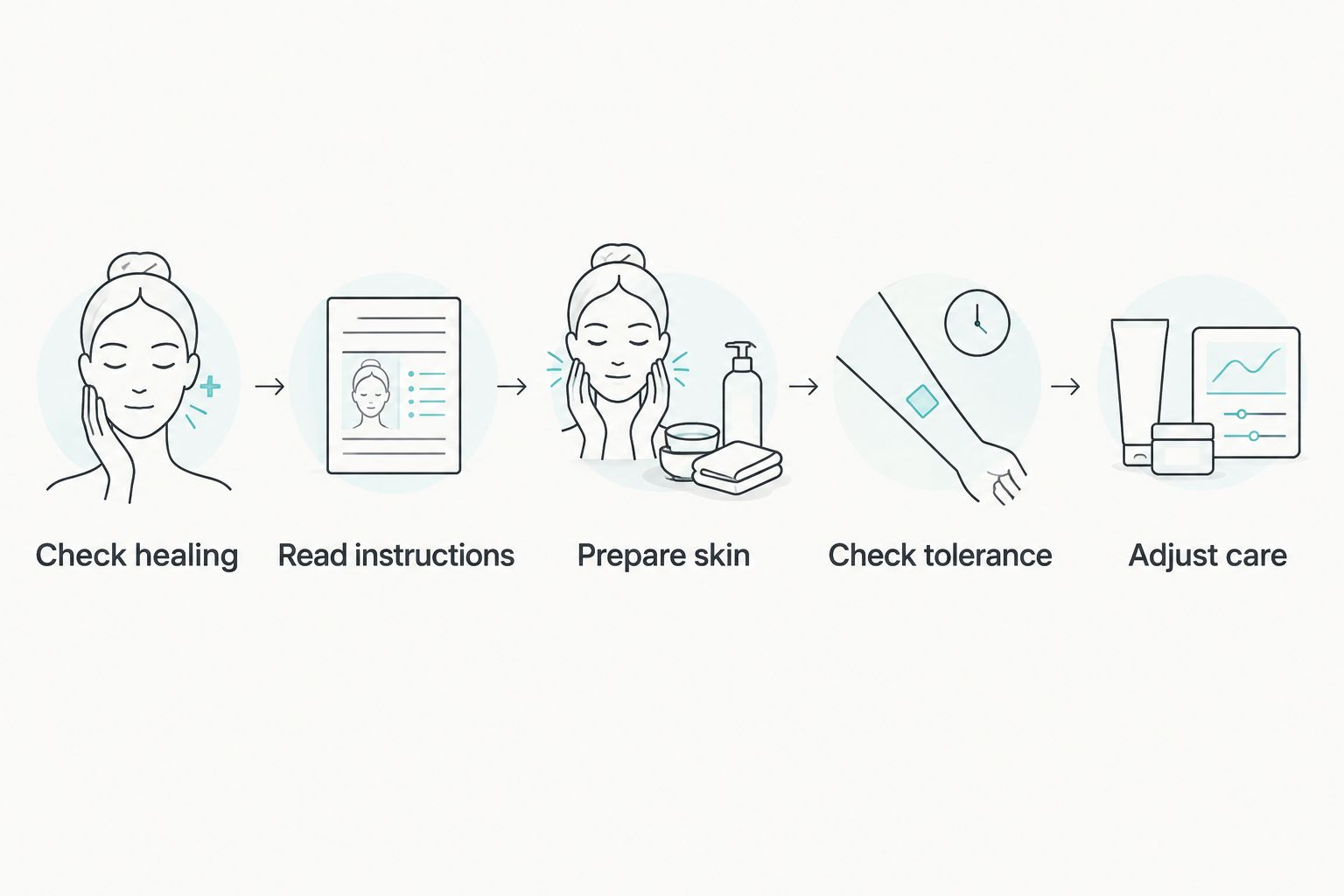
The sequence is especially useful when eczema affects the area around a healed scar. A scar can be ready for treatment while nearby skin still needs a different approach.
Match daily wear to your skin’s condition
The right response to a comfortable sheet is different from the right response to a rash. Use the condition of your skin—not the amount of time already invested—to decide what happens next.
| Skin situation | Best next step | Benefit | Limitation or caution |
|---|---|---|---|
| Fully closed scar with comfortable surrounding skin | Follow the sheet’s labeled schedule | Keeps daily care consistent | Cleaning and skin checks still matter |
| Dry, eczema-prone skin without an active rash | Introduce wear according to instructions and monitor closely | Allows you to assess tolerance | Irritation can develop after an initially comfortable application |
| Active eczema beneath the proposed sheet area | Pause sheeting over the affected area and address the flare | Avoids covering already inflamed skin | Scar treatment needs a separate restart plan |
| Persistent itching or a new rash beneath the sheet | Remove the sheet and seek advice before restarting | Stops continued exposure to a possible irritant | Appearance alone does not identify the cause |
| Increasing pain, warmth, drainage, or spreading redness | Contact a healthcare professional promptly | Prioritizes assessment of a possible complication | Changing the wear schedule is not enough |
Best for comfortable, healed scars: a repeatable, label-directed routine. For eczema-prone skin, tolerance is a requirement—not a bonus you consider after reaching a daily target.
Why daily silicone sheet wear varies
A useful wear schedule accounts for more than the scar’s appearance. These factors explain why copying someone else’s routine is the wrong starting point:
- The sheet’s instructions. Wear, washing, reuse, and replacement directions belong to the specific product. Use its current instructions in 2026 rather than an older recommendation for another sheet.
- Wound closure. Silicone scar treatment is not a substitute for wound care. An incision that is open, draining, or not fully healed needs clinical guidance.
- Eczema activity. Inflamed, scratched, or weeping skin needs assessment and appropriate eczema care before you cover it with scar sheeting.
- Sweat and moisture. Moisture trapped beneath a sheet can leave skin overly soft or uncomfortable. Remove the sheet when needed to clean and dry the area according to its instructions.
- Friction and fit. A lifting edge or a sheet that rubs against clothing can irritate the surrounding skin. Longer wear does not correct a poor fit.
- Your treatment plan. Prescription creams, dressings, and postoperative restrictions can change how you use a scar sheet. Ask before combining treatments on the same area.
Do not solve every problem by cutting daily wear shorter and trying again indefinitely. Repeated irritation deserves an explanation, particularly when it keeps returning in the same outline as the sheet.
How should you start if your skin is eczema-prone?
Start with calm, intact skin and the introduction schedule supplied with the sheet. Do not apply a silicone scar sheet directly over active eczema. If your scar sits inside an area that repeatedly flares, ask your dermatologist or surgeon how to coordinate the two treatment plans.
Before applying the sheet, look beyond the scar line. Check for scratch marks, cracks, redness, tenderness, and moist areas where the sheet’s edges will sit. Covering an irritated border can make an otherwise small problem harder to manage.
Keep your first applications easy to monitor. Avoid starting a new sheet immediately before a situation in which you cannot remove it or inspect your skin. The goal is to learn how the area responds, not to prove that you can tolerate discomfort.
For your 2026 eczema-care routine, change one relevant product or application habit at a time when practical. Introducing a new cleanser, moisturizer, adhesive product, and scar sheet together makes it harder to identify what caused a reaction.
Keep cleansing gentle
Use lukewarm rather than hot water, and avoid scrubbing the scar or the skin around it. The American Academy of Dermatology’s patient guidance for eczema recommends short bathing sessions of 5–10 minutes and applying moisturizer while skin is still damp.
That bathing advice is not a scar-sheet application instruction. Let the area intended for sheeting become dry, and follow the sheet’s directions about products underneath it. Moisturizing the rest of your eczema-prone skin and preparing a scar for adhesion are separate tasks.
Can you wear a silicone scar sheet overnight?
Overnight wear is appropriate only when the sheet’s instructions allow it and your skin tolerates the application. Sleep does not make the recommended duration longer, and nighttime use should not replace cleaning or inspection.
For eczema-prone skin, establish tolerance while you are awake before relying on an overnight routine. You need to know whether the sheet causes itching, slips, or traps enough moisture to leave the skin uncomfortable.
If you wake with persistent itching, a new rash, or softened, soggy skin, remove the sheet. Do not automatically repeat the same overnight schedule. Review the instructions and get advice if the reaction persists or recurs.
Should you remove a silicone scar sheet to shower?
Follow the sheet’s washing and bathing instructions rather than assuming every silicone product is designed for shower wear. Showering, cleaning a reusable sheet, and preparing the skin for reapplication are different steps.
When you remove a sheet, inspect the scar before washing. Clean the sheet only as directed, rinse away any permitted cleanser thoroughly, and allow the required drying time. Do not reapply a dirty sheet simply to preserve an uninterrupted run of wear.
For eczema-prone skin, keep showers brief and avoid rough washcloths or exfoliating tools on the treatment area. Your 2026 scar-care routine should make cleaning easy enough to repeat, rather than turning it into an irritating scrub-and-reapply cycle.
Can you put eczema cream underneath a silicone scar sheet?
Do not layer eczema medication or moisturizer beneath a silicone scar sheet unless your clinician and the product instructions permit it. Occlusion can change how topical medication behaves, and a cream underneath can interfere with adhesion.
Tell your clinician exactly what you use, including prescription corticosteroids, nonsteroidal eczema treatments, and nonprescription creams. Ask whether scar care and eczema care belong at different times or on different areas.
Rejûvaskin eczema care and silicone scar care address different needs. An eczema product is not permission to cover an active flare with a scar sheet. Treat the condition present on the skin, rather than choosing a schedule around the products you want to use.
When should you stop wearing the sheet?
Remove the sheet if you develop persistent burning, increasing itching, a new rash, blisters, or skin breakdown. Stop covering the area while you seek guidance; do not treat these symptoms as evidence that scar treatment is working.
Also check for maceration: skin that looks unusually pale, wrinkled, soft, or soggy after being covered. Let the area recover and review the wear and cleaning instructions before restarting. Repeated maceration calls for a revised plan, not more determination.
Increasing pain, spreading redness, warmth, pus, or fever needs prompt medical assessment. Eczema, contact dermatitis, and infection do not all require the same response, so avoid diagnosing a worsening reaction from a photograph alone.
How many weeks should you keep using silicone sheets?
Daily wear and total treatment length are separate decisions. Follow the product’s recommended course and your clinician’s plan rather than stopping simply because the scar looks unchanged after a short period.
Scars change gradually. Silicone treatment aims to improve scar appearance; it does not erase a scar or guarantee a particular result. Raised, painful, enlarging, or movement-limiting scars deserve clinical assessment rather than an indefinitely extended home routine.
For a useful 2026 progress record, photograph the scar in similar lighting and note comfort, texture, and any skin reactions. A record of tolerated use is more informative than a calendar filled with long sessions that repeatedly caused irritation.
FAQ
How long to wear silicone scar sheet each day if I have eczema?
Follow the specific sheet’s daily wear instructions only when the application area is fully closed and free of active eczema. Stop if persistent itching, a rash, or skin breakdown develops, and ask your clinician about restarting.
Can I leave a silicone scar sheet on all day?
Leave a silicone scar sheet on for a full day only if its instructions allow that schedule and your skin tolerates it. Remove it for the cleaning and skin checks required by the product directions.
Is itching under a silicone scar sheet normal?
Persistent or worsening itching is a reason to remove the sheet and inspect your skin. A new rash or recurring reaction needs advice before you restart, especially if you have eczema.
Can I use silicone sheets on eczema marks?
Silicone scar sheets are not a treatment for active eczema or a general solution for discoloration left after a flare. Ask a dermatologist whether the mark is a scar, post-inflammatory discoloration, or ongoing dermatitis before choosing treatment.
Can I sleep with a silicone scar sheet on?
You can sleep with a silicone scar sheet when the product instructions permit overnight wear and your skin has tolerated it. Do not use overnight wear to push through irritation or skip cleaning.
Should I put moisturizer under a silicone scar sheet?
Do not put moisturizer beneath a silicone scar sheet unless the sheet’s instructions and your clinician permit it. Prepare the application area as directed, usually with clean, dry skin.
Does wearing a scar sheet longer make it work faster?
Wearing a scar sheet beyond its recommended schedule is not a shortcut to faster results. Consistent, tolerated use matters more than extending wear until the skin becomes irritated.
One last thing
The outline of a reaction can be useful information. If irritation follows the sheet’s edges or the entire covered area, photograph it after removal and show your clinician. That pattern can help guide assessment, but it does not establish a diagnosis.
Before your next application, check the surrounding skin as carefully as the scar itself. For eczema-prone skin, a comfortable border is part of a workable scar-care plan—not an optional detail.
Related guides
- How to tell if a surgical scar is infected
- Scar cream for old, stubborn scars
- Mineral sunscreen for eczema-prone skin
Leave a comment