





Stretch mark cream does not reliably fade old, pale stretch marks, though moisturizing can make the surrounding skin feel softer and less dry. Cream cannot erase the deeper skin changes that create mature stretch marks, and eczema-prone skin needs extra care because irritating treatments can trigger a separate skin problem.
- Can stretch mark cream fade old stretch marks? The American Academy of Dermatology says creams offer little help for mature marks.
- Old stretch marks and eczema need different care: moisturize dryness without treating a rash as a cosmetic concern.
- Rejûvaskin Stretch Mark Cream targets stretch mark appearance; do not expect it to erase established pale lines.
- For eczema-prone skin, avoid irritating experiments and discuss persistent itching or treatment options with a dermatologist.
Why this matters
If you have old stretch marks and eczema, a stronger cosmetic routine is not automatically a better routine. Your first priority is comfortable skin without an active flare; changing the appearance of established lines comes second.
Stretch mark cream is a cosmetic-care option, not a substitute for eczema treatment. For your 2026 routine, separate the result you want into two questions: does your skin need relief from dryness, or do you want to change the stretch marks themselves?
That distinction prevents a common mistake: applying more product because the lines remain visible even though the skin already feels moisturized. Softer skin is a useful result, but it is not proof that an old stretch mark is fading.
Can stretch mark cream fade old stretch marks?
Old stretch marks respond poorly to topical creams. The American Academy of Dermatology's patient guidance on stretch marks distinguishes early marks from mature ones and explains that treatments generally work better on newer stretch marks.
Mature marks often look pale, silvery, or lighter than nearby skin. Earlier marks can appear red, purple, pink, or dark brown, depending on your skin tone. Color helps describe their stage, but it does not diagnose every line or patch on your skin.
| Approach | Best for | Main benefit | Main limitation |
|---|---|---|---|
| Moisturizing cream | Dryness around established marks | Improves skin hydration and softness | Does not erase mature stretch marks |
| Stretch mark cream | A stretch-mark-focused skincare routine | Targets the appearance of stretch marks | Results on old, pale marks are limited |
| Prescription topical treatment | Selected early marks assessed by a clinician | Certain treatments have evidence for newer marks | Not suitable for everyone; irritation is a concern |
| Dermatologist procedures | Discussing visible texture changes | Can improve appearance in selected cases | Require assessment and do not completely remove marks |
For a 2026 decision, judge a cream by its stated purpose and your skin's tolerance—not by promises that every type of stretch mark will disappear. An improvement in dryness, color contrast, or surface feel is different from rebuilding the altered tissue beneath an established line.
Old stretch marks: expect moisture support, not removal
A mature stretch mark is a type of scar. The skin has undergone changes involving its supporting structures, so applying moisture to the surface does not reverse the entire process.
You can still choose to moisturize the area. Dryness can make skin feel rough or tight, and a comfortable routine has value even when the marks remain visible. The limitation is the expectation, not necessarily the act of applying cream.
Do not use tingling, peeling, or stinging as evidence that a stretch mark treatment is working. Those sensations can indicate irritation, particularly if you already have eczema or sensitive skin.
If your main concern is a longstanding indentation rather than dryness, discuss that specific concern with a dermatologist. Describe whether you want help with texture, color, itching, or all three; each concern calls for a different assessment.
Newer stretch marks: treatment timing changes the discussion
New stretch marks deserve a different conversation from old, pale ones. The American Academy of Dermatology identifies early treatment as more promising and discusses prescription tretinoin among options studied for newer marks.
That does not make an over-the-counter retinoid serum interchangeable with a prescription treatment. It also does not establish that a product intended for facial aging will improve body stretch marks.
Retinoids can irritate skin. Do not start a retinoid on eczema-affected skin without medical guidance, and avoid retinoids during pregnancy. If you are breastfeeding, discuss the product and application site with your clinician before use.
Your 2026 treatment choice should reflect the marks' stage, your medical circumstances, and whether your skin barrier is currently irritated. A product recommendation that ignores those factors is incomplete.
Why stretch mark cream results vary
The same product does not produce the same visible result on every area of skin. These factors explain why expectations need to stay specific:
- Stage of the marks: Newer, colored marks and established pale marks respond differently; mature marks are less responsive to topical treatment.
- Treatment goal: Hydrating dry skin is different from changing an indentation or reducing color contrast.
- Skin tolerance: Eczema, irritation, or contact allergy can limit which ingredients you can comfortably use.
- Treatment type: A moisturizer, a prescription medicine, and an office procedure do different jobs. They are not substitutes for one another.
- Natural change: Stretch marks often become less noticeable over time, so a change during product use does not establish that the product caused it.
Before switching products, identify which outcome has not improved. If dryness is better but the lines remain, increasing application frequency beyond the label is not a sound next step.
How should you care for stretch marks on eczema-prone skin?
Treat active eczema before pursuing cosmetic improvement. A stretch mark cream is not automatically appropriate for an itchy, inflamed patch simply because both concerns occur in the same place.
The National Eczema Association's bathing guidance recommends lukewarm bathing for 5–10 minutes and applying moisturizer within 3 minutes afterward. These steps support eczema care; they are not a timetable for stretch mark fading.
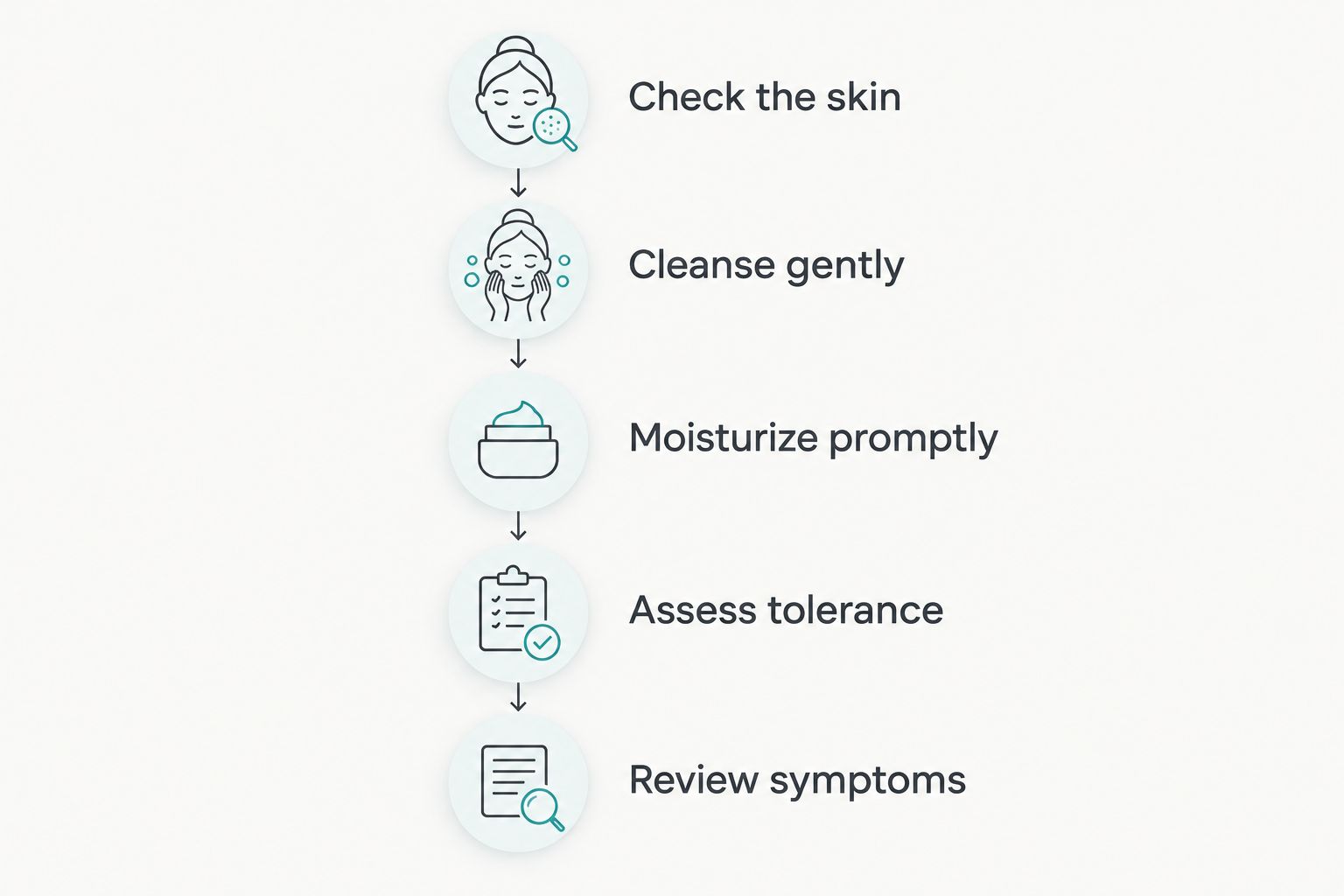
Use this sequence when planning your routine:
- Check the skin. Look for an active rash, broken skin, weeping, or persistent irritation before adding a cosmetic product.
- Cleanse gently. Use lukewarm water and a mild cleanser suitable for your skin. Avoid scrubbing the marks.
- Moisturize promptly. Pat dry gently and apply an appropriate moisturizer while the skin is still damp.
- Assess tolerance. Introduce a new leave-on product cautiously on a small area of unaffected skin, following its directions.
- Review symptoms. Stop a product that causes burning or a worsening rash, and seek medical advice when symptoms persist.
A small-area check does not guarantee that a product will never cause irritation. It is a cautious introduction, not a medical allergy test. Your dermatologist can advise whether formal patch testing is appropriate when reactions recur.
For your 2026 routine, keep prescribed eczema treatment separate from cosmetic experimentation. Do not stop a prescribed medicine because an unrelated stretch mark product sounds gentler.
What should you look for on a product label?
Start with the product's intended use, then read its ingredients and warnings. A formula marketed for stretch marks is not necessarily an eczema treatment, and a formula marketed for sensitive skin still needs to suit your individual skin.
For eczema-prone areas, fragrance-free labeling is a useful starting point. Unscented does not necessarily mean fragrance-free, and botanical ingredients are not automatically nonirritating.
Check these points before applying a new cream:
- Is the product intended for the body area you want to treat?
- Does the label describe cosmetic appearance, eczema symptom relief, or another purpose?
- Have you reacted to any listed ingredient before?
- Are there pregnancy, breastfeeding, or application warnings relevant to you?
- Does the product fit your clinician's instructions for active eczema?
Avoid judging effectiveness by a long ingredient list. The presence of an ingredient does not, by itself, establish that the finished formula fades mature stretch marks.
You also do not need to exfoliate stretch marks to prepare them for moisturizer. Scrubs add friction, while exfoliating acids can irritate sensitive skin. Neither step is required for a basic moisturizing routine.
Where does Rejûvaskin Stretch Mark Cream fit?
Rejûvaskin Stretch Mark Cream is best for consumers seeking stretch-mark-focused skincare rather than treatment for active eczema. Its product description identifies new mothers as an intended audience and describes minimizing the appearance of stretch marks.
That positioning does not establish that the cream removes old, pale marks or treats an eczema flare. Use its current directions, check the ingredient list, and ask your clinician about suitability if you have eczema, are pregnant, or are breastfeeding.
The practical benefit is a product directed at your stated cosmetic concern. The limitation is that mature stretch marks remain difficult to change with topical skincare; a product-specific promise of complete removal would exceed the evidence.
Will moisturizing make white stretch marks disappear?
Moisturizing will not make white stretch marks disappear. It can improve dry skin's feel, but pale mature marks reflect changes that a moisturizer does not erase.
If your skin looks smoother immediately after applying cream, assess that as a hydration effect rather than proof of lasting scar remodeling. Keep the distinction clear when deciding whether a product meets your goal.
Can you use a stretch mark cream during an eczema flare?
Do not add a new stretch mark cream directly to an active eczema flare without guidance. Follow your established eczema plan and ask a clinician about persistent inflammation or uncertainty about a product.
Once the flare settles, you can discuss cosmetic care separately. Comfort and rash control remain the priority, even when the stretch marks are the reason you first noticed the area.
When should you ask a dermatologist about old stretch marks?
Ask a dermatologist when you want improvement beyond moisturization, when the diagnosis is uncertain, or when itching and inflammation continue. A clinician can distinguish stretch marks from other skin changes and explain the benefits and risks of treatment.
Also arrange an assessment for sudden, extensive stretch marks without an obvious explanation. Tell the clinician about medication use, including topical steroids; do not abruptly change prescribed treatment yourself.
For exposed areas, general sun protection also matters. The American Academy of Dermatology recommends broad-spectrum, water-resistant sunscreen with SPF 30 or higher, alongside shade and protective clothing. Sun protection does not remove stretch marks, but tanning can make pale marks stand out more against surrounding skin.
FAQ
Can stretch mark cream fade old stretch marks completely?
Stretch mark cream does not completely remove old stretch marks. Mature pale marks respond poorly to topical treatment, although moisturizing can improve surrounding dryness and skin feel.
Is Rejûvaskin Stretch Mark Cream an eczema treatment?
Rejûvaskin Stretch Mark Cream is described as a product for stretch mark appearance, not as an eczema treatment. Ask your clinician about suitability before applying it to eczema-affected skin.
What works better for old stretch marks: cream or a dermatologist procedure?
Dermatologist procedures can address established stretch mark appearance more directly than a moisturizer, but no treatment guarantees removal. Suitability depends on your skin, the marks, and the procedure's risks.
How long should I use cream before old stretch marks disappear?
There is no reliable application period after which old stretch marks disappear with cream. Follow the product directions and assess realistic goals such as improved dryness rather than expecting complete removal.
Can I scrub old stretch marks away?
You cannot scrub old stretch marks away. Scrubbing does not reverse the deeper skin changes and can irritate eczema-prone skin.
Should I moisturize stretch marks if I also have eczema?
Moisturizing remains part of eczema care even when stretch marks are present. Choose a suitable product and follow your treatment plan rather than assuming every stretch mark cream is appropriate for an active flare.
Are retinoids safe for stretch marks during pregnancy?
Avoid retinoids during pregnancy. Discuss stretch mark care with your pregnancy clinician, particularly before starting a medicated or active-ingredient treatment.
One last thing
The most useful progress check is not whether your skin feels different immediately after application. Compare appearance under consistent lighting, and keep dryness, itching, and visible lines as separate observations.
For your 2026 skincare plan, a comfortable, tolerable routine is a better starting point than repeated product changes. If your goal remains a visible change in old stretch marks, take that specific goal to a dermatologist rather than treating irritation as the price of progress.
Related guides
- Choosing a moisturizer for eczema-prone facial skin
- Comparing body washes for eczema-prone skin
- Understanding skincare options for old, stubborn scars
Leave a comment