





Silicone tape intended for scar management and silicone scar sheets serve the same general purpose, but the name alone does not establish equal effectiveness. For your 2026 scar-care routine, choose a product labeled for scars that covers the healed area and stays comfortable; if you have eczema, avoid applying either format over an active flare.
- Silicone tape vs silicone scar sheets: neither label establishes better scar results; intended use and skin tolerance matter.
- Silicone scar products belong on fully closed skin, not open wounds or actively inflamed eczema.
- Rejûvaskin Scar Fx offers silicone scar sheeting; choose coverage that fits your healed scar.
- Stop using adhesive scar products if the covered skin develops a rash, blistering, or persistent irritation.
Is silicone tape as effective as silicone scar sheets?
Silicone scar tape is not automatically less effective than silicone scar sheets, and sheets are not automatically better. First establish what the product actually is: silicone used for scar management differs from silicone adhesive tape intended to secure dressings.
Both scar-care formats place silicone against healed skin. The practical differences are coverage, construction, handling, and the instructions for that particular product—not a reliable treatment ranking based on the words tape and sheet.
If itching drives your decision, distinguish scar discomfort from an eczema flare or adhesive reaction. This guide to reducing scar itching during healing addresses that separate concern.
| Question | Silicone scar tape | Silicone scar sheets |
|---|---|---|
| What should the label say? | Intended for scar management, not just dressing fixation | Intended for scar management |
| Best for | A healed scar that matches the tape's coverage | A healed scar that matches the sheet's dimensions or shape |
| Main advantage | A roll format can provide adjustable lengths when cutting is permitted | Defined dimensions make coverage easier to assess |
| Main limitation | A narrow strip does not suit every scar shape | A sheet's edges or outline might not suit a moving body area |
| Eczema consideration | Adhesive contact and covered skin require monitoring | Adhesive contact and covered skin require monitoring |
| What establishes the better choice? | Appropriate use, coverage, comfort, and adherence to instructions | Appropriate use, coverage, comfort, and adherence to instructions |
Neither format removes a scar completely. Silicone scar care aims to improve scar appearance and symptoms, particularly in raised scars; a changing, painful, or enlarging scar deserves clinical assessment rather than repeated product switching.
Why this matters for eczema-prone skin
A scar and eczema need different care. A closed surgical scar can be suitable for silicone management while nearby eczema still needs its own treatment plan.
Covering irritated skin is not a shortcut to recovery. Adhesive contact, trapped moisture, and repeated removal can aggravate vulnerable skin, so comfort is a safety consideration—not just a preference.
For eczema-prone skin in 2026, the first question is not which format sounds stronger. Ask whether the skin is intact, whether inflammation is controlled, and whether the product's directions fit your situation.
Do not use scar tape or scar sheets as eczema treatment. If the area is actively red, weeping, cracked, or intensely itchy, ask your clinician what to treat first.
Silicone scar tape: best for adjustable strip coverage
Silicone scar tape is a reasonable format to consider when its width suits a fully healed scar and its labeling permits the way you intend to use it. The roll format offers flexibility in length, but that does not establish better scar outcomes.
The main limitation is coverage. A strip that fits a straight incision might leave part of a wider or branching scar exposed, and overlapping pieces introduces additional edges to manage.
Before selecting a roll, check:
- Intended use: The label specifically identifies scar management.
- Skin requirements: The directions explain when application can begin.
- Cutting instructions: The manufacturer permits trimming to the needed length.
- Wear instructions: The product specifies application, removal, and replacement.
- Skin warnings: The directions explain what to do if irritation develops.
Do not substitute silicone wound-fixation tape solely because the materials sound similar. A gentle adhesive designed to hold a dressing does not automatically carry a scar-management purpose.
Verdict: choose silicone scar tape for suitable strip coverage, not because “tape” promises equal or better results.
Silicone scar sheets: best for defined coverage
Silicone scar sheets provide a defined area of contact, with different dimensions and shapes suited to different scar outlines. Their advantage is practical: you can compare the coverage with your healed scar before choosing.
The limitation is equally practical. A sheet that extends into a joint crease, catches on clothing, or requires uncomfortable removal is not a good fit simply because it covers more skin.
The following Rejûvaskin Scar Fx options illustrate the difference between compact and broader coverage. The dimensions describe the products, not the size of scar each person should treat.
| Product | Stated dimensions | Best for | Advantage | Limitation |
|---|---|---|---|---|
| Scar Fx Silicone Sheet - 1.5 x 3 inches | 1.5 inches × 3 inches | A localized healed scar that fits within the coverage | Compact format for a smaller treatment area | Does not cover every long or broad scar |
| Scar Fx Silicone Sheet - 4 x 8 inches | 4 inches × 8 inches | A healed scar requiring a broader sheet | Larger defined coverage area | More coverage is unnecessary when the scar and instructions do not require it |
Rejûvaskin Scar Fx silicone scar sheeting is best for people seeking sheet-format care for a fully healed scar. It is not a treatment for active eczema, and the appropriate size depends on the scar and product directions.


Why results and skin tolerance vary
A silicone tape vs silicone scar sheets comparison needs more than a format label. These factors explain why the right choice differs between people:
- Scar type: A raised scar and a flat area of discoloration present different treatment concerns. Confirm what you are treating.
- Healing stage: Scar-management silicone belongs on fully closed skin. An incision that still drains or separates needs wound-care guidance.
- Coverage: The product needs to contact the intended treatment area according to its directions. Gaps and lifting edges interfere with that contact.
- Body movement: Bending, clothing friction, and skin folds affect how comfortably a product stays in place.
- Skin condition: Active eczema, fragile skin, or a new rash changes whether adhesive coverage is appropriate.
- Consistent use: A product that is uncomfortable or difficult to maintain is harder to use as directed. Switching formats does not replace following instructions.
A larger sheet is not inherently a stronger treatment. Likewise, stronger adhesion does not prove better scar improvement and is not a reason to tolerate skin injury.
How do you choose safely if you have eczema?
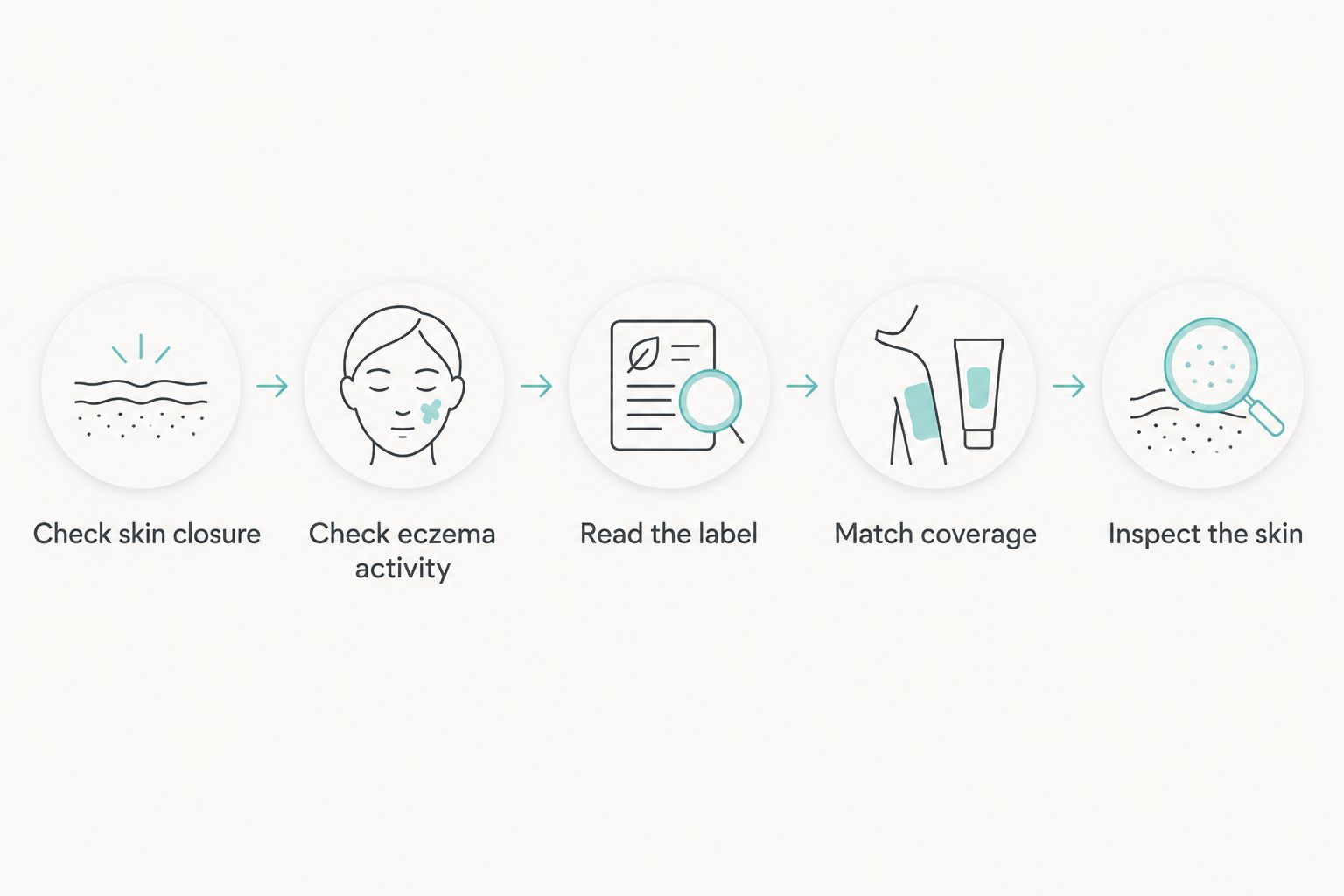
Start with the condition of the skin, then consider the format. Your 2026 scar-care plan should keep eczema management separate from treatment of the healed scar.
- Check skin closure. Do not cover an open, draining, or separating incision with a scar-management product. Follow your surgical team's wound-care instructions.
- Check eczema activity. Look for an active rash, cracks, weeping, or a marked increase in itching. Ask your clinician before covering an affected area.
- Read the label. Confirm scar-management use and review the application, cleaning, wear, and removal instructions. Do not borrow a schedule from a different product.
- Match coverage. Compare the healed scar's outline with the product dimensions and any required surrounding coverage in the directions.
- Inspect the skin. During removal and cleaning, check for rash, blistering, excessive moisture, or skin damage. Stop if irritation develops.
If your clinician recommends trying silicone, introduce it according to the product's instructions. Do not interpret burning or a spreading rash as evidence that treatment is working.
Keep cleansing gentle
Use lukewarm water and avoid scrubbing eczema-prone skin. For routine bathing, the American Academy of Dermatology recommends short baths or showers of 5–10 minutes for eczema care, followed by moisturizer while the skin remains damp.
That bathing advice is separate from preparing skin for an adhesive scar product. Follow the scar product's instructions about clean, dry skin and whether anything can be applied underneath it.
Do not improvise wet wraps
Eczema wet-wrap treatment and silicone scar coverage are different approaches. Do not add wet dressings, tight layers, or prescription creams beneath silicone unless your clinician specifically directs that combination.
Occlusion changes the conditions at the skin surface. Your eczema treatment plan should specify when covering treated skin is appropriate.
Can silicone tape make eczema worse?
Silicone tape can irritate eczema-prone skin, and silicone scar sheets can do the same. Neither format guarantees freedom from irritation simply because it contains silicone.
The pattern matters. Redness limited to an adhesive outline, a rash spreading beyond the scar, or worsening itch after application warrants stopping the product and seeking advice rather than applying another layer.
For eczema-prone skin in 2026, keep a simple record of the product used, where it touched the skin, and when symptoms started. That information helps your clinician distinguish a scar symptom from irritation or another skin problem.
Is silicone scar gel better if adhesives irritate your skin?
Silicone scar gel is an alternative format to discuss when adhesive sheets or tape are difficult to tolerate. It avoids a physical sheet, but that does not guarantee that every gel formula will suit eczema-prone skin.
Check the full ingredient list and directions rather than assuming all silicone products are interchangeable. Do not apply a scar gel to active eczema or an open wound as a substitute for appropriate treatment.
If your clinician recommends changing formats, introduce the replacement carefully. Adding several products at once makes it harder to identify what causes a new reaction.
When should you contact your clinician?
Contact your clinician for spreading redness, increasing warmth, worsening pain, pus, fever, or a wound that reopens. Those findings need assessment, not a different scar-tape format.
A rapidly enlarging raised scar also deserves review. Silicone is one scar-management approach, not a replacement for diagnosis or other treatment when needed.
If eczema repeatedly flares beneath adhesive products, pause self-directed trials. A dermatologist can assess whether eczema activity, contact irritation, or another condition is limiting your options.
FAQ
What's the difference between silicone tape and silicone scar sheets?
Silicone scar tape generally provides strip coverage from a roll, while silicone scar sheets provide defined dimensions or shapes. Check intended use: silicone tape for securing dressings is not automatically a scar-management product.
Is silicone tape as effective as silicone scar sheets in 2026?
Neither format label establishes equal or better effectiveness in 2026. Compare scar-management labeling, coverage, skin tolerance, and the instructions for each specific product.
Can I put silicone scar sheets on an eczema patch?
Do not put silicone scar sheets over an active eczema patch as eczema treatment. Ask your clinician how to manage inflammation before considering adhesive scar care nearby.
Can I use silicone tape before my incision has fully healed?
Do not use scar-management silicone tape on an open, draining, or separating incision. Your surgical team should confirm when the skin is ready for scar care.
Can I put eczema cream underneath silicone scar tape?
Do not put eczema medication underneath silicone scar tape unless your clinician directs it. Follow the scar product's instructions about skin preparation and products used underneath.
How many hours should I wear silicone scar sheets each day?
Follow the wear schedule supplied with your specific silicone scar sheets. Do not transfer a schedule from another product, and stop if the skin develops irritation or damage.
Which Rejûvaskin Scar Fx size should I choose?
Choose a Rejûvaskin Scar Fx size by comparing your healed scar with the product dimensions and coverage instructions. Examples include 1.5 inches × 3 inches and 4 inches × 8 inches; neither size is appropriate for every scar.
Should I switch from tape to sheets if my skin gets itchy?
Stop and assess the skin before switching from tape to sheets. Itching can reflect scar symptoms, eczema, or irritation, and another adhesive format does not automatically address the cause.
One last thing
Do not mistake post-eczema discoloration for a raised scar. A flat mark left after inflammation is a different concern, so scar tape is not an automatic next step.
Treat the skin problem you have, not the product category you recognize. Before choosing silicone, confirm that the area is a fully healed scar and that your eczema is controlled enough for the proposed care.
Related guides
Leave a comment