





Yes—silicone gel can replace silicone sheets for a fully closed C-section scar once your obstetrician or surgeon approves scar care. Gel is a practical alternative when sheets lift, rub against clothing, or irritate eczema-prone skin, but switching formats does not treat an eczema flare or guarantee the same result. Choose the format your healed skin tolerates; never apply either over an open, draining, or infected incision.
- Silicone gel for c section scar care is an alternative to sheets after the incision fully closes and your clinician approves.
- Rejûvaskin offers silicone scar care; neither gel nor sheets treats an active eczema flare.
- Gel avoids sheet edges and removal; sheets provide a physical covering but require comfortable, secure contact.
- Stop scar products on irritated skin and seek care for spreading redness, drainage, worsening pain, or fever.
Why this matters
After a C-section, scar care and eczema care can overlap—but they have different jobs. Silicone supports scar management on healed skin; eczema treatment addresses inflammation, itching, and a disrupted skin barrier.
RejûvaSil Silicone Scar Gel is described as a medical-grade silicone gel for post-operative scars. That purpose does not make it an eczema treatment or a substitute for incision care. For your 2026 postpartum routine, establish which skin problem needs attention before adding a product.
Can silicone gel replace sheets after a C-section?
Yes, silicone gel is an alternative to silicone sheets for a healed C-section scar—not an interchangeable wound dressing. Both formats place silicone against the scar surface, but they differ in application, removal, and how they fit under clothing.
Silicone is widely used in non-invasive management of raised surgical scars. It does not erase a scar, and no format guarantees that a scar will stay flat or become less visible. Your scar's condition and your clinician's instructions matter more than the format alone.
| Format | Best for | Main advantage | Main limitation |
|---|---|---|---|
| Silicone gel | People who prefer scar care without a removable sheet | Forms a film without sheet edges | Needs application and drying according to its label |
| Scar Fx Silicone Sheet - 1.5 x 9 | People who prefer a physical silicone covering on healed skin | Keeps silicone in contact with the covered area | Fit, skin moisture, and removal affect comfort |
| Alternating formats | People whose clinician recommends different formats for different activities | Allows a routine to adapt to comfort and clothing | Requires following both products' instructions; layering is not automatically appropriate |
A switch makes sense when the current format creates a practical problem. If sheets remain comfortable and your skin looks healthy underneath, gel is not automatically an upgrade. If sheets repeatedly irritate the area, do not assume that applying gel immediately over the rash solves the problem.
Silicone gel: best for avoiding sheet edges
Silicone gel suits people who want a scar-care film rather than a removable covering. Apply it only to healed skin, following the product's directions for amount, drying, and frequency.
The advantage is straightforward: there is no sheet edge to catch on a waistband. The limitation is equally important: applying extra gel does not create a better treatment, and clothing can disturb a film that has not dried.
For eczema-prone skin, examine the complete ingredient list rather than assuming every silicone gel has the same formula. Irritation can come from a product ingredient or from already-inflamed skin. A gel is not automatically suitable simply because it avoids sheet removal.
Rejûvaskin silicone scar care is best for people managing healed scars, not active eczema or open incisions. Keep that distinction central when choosing your 2026 postpartum skincare routine.
Silicone sheets: best for a physical covering
Silicone sheets suit people who prefer a tangible covering and can wear it comfortably on healed skin. The listed Scar Fx sheet measures 1.5 inches by 9 inches; that size is a product dimension, not a claim that every C-section scar needs that sheet.
Check coverage against your own scar and follow the sheet's instructions. A sheet that folds, traps excess moisture, or repeatedly pulls at sensitive surrounding skin needs reassessment—not more determination to keep wearing it.
Sheets also need the cleaning and handling specified by the manufacturer. Do not extend wear through worsening itching or redness to meet an arbitrary goal. Comfort does not prove effectiveness, but irritation is a reason to stop and check the skin.
If eczema affects the skin under or around the sheet, ask your clinician whether scar care should pause until the flare settles. A physical covering is not a replacement for treating the underlying inflammation.
Why the best format varies
The right choice depends on the scar and the skin around it. Use these factors to guide the decision rather than treating one format as universally better:
- Incision closure: Neither format belongs on an open or draining surgical wound. Your surgical team should confirm when scar care can begin.
- Eczema activity: Active itching, cracking, or inflammation changes what the surrounding skin can tolerate. Address the flare before adding a covering or film over it.
- Friction: Waistbands, underwear, and movement affect how comfortable scar products feel across the lower abdomen.
- Moisture: Sweat and skin folds affect sheet contact and comfort. Persistent dampness or softened, irritated skin needs attention.
- Application routine: Gel requires application and drying; sheets require placement, removal, and label-directed cleaning. Choose the process you can follow correctly.
- Ingredient tolerance: Review the actual formula and your history of reactions. Neither a sensitive-skin label nor silicone alone guarantees tolerance.
These factors apply to a 2026 purchase just as they apply to a product already in your bathroom. A new package does not change the requirement for healed, healthy skin.
How do you switch from sheets to silicone gel safely?
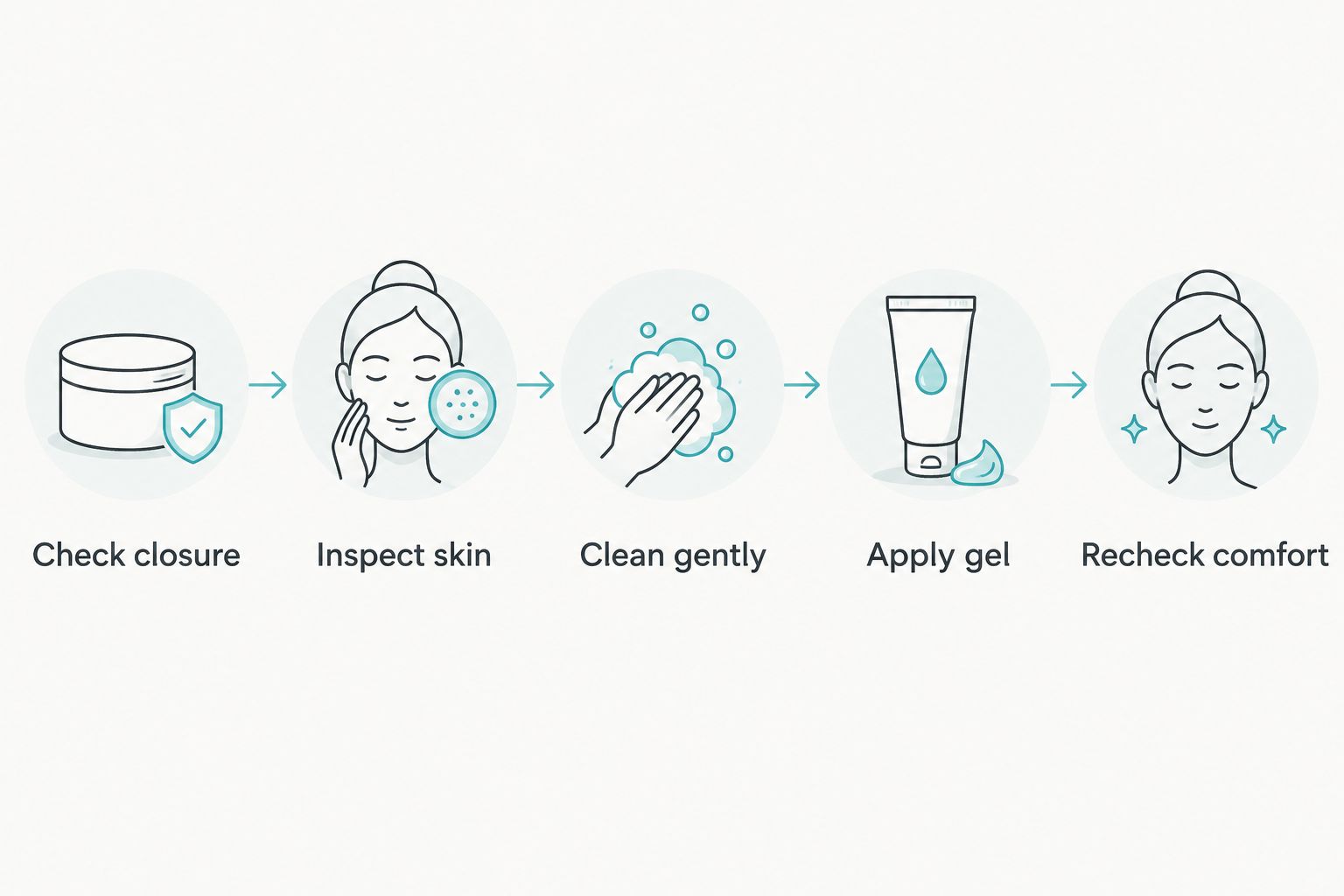
Switching formats starts with a skin check, not a new application schedule. Follow your surgeon's instructions whenever they differ from general scar-care advice.
- Check closure. Confirm that the incision is fully closed and that your clinician has approved silicone scar care. Do not use a calendar date alone to judge readiness.
- Inspect skin. Look for a rash, cracks, weeping, unusual warmth, or worsening tenderness. Pause scar products and seek advice if the skin is inflamed or the incision looks abnormal.
- Clean gently. Follow the existing incision-care instructions and remove product residue without scrubbing. Dry the healed area as directed before applying silicone.
- Apply gel. Follow the gel's label for a thin application and let it dry before dressing. Do not copy another product's frequency or drying instructions.
- Recheck comfort. Watch for burning, persistent itching, or a new rash. Stop the product if irritation develops and contact your clinician for guidance.
Do not add a sheet over wet gel unless the manufacturer and your clinician specifically direct that combination. Alternating products at separate times is different from layering them together.
Product formats to discuss with your clinician
Rejûvaskin offers both a medical-grade silicone gel for post-operative scars and silicone sheets for scar management. The products below illustrate those formats; neither is presented as treatment for eczema, infection, or an unhealed incision.


What if you have eczema near your C-section scar?
Treat eczema and scar management as separate decisions. An itchy lower abdomen does not automatically mean the scar needs more silicone, and a rash under a sheet does not establish an allergy without assessment.
Eczema, friction, contact irritation, and infection can share visible symptoms. Tell your clinician where the irritation started, whether it matches the sheet's outline, and which cleansers, moisturizers, or scar products touched the area. Those details help guide assessment without guessing at a diagnosis.
For surrounding eczema-prone skin, established care includes gentle cleansing, fragrance-free products, and regular moisturizing. General eczema bathing guidance favors lukewarm baths or showers lasting 5–10 minutes, followed by moisturizer within 3 minutes. After surgery, your team's bathing restrictions take priority; do not soak an incision without permission.
Keep eczema creams and moisturizers out of the incision unless your surgical team directs otherwise. On healed skin, ask how to separate prescribed eczema medication from silicone application rather than mixing products or applying a sheet over medication on your own.
For your 2026 routine, change one nonessential skincare product at a time. This makes it easier to identify which change preceded irritation, although it does not replace medical assessment.
Can you use gel during the day and sheets at night?
You can discuss alternating silicone gel and sheets with your clinician once the incision has healed. The benefit is flexibility, not a proven guarantee that combining formats produces a better scar.
Use each product as directed and inspect the skin between applications. If nighttime covering worsens heat, dampness, or eczema symptoms, reassess the routine instead of assuming longer contact is always better.
Will silicone gel get rid of a raised C-section scar?
Silicone gel does not remove a C-section scar. It is used to help manage scar appearance and texture, especially when a scar is raised, but individual outcomes vary.
Ask a dermatologist or surgeon to assess a scar that keeps thickening, becomes painful, or grows beyond the original incision boundaries. Persistent symptoms deserve a treatment discussion rather than repeated switches between over-the-counter formats.
When should you contact your surgical team instead of switching products?
Contact your surgical team promptly for spreading redness, increasing warmth, worsening pain, drainage, wound separation, or fever. These findings require assessment; silicone gel and sheets do not treat a surgical-site infection.
Seek urgent medical care if you feel seriously unwell or symptoms worsen rapidly. Do not cover concerning changes with a scar sheet while waiting to see whether they improve.
For a localized itchy rash without those warning signs, stop the suspected product and ask your clinician what to use next. Bring the packaging or ingredient list to the conversation.
FAQ
Can silicone gel replace sheets after a C-section?
Yes, silicone gel can replace sheets on a fully closed C-section scar once your clinician approves scar care. Choose according to skin tolerance and follow the selected product's directions; neither format treats an open wound.
When can I start silicone gel on my C-section scar?
Start silicone gel only after the incision is fully closed and your obstetrician or surgeon approves it. Do not rely on a fixed postpartum date, and do not apply it over scabs, drainage, or wound separation.
Is silicone gel better than sheets if I have eczema?
Silicone gel is not automatically better than sheets for eczema-prone skin. It avoids sheet edges and removal, but ingredients or application over inflamed skin can still cause irritation; active eczema needs its own treatment plan.
Can I put eczema cream under a silicone scar sheet?
Do not put eczema cream under a silicone scar sheet unless your clinician specifically directs it. Covering medication can change how it affects the skin, and creams can also interfere with sheet contact.
Should silicone gel sting when I apply it?
Persistent stinging or burning is a reason to stop silicone gel and assess the skin. Do not keep applying it over an irritated, cracked, or incompletely healed area.
Can I switch back to sheets after using gel?
Yes, you can discuss switching back to sheets if the scar remains fully healed and the surrounding skin tolerates them. Switching formats does not require combining them, and irritation should be resolved before restarting a covering.
Does Rejûvaskin silicone scar care treat eczema?
Rejûvaskin silicone scar care is intended for scar management, not treatment of active eczema. Ask your clinician how to coordinate scar care with a separate eczema routine.
One last thing
Before buying a replacement format, look at the skin around the scar—not just the scar itself. A raised scar, an eczema patch, and an irritated incision need different responses, even when all three feel itchy.
Make your next step in 2026 a clear question for your clinician: Is this healed scar tissue ready for silicone, or does the surrounding skin need treatment first? That answer is more useful than choosing gel or sheets by habit.
Related guides
- Scar Heal Kit for C-Sections
- Moisturizer for eczema-prone facial skin
- Scar cream for older, stubborn scars
Leave a comment