





Silicone scar gel costs depend on the product and the amount you need; check the current product listing rather than treating a single tube price as your total treatment budget in 2026. Repeat purchases add to that total, and eczema-prone skin needs a separate check: scar gel treats the appearance of a healed scar, not an active eczema flare.
- How much does silicone scar gel cost? Compare current listings, package size, and the amount needed for your scar.
- RejûvaSil Silicone Scar Gel is designed for post-operative and facial scars, not active eczema.
- For eczema-prone skin, separate scar management from treatment of itching, inflammation, and broken skin.
- Choose silicone gel or sheets by scar location, skin tolerance, and the product’s directions—not the package price alone.
How much does silicone scar gel cost?
The current tube price is only the starting point. Your total spending depends on the amount of skin you treat, the application directions, and whether you need another package before your clinician recommends stopping.
For a specific example, RejûvaSil Silicone Scar Gel is a medical-grade silicone gel designed for post-operative and facial scars. The product cards below show supplied listing prices; confirm current pricing and package details before ordering in 2026.
Use this comparison to separate two scar-care formats before comparing their purchase amounts.
| Scar-care option | Best for | What you are buying | Main limitation |
|---|---|---|---|
| RejûvaSil Silicone Scar Gel | People seeking a topical silicone format for post-operative or facial scars | A silicone gel applied according to its directions | You must follow the application routine; it is not an eczema treatment |
| Scar Fx Silicone Sheet — 1.5 x 3 inches | People considering a small silicone sheet for a healed scar | A physical sheet with defined dimensions | The sheet must suit the treatment area and be tolerated by the surrounding skin |
Neither format is automatically the better purchase for everyone. A product that fits your scar and your clinician’s plan is more useful than one selected only because its package costs less.
Why this matters for eczema-prone skin
Eczema and scarring require different decisions. Active eczema involves inflammation and an impaired skin barrier; scar management addresses tissue left after an injury has healed.
If you have eczema near a surgical scar, start by identifying which problem needs attention. Itch, flaking, and discoloration do not establish that you need a scar product, and scratching can leave marks that are not raised scars.
Treat the skin condition before shopping for a scar treatment. A clinician can distinguish a healed scar from active dermatitis, infection, or post-inflammatory pigment changes. That distinction prevents you from buying a product for the wrong concern.
For your 2026 routine, keep prescribed eczema treatment and scar care clearly separated. Do not replace an anti-inflammatory treatment with silicone gel, and do not apply a scar product over broken or actively inflamed skin without medical guidance.
Silicone scar gel: compare the package and the routine
A gel listing tells you what the package costs, but it does not automatically tell you what your full course of care will cost. Read the amount supplied and the directions together.
Check whether the listing describes the same product and package size you intend to buy. A photograph alone is not a reliable way to establish quantity, and a product name does not tell you how many applications your particular scar requires.
Rejûvaskin’s RejûvaSil Silicone Scar Gel is best for consumers seeking a topical silicone option for post-operative or facial scars. Its stated purpose supports that use; it does not establish suitability for every person with eczema or every type of skin mark.
The practical advantage of gel is its topical format. The trade-off is that you must apply it consistently according to the label, rather than assuming a purchase alone delivers the intended care.
For eczema-prone skin, review the complete ingredient list with your clinician if you have known contact allergies. Do not assume that a medical-grade designation means an individual cannot develop irritation.
Silicone sheets: compare dimensions before buying
A silicone sheet has a defined treatment footprint. The Scar Fx option in the table measures 1.5 inches by 3 inches, so check your scar’s shape and the product’s fitting directions before selecting it.
A separate Scar Fx format measures 1 inch by 22 inches. Those dimensions describe a different shape, not a promise that it is better for a larger number of scars or that it will provide a particular treatment duration.
This distinction matters when comparing a sheet with gel. You cannot use the package price alone to establish an equal amount of scar coverage, because the formats are measured and used differently.
Sheets also remain in contact with the skin during wear. If you have eczema where a sheet would sit, ask your clinician whether the area is ready for that format and what to do if irritation develops.
The advantage is a physical silicone covering shaped for a particular area. The limitation is fit and tolerance: the dimensions must suit the scar, and your skin must tolerate the recommended wear routine.
What changes your total scar-care spending?
Compare these factors before placing a 2026 order. Each affects what you select or how much product your routine requires; none establishes a universal treatment budget.
- Package quantity. Compare the labeled amount, not just the product name or the apparent tube size in a photograph.
- Scar dimensions. A short facial scar and a long surgical incision require different coverage decisions.
- Product format. Gel and sheeting are different purchases, with different application and care directions.
- Treatment instructions. Follow the label and your clinician’s plan when assessing repeat purchases; do not invent a daily amount to calculate savings.
- Skin tolerance. A product that irritates the treatment area needs reassessment, especially when eczema affects nearby skin.
- Separate skin needs. Eczema care and scar management serve different purposes. Buying a scar product does not replace treatment for active dermatitis.
Be cautious with cost-per-day claims that omit the scar’s dimensions or the amount applied. Without those details, the calculation does not describe your use.
Likewise, do not assume a kit is necessary because it contains more products. First establish which format your clinician recommends and whether each item has a role in your routine.
How do you compare scar products without overbuying?
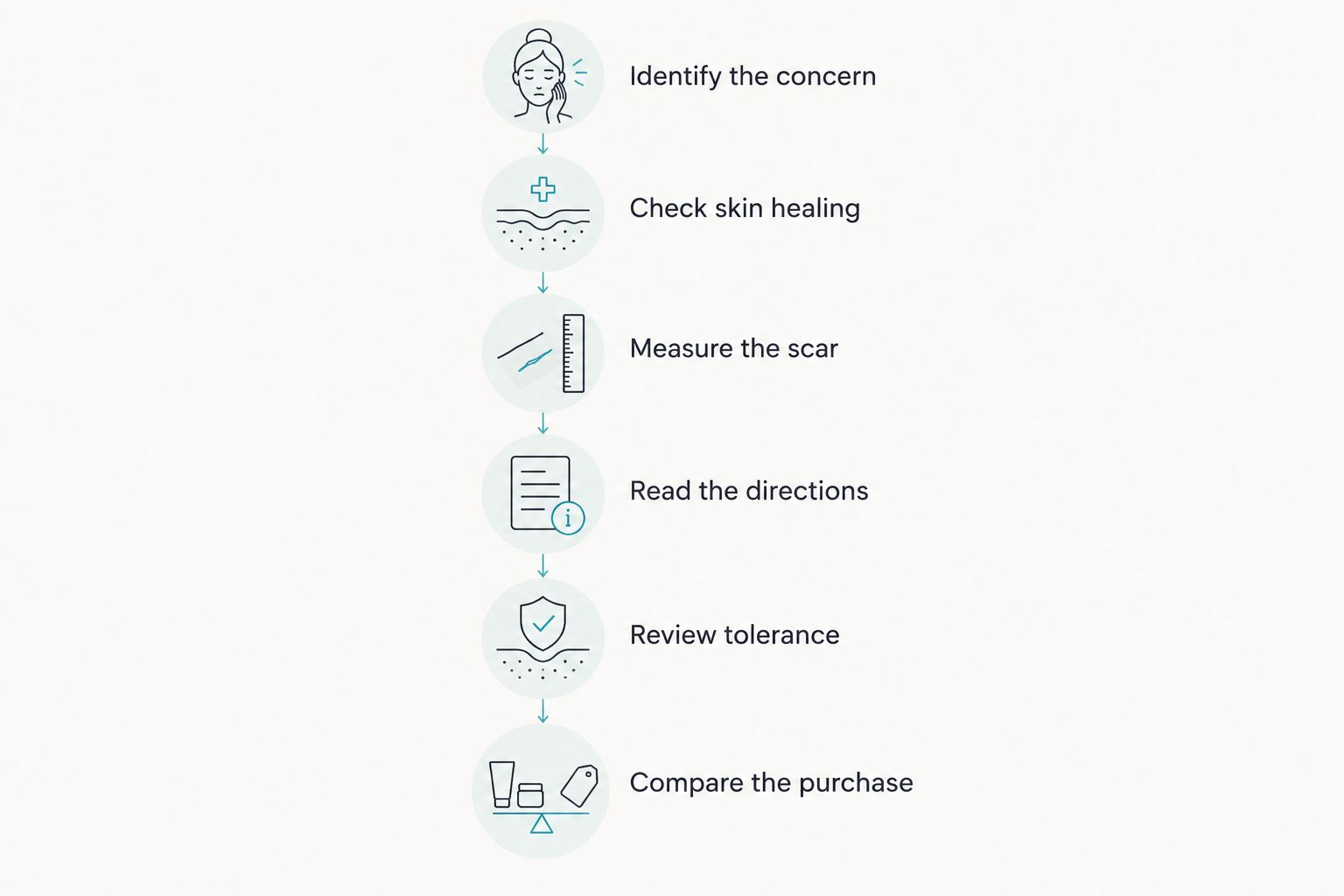
Use a short decision process before choosing between gel and sheets. The goal is to select an appropriate format, not to build the largest possible routine.
- Identify the concern. Establish whether you have a healed scar, active eczema, or a flat mark after inflammation.
- Check skin healing. Confirm that the wound has closed and ask about any remaining crusting, drainage, or irritation.
- Measure the scar. Record its length and location so you can compare sheet dimensions or discuss gel coverage.
- Read the directions. Check application, wear, cleaning, and replacement instructions for the exact product.
- Review tolerance. Discuss known allergies and eczema at the treatment site before adding a new product.
- Compare the purchase. Check the current listing, package quantity, and whether you need individual products or a kit.
If you are comparing Rejûvaskin scar care in 2026, these are two distinct formats to discuss with your clinician. The cards identify the exact supplied products rather than implying that gel and sheets provide interchangeable quantities.


Is silicone scar gel worth buying if you have eczema?
Silicone scar gel is a scar-management option, not a treatment for eczema itself. It is relevant when you have a healed scar and your clinician considers the product appropriate for the treatment area.
If your main concern is an itchy, dry patch, start with eczema assessment and care. Spending on scar gel before identifying the problem does not resolve that distinction.
Is silicone gel better than silicone sheets for sensitive skin?
Neither silicone gel nor silicone sheets is automatically better for every person with sensitive skin. The choice depends on the scar’s location, the product’s ingredients, the fitting or application instructions, and your skin’s response.
For eczema-prone skin, the best format is the one your clinician considers appropriate and that you can use without worsening irritation. Stop and seek guidance if a new product causes a persistent rash or worsening discomfort.
How many tubes will you need for a scar?
The number of tubes depends on the package quantity, scar coverage, and application directions. A product listing alone does not establish a reliable tube count for your treatment course.
Ask your clinician how long to continue and reassess progress. Do not apply extra gel to accelerate results or extend use indefinitely because a tube remains unfinished.
Keep eczema care separate from scar care
A simple routine makes it easier to identify what your skin tolerates. Avoid introducing several new products to the same sensitive area at once, particularly when you are trying to understand a new rash.
For bathing, choose a mild cleanser intended for dry, sensitive, eczema-prone skin rather than a scrub or deodorant soap. Use lukewarm water, pat dry, and moisturize while skin is still damp.
That bathing advice does not change the directions for a scar product. Apply silicone gel to the skin as its label instructs, and ask before layering it with moisturizer or prescription treatment on the same site.
Contact your clinician promptly for increasing warmth, spreading redness, pus, worsening pain, or fever around a healing wound. Those changes need assessment, not a different scar-care purchase.
FAQ
How much does silicone scar gel cost in 2026?
Check the current listing for the exact silicone scar gel and package size you plan to buy. Your total spending also depends on scar coverage, application directions, and repeat purchases.
Is one tube of silicone scar gel enough?
One tube is not a guaranteed complete treatment course. The amount you need depends on the package quantity, treatment area, and your clinician’s recommended routine.
Can I use silicone scar gel on active eczema?
Do not use silicone scar gel as a treatment for active eczema. Ask your clinician before applying it to inflamed, scratched, or broken skin, even when a scar is nearby.
Will silicone scar gel remove dark marks left by eczema?
Silicone scar gel is not a general treatment for dark marks left by eczema. A clinician can distinguish post-inflammatory pigment changes from a raised scar and recommend care for the actual concern.
Is RejûvaSil Silicone Scar Gel an eczema cream?
RejûvaSil Silicone Scar Gel is a medical-grade silicone scar product designed for post-operative and facial scars, not an eczema cream. It does not replace prescribed eczema treatment.
Should I buy silicone gel or a silicone sheet?
Choose silicone gel or a silicone sheet according to the scar’s location, product directions, and skin tolerance. A sheet’s dimensions and wear requirements create different practical considerations from a topical gel.
Can I put silicone scar gel on an open wound?
Do not apply silicone scar gel to an open wound. Wait until the skin has healed and follow your clinician’s instructions and the product label.
Can I use eczema moisturizer underneath silicone scar gel?
Do not assume eczema moisturizer belongs underneath silicone scar gel. Follow the gel’s application instructions and ask your clinician how to coordinate products used on the same area.
One last thing
A flat mark after an eczema flare is not automatically a scar. Before your next scar-care purchase in 2026, ask whether you are treating scar tissue, residual pigmentation, or ongoing inflammation.
Bring the product label and a list of treatments you already use to that conversation. The most useful buying decision starts with identifying the skin concern—not comparing two package prices.
Leave a comment