





Compare the cost of a complete laser treatment plan with the cost of your full silicone-gel regimen—not a single appointment with a single tube. For eczema-prone skin, treatment suitability comes first: an active rash needs assessment before cosmetic scar treatment, and either approach can involve additional skin-care needs.
- Laser scar treatment cost vs silicone gel depends on the complete treatment plan, not the initial purchase.
- Rejûvaskin offers at-home silicone scar care; active eczema requires a separate treatment plan.
- Laser treatment and silicone gel address different scar concerns and are not interchangeable.
- Ask about follow-up, aftercare, skin irritation, and the expected outcome before choosing a treatment.
Why this matters
If you have eczema, the mark bothering you is not necessarily a scar. Flat discoloration after a flare, thickened skin from repeated scratching, and a raised surgical scar call for different assessments. Paying for the wrong treatment does not solve that distinction.
Start by identifying the concern. This guide to scar cream for old, stubborn scars provides related reading, but a clinician should assess an uncertain mark before you choose a procedure or scar product.
How much does laser scar treatment cost vs silicone gel?
For a useful 2026 comparison, request a written laser treatment plan and compare it with a complete, label-directed silicone regimen. Laser treatment is a clinician-performed procedure; silicone gel is applied at home to appropriate, fully healed scars. Neither comparison makes sense until you know what you are treating.
| Approach | Best for | What your budget must cover | Main advantage | Main limitation |
|---|---|---|---|---|
| Laser scar treatment | Clinician-selected concerns involving scar redness or texture | Assessment, planned procedures, follow-up, and prescribed aftercare | Treatment can target a specific scar feature | Requires clinical assessment and carries procedural risks |
| Silicone scar gel | At-home management of appropriate healed, raised scars | Product needed for the full regimen and any replacements | Noninvasive application without a laser appointment | Requires consistent use and does not address every scar type |
Ask the clinic whether its estimate covers the whole proposed course or only an individual appointment. For silicone gel, check the current product instructions and consider how much scar area you need to cover.
Do not compare the options as though they promise the same result. A treatment chosen for persistent redness serves a different purpose from a home regimen intended to improve the appearance of a raised scar.
Laser treatment: budget for the complete clinical plan
A laser estimate should explain the concern being treated, the proposed procedure, and the expected improvement. Ask the clinician to distinguish redness, raised tissue, uneven texture, and depressed scarring. “Scar treatment” alone is not a sufficiently specific plan.
Laser procedures can cause temporary redness and swelling, pigment changes, burns, or additional scarring. Your skin tone, medical history, and current skin condition belong in the consultation—not just in an aftercare conversation.
For eczema-prone skin, tell the clinician about recent flares, broken skin, previous reactions to adhesives or topical products, and every treatment you currently use. Do not stop prescribed eczema medication to prepare for a procedure unless your treating clinician directs you to do so.
Before accepting a 2026 estimate, ask:
- What specific feature of my scar will this procedure target?
- Does the estimate cover the complete proposed course?
- Are assessment and follow-up included?
- What aftercare products or prescriptions will I need?
- What happens if eczema becomes active near the treatment area?
Choose laser assessment for a defined treatment goal, not a general promise to erase a scar. No scar treatment restores injured skin to its original, uninjured state.
Silicone gel: budget for consistent home use
Silicone gel belongs on appropriate, fully healed skin—not an open scratch, a weeping eczema patch, or a surgical incision that has not closed. Its role is scar management, not treatment of active eczema.
Silicone products are commonly used for raised scars. They are not interchangeable with treatments for depressed acne scars or flat discoloration after inflammation. Confirm that the visible change is actually the type of scar the product is intended to manage.
Your total product use depends on the treatment area and the product's directions. A small scar and an extensive scar do not require the same amount of gel. Applying a thicker layer is not a substitute for following the label.
The practical advantage is home application without a procedure. The trade-off is consistency: a regimen you cannot comfortably maintain is a poor choice, even when the product itself fits the scar concern.
If the application area becomes red, itchy, or irritated, stop using the product and ask a clinician or pharmacist for guidance. Do not assume discomfort means the product is working.
Why total scar-treatment spending varies
Use these factors to organize your 2026 comparison. Each changes either the proposed treatment plan or the amount of home care you need.
- Scar concern: Raised tissue, redness, depressed texture, and post-inflammatory discoloration require different assessments.
- Treatment area: The size and location of the scar affect procedure planning and silicone-product use.
- Planned course: Compare every planned appointment with the complete home regimen, rather than comparing starting points.
- Aftercare: Ask what cleansing, moisturizing, sun protection, or prescriptions the clinician recommends after a procedure.
- Skin tolerance: Eczema, irritation, or a reaction to a product can require reassessment before treatment continues.
- Treatment goal: Improving a scar's appearance is a different goal from managing pain, restricted movement, or recurrent inflammation.
Keep medical symptoms separate from cosmetic preferences. A painful or restrictive scar deserves assessment even if its appearance does not bother you. Likewise, a mark that looks prominent does not automatically require a procedure.
Eczema changes the decision before it changes the budget
Repeated scratching can injure skin, but not every lingering eczema mark is a permanent scar. Inflammation can leave lighter or darker patches, and chronic rubbing can thicken the skin. Treating those changes as ordinary surgical scars risks choosing an unsuitable product or procedure.
Control active eczema before pursuing cosmetic treatment on the affected area. A clinician can determine whether you need eczema treatment, scar management, or both. New warmth, spreading redness, drainage, or worsening pain requires medical advice rather than another cosmetic product.
You also need a tolerable cleansing routine. Choose a mild, fragrance-free cleanser intended for sensitive skin; “unscented” does not necessarily mean fragrance-free. Avoid scrubbing a mark in an attempt to remove it.
The American Academy of Dermatology's eczema bathing guidance recommends short baths or showers of 5–10 minutes using warm rather than hot water. Pat dry and apply moisturizer while your skin is still damp. These steps support eczema care; they do not replace prescribed treatment or remove an established scar.
Do not start several new products around the same time as a procedure. Keeping your routine simple helps you recognize what is irritating your skin and gives your clinician a clearer history.
How to compare your options without buying the wrong treatment
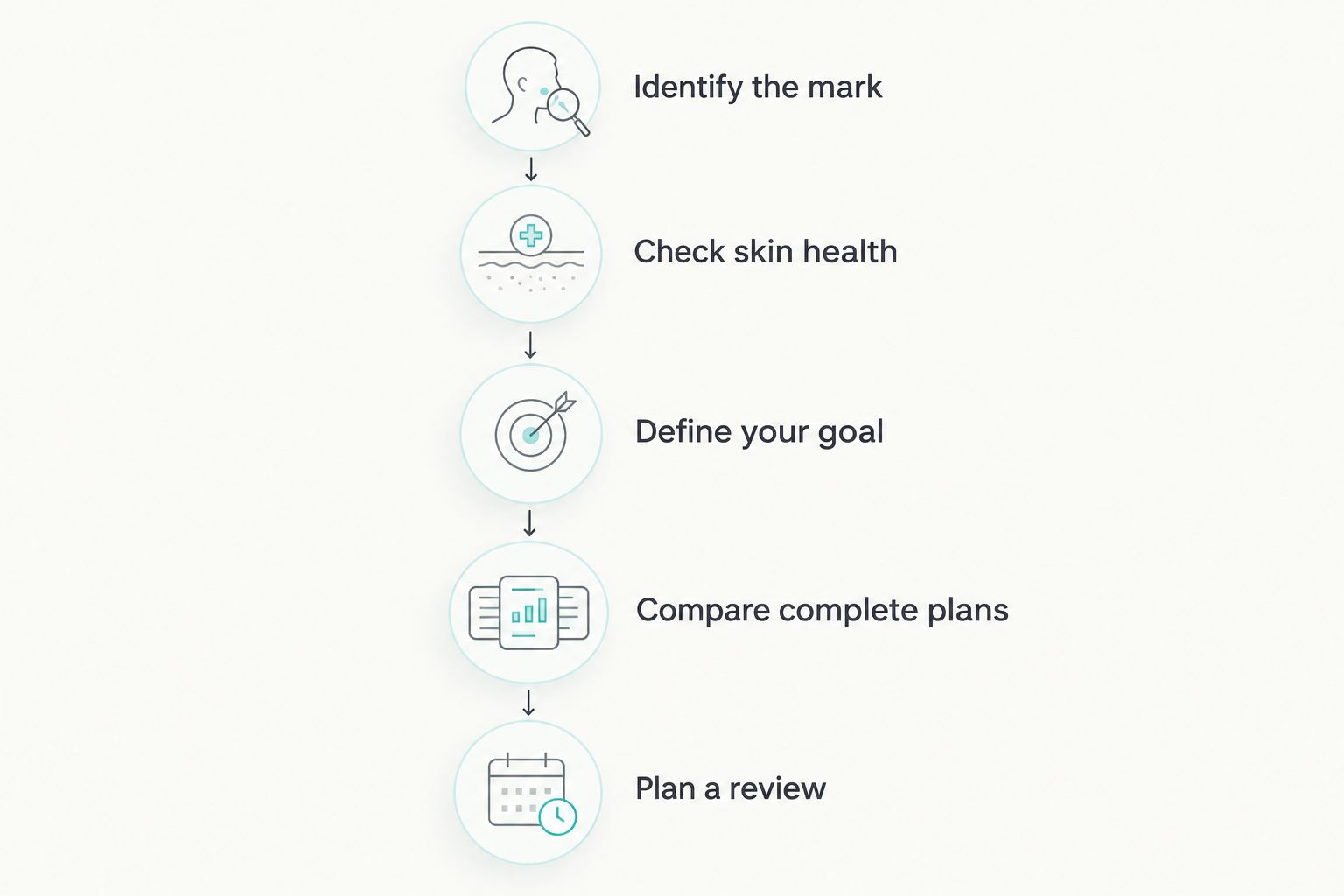
Use this sequence for a 2026 treatment decision. Start with skin health, then compare plans that address the same concern.
- Identify the mark. Ask whether you have a raised scar, depressed scar, discoloration, or thickened eczema-affected skin. A diagnosis determines which comparison is relevant.
- Check skin health. Report active eczema, broken skin, infection symptoms, and prior product reactions. Do not apply scar gel to an untreated rash.
- Define your goal. Describe the change you want: less redness, a flatter scar, improved texture, or less discomfort. Avoid using “removal” as the only outcome.
- Compare complete plans. Request the full proposed laser course and list the products required for label-directed home care. Include aftercare and follow-up questions.
- Plan a review. Ask when to reassess progress and which symptoms require earlier contact. Use your clinician's instructions rather than a self-imposed deadline.
Bring the same questions to every consultation. Consistent questions make the answers useful; a collection of unrelated treatment estimates does not.
Where at-home scar care fits
RejûvaSil Silicone Scar Gel is a medical-grade silicone gel designed as a noninvasive option for postoperative and facial scar management. Check the current directions and confirm that your skin is fully healed before starting.
Rejûvaskin scar care is best for people seeking an at-home silicone option for an appropriate healed scar—not treatment for an active eczema flare. Home application is the advantage; the limitation is that silicone gel does not address every cause of a visible skin mark.
For eczema-prone skin, discuss the proposed application site with your clinician if it is frequently inflamed or easily irritated. Keep scar care and eczema treatment distinct, even when both concerns affect the same area.
Rejûvaskin eczema care and scar care serve different needs. Choose by the skin concern and product directions, not by assuming every sensitive-skin product has the same purpose.
Is silicone gel better than laser treatment for raised scars?
Silicone gel is a noninvasive home-care option for appropriate healed, raised scars; laser treatment requires a clinician to select a suitable procedure and goal. “Better” depends on the scar, symptoms, skin condition, and treatment history—not simply the format.
Ask whether home scar care is an appropriate starting point for your particular scar. A scar that grows beyond the original injury, becomes painful, or restricts movement deserves clinical assessment rather than repeated product changes.
Can I use silicone gel after laser scar treatment?
Use silicone gel after laser treatment only when your treating clinician confirms the skin is ready and recommends it. Some laser procedures disrupt the skin surface, so routine scar-product instructions do not replace procedure-specific aftercare.
Ask exactly when to restart moisturizer, sunscreen, eczema treatments, and scar products. Do not infer readiness from the disappearance of redness alone.
Should I treat eczema marks with scar gel?
Scar gel is not an eczema treatment and is not automatically appropriate for flat marks left after a flare. First establish whether the change is discoloration, thickened skin, or a true scar.
Sun protection also matters. The American Academy of Dermatology recommends broad-spectrum, water-resistant sunscreen with SPF 30 or higher and reapplication every 2 hours outdoors; for recently treated skin, follow your clinician's specific instructions about timing and product choice.
FAQ
How do I compare laser scar treatment cost vs silicone gel in 2026?
Compare the complete proposed laser course with the full, label-directed silicone regimen. Include consultation, follow-up, aftercare, and replacement products rather than comparing an individual appointment with a single tube.
Is laser treatment guaranteed to remove my scar?
No, laser treatment does not guarantee scar removal. Ask which scar feature the clinician expects to improve and what limitations apply to your skin.
Can I put silicone scar gel on an eczema flare?
Do not use silicone scar gel as treatment for an active eczema flare. Ask a clinician to assess inflamed, broken, or weeping skin before applying a scar product.
Is Rejûvaskin scar care the same as eczema treatment?
No, Rejûvaskin scar care and eczema care address different concerns. Select a product for its stated purpose and follow its directions rather than treating the categories as interchangeable.
Will silicone gel fade dark marks from scratching?
Silicone gel is not automatically appropriate for dark marks left after scratching. A clinician should distinguish post-inflammatory discoloration from a raised scar before you choose treatment.
How long should I shower if I have eczema-prone skin?
Keep baths or showers to 5–10 minutes, consistent with American Academy of Dermatology eczema guidance. Use warm water, pat dry, and moisturize while the skin is still damp.
What should I ask before booking a scar laser appointment?
Ask for the treatment goal, complete proposed course, aftercare instructions, risks, and follow-up arrangements. Tell the clinician about eczema, previous reactions, and current medications before scheduling.
One last thing
Before starting a new scar regimen, take a clear photograph in consistent lighting and write down what actually bothers you. Record texture, color, itching, or discomfort separately. This gives you and your clinician a more useful comparison than relying on memory or judging every skin change as treatment failure.
The most useful next step is identifying the mark—not buying the first treatment you find.
Leave a comment