





Yes—zinc oxide sunscreen is safe for daily facial use when you follow the label, including on eczema-prone skin that tolerates the complete formula. Choose broad-spectrum SPF 30 or higher; zinc oxide does not treat eczema, and fragrance or other ingredients can still irritate sensitive skin.
- Is zinc oxide sunscreen safe for daily use? Yes, when used as directed and tolerated by your skin.
- The American Academy of Dermatology recommends broad-spectrum SPF 30 or higher, including for sensitive skin.
- For eczema-prone skin, choose fragrance-free sunscreen and apply it after moisturizer.
- Reapply sunscreen every 2 hours outdoors and after swimming, sweating, or towel drying, following the label.
Is zinc oxide sunscreen safe for daily facial use?
Yes. Daily use is appropriate; the deciding factor for eczema-prone skin is whether the entire sunscreen formula agrees with your skin. Zinc oxide provides protection against ultraviolet radiation, but the ingredient name alone does not tell you the finished product’s SPF, water resistance, or potential to irritate.
For your 2026 routine, use this selection checklist:
- Check broad-spectrum labeling. This identifies protection against both UVA and UVB radiation.
- Choose SPF 30 or higher. This is the American Academy of Dermatology’s minimum sunscreen recommendation.
- Check fragrance and other ingredients. A mineral active ingredient does not make every formula suitable for eczema.
- Follow the application directions. Apply before exposure and reapply as directed rather than treating morning application as all-day protection.
For a facial option, Mineral Facial Sunscreen uses zinc oxide and has SPF 32. Check the current package directions and full ingredient list before adding it to an eczema-care routine.
Why this matters for eczema-prone skin
Eczema affects the skin barrier. When that barrier is irritated, products that normally feel comfortable can sting, and rubbing sunscreen onto inflamed skin can add discomfort.
That does not make skipping sun protection the better choice. Instead, combine a tolerated sunscreen with shade, a wide-brimmed hat, and clothing that covers exposed skin. You do not need to make sunscreen do every protective job by itself.
The American Academy of Dermatology’s sunscreen-selection and eczema-care guidance supports mineral filters, fragrance-free formulas, and regular moisturizing for sensitive skin. FDA sunscreen guidance also distinguishes protection from UV exposure from treatment of a skin condition. Sunscreen protects against ultraviolet radiation; it is not an eczema treatment.
Which sunscreen type makes sense for sensitive facial skin?
Zinc oxide is a useful starting point, not a guarantee. In 2026, compare finished formulas by their labels and your skin’s response rather than assuming that every mineral sunscreen feels the same.
| Sunscreen option | Best for | Main benefit | Main limitation |
|---|---|---|---|
| Zinc oxide mineral sunscreen | Eczema-prone skin that tolerates the formula | Zinc oxide provides UVA and UVB protection | Some formulas leave a visible cast or feel thick |
| Titanium dioxide mineral sunscreen | Sensitive skin that tolerates this mineral filter | Another mineral option recommended for sensitive skin | Confirm broad-spectrum protection on the finished product |
| Sunscreen with organic UV filters | People who prefer the texture and tolerate the formula | Offers additional formulation and texture choices | Some formulas sting sensitive skin or eyes |
Mineral sunscreens can still contain fragrance, preservatives, or other ingredients that bother an individual user. Organic-filter sunscreens are not automatically unsuitable, either. If you already use a broad-spectrum product comfortably, eczema alone is not a reason to discard it.
Choose the sunscreen you can apply adequately and consistently without worsening your skin symptoms. A product that looks appealing but burns every time you use it is not a good daily fit.
How do you apply zinc oxide sunscreen over eczema skincare?
Keep the routine simple. Apply your moisturizer first, then sunscreen after the moisturizer has settled, unless your clinician or product directions specify otherwise.
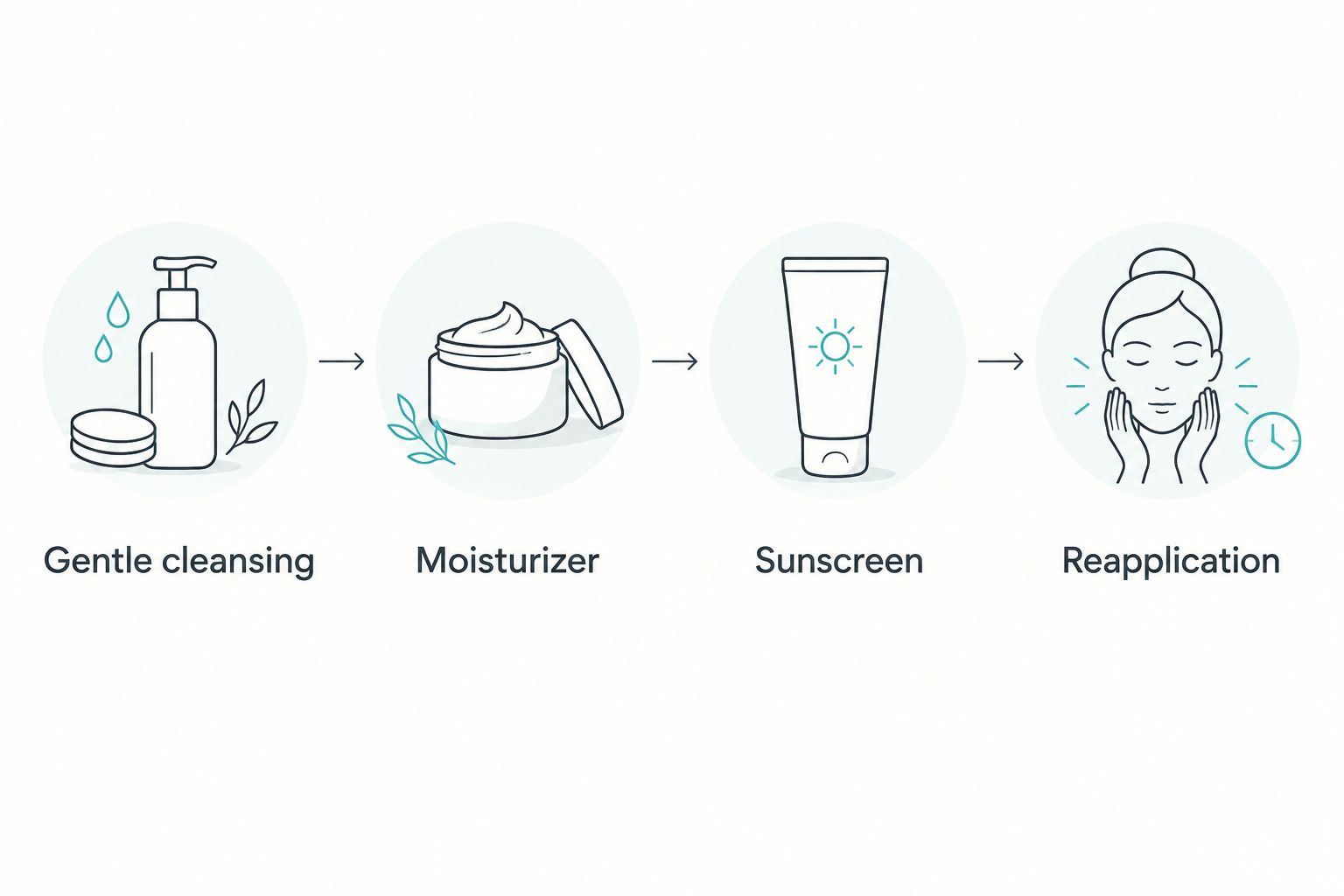
- Gentle cleansing. Use lukewarm water and a mild cleanser when cleansing is needed. Avoid scrubs, cleansing brushes, and vigorous towel rubbing on irritated facial skin.
- Moisturizer. Apply a fragrance-free moisturizer suited to your eczema-care plan. Sunscreen does not replace this step simply because its texture feels creamy.
- Sunscreen. Apply an even layer to exposed skin according to the label. Include often-missed areas such as the ears, hairline, and neck.
- Reapplication. Renew protection during outdoor exposure. Follow water-resistance directions and reapply after swimming, sweating, or towel drying.
Let each layer settle rather than repeatedly rubbing everything together. If the products pill, simplify the layers and try again; do not solve pilling by applying too little sunscreen.
How long before going outside should you apply it?
Apply sunscreen 15 minutes before going outdoors, following American Academy of Dermatology guidance and your product’s label. Mineral filters do not need a chemical activation period, but applying in advance helps you cover exposed skin before exposure begins.
For your 2026 morning routine, apply sunscreen before leaving home rather than waiting until you are already in direct sunlight. Keep hats and other protective clothing nearby so protection does not depend on remembering a single product.
How often should you reapply facial sunscreen?
Reapply every 2 hours while outdoors, and after swimming, sweating, or towel drying as directed. Water-resistant sunscreen still requires reapplication; water resistance does not mean waterproof.
A morning layer does not provide dependable protection through an entire outdoor afternoon. If you spend most of the day indoors, consider your actual exposure, including time near windows and your trip outside, rather than assuming the same schedule fits every setting.
Why zinc oxide sunscreen tolerance varies
A reaction to sunscreen does not identify the responsible ingredient by itself. Review these factors before deciding that zinc oxide is the problem:
- Fragrance: Fragranced skincare can irritate eczema-prone skin. Look for fragrance-free labeling; unscented does not necessarily mean fragrance-free.
- Other formula ingredients: Preservatives, botanical extracts, and other components can cause irritation or contact allergy in susceptible people.
- Current barrier condition: Inflamed, cracked, or recently irritated skin often tolerates less than calm skin.
- Texture and application: Thick formulas require careful spreading. Repeated rubbing can be uncomfortable on inflamed areas.
- Products underneath: An irritating cleanser, exfoliant, or treatment can make sunscreen application sting even when sunscreen is not the original trigger.
- Heat and sweat: Both can aggravate eczema symptoms independently of sunscreen and complicate your assessment of a new product.
Change one product at a time when possible. Introducing a cleanser, moisturizer, and sunscreen together makes it harder to identify which product caused a problem.
If a reaction keeps returning, bring the packaging and ingredient lists to a dermatologist. Clinical patch testing can help investigate allergic contact dermatitis; a small home trial cannot diagnose an allergy.
What should you check before trying a new formula?
Read the full label. For a 2026 sunscreen purchase, prioritize broad-spectrum protection, SPF 30 or higher, fragrance-free labeling, and water resistance when you expect swimming or sweating.
Try a small amount on a limited area of intact skin before applying it across your face. Follow any testing instructions on the package, and stop if the product causes burning, itching, swelling, or a worsening rash. Do not deliberately test a new formula on an actively inflamed patch.
Also check the expiration date and storage instructions. Replace expired sunscreen, and avoid relying on a bottle that has been stored contrary to its directions.
A visible white cast is a cosmetic limitation, not evidence that sunscreen is damaging your skin. Burning, swelling, and worsening eczema are different: those symptoms require stopping the product and reassessing the formula.
Where does a mineral facial sunscreen fit?
Rejûvaskin Mineral Facial Sunscreen - SPF 32 is a zinc oxide facial sunscreen described as providing UVA/UVB protection. Rejûvaskin mineral sunscreen is best for people seeking a zinc oxide facial option, provided they tolerate the complete formula.
Its stated SPF 32 exceeds the SPF 30 minimum recommended by the American Academy of Dermatology. That is a useful selection point, not proof that the product treats eczema or suits every sensitive-skin user.
The limitation is individual tolerance. Rejûvaskin sunscreen belongs in an eczema-prone skincare routine only when its ingredients and application feel comfortable; keep prescribed eczema treatment separate and follow your clinician’s instructions.
Can you put zinc oxide sunscreen on an active eczema flare?
Do not apply sunscreen to open or broken skin. Check the product warnings and ask your clinician how to protect an affected area if it is cracked, weeping, or raw.
For intact but inflamed skin, tolerance varies. Use shade and protective clothing while you address the flare, and avoid repeatedly applying a product that burns. Eyelid eczema, persistent facial flares, and suspected infection need medical assessment rather than another product trial.
Seek prompt medical care for rapidly worsening redness, increasing pain, pus, or fever. Sun protection remains important, but managing damaged or infected skin takes priority over finding a more comfortable sunscreen texture.
Does daily zinc oxide sunscreen dry out your face?
Daily zinc oxide sunscreen does not automatically cause dryness, but some finished formulas feel drying or heavy on eczema-prone skin. Texture, other ingredients, cleansing habits, and your existing barrier condition all affect comfort.
Apply your usual tolerated moisturizer first. If tightness continues, reassess the sunscreen and cleanser rather than adding multiple new treatments at once.
At the end of the day, remove sunscreen gently. Use a mild cleanser and lukewarm water without scrubbing, then moisturize; an aggressive removal routine can undermine an otherwise comfortable day of sun protection.
Is daily sunscreen necessary when you stay indoors?
Daily facial sunscreen is useful when your day includes UV exposure, including outdoor errands or substantial time beside a sunny window. UVA can pass through window glass, while exposure varies with the setting.
In 2026, base your routine on daylight exposure, not just the weather forecast. Clouds do not eliminate UV radiation, and a cool day does not remove the need for protection outdoors.
If facial eczema makes sunscreen difficult, adjust your surroundings as well as your skincare. Move away from direct window sunlight, seek shade outside, and use a protective hat instead of repeatedly applying an irritating product.
FAQ
Is zinc oxide sunscreen safe for daily use on eczema-prone skin?
Yes, zinc oxide sunscreen is safe for daily use when applied as directed and tolerated by your skin. Choose broad-spectrum SPF 30 or higher, and assess the complete formula rather than the mineral ingredient alone.
What SPF should I use on my face every day?
Use broad-spectrum SPF 30 or higher, following American Academy of Dermatology guidance. Reapply every 2 hours outdoors and after swimming, sweating, or towel drying as directed.
Should sunscreen go before or after eczema moisturizer?
Apply sunscreen after your moisturizer has settled, unless your clinician or the product directions say otherwise. Follow separate instructions for prescription eczema treatments.
Is zinc oxide sunscreen better than chemical sunscreen for eczema?
Zinc oxide sunscreen is a useful starting point for eczema-prone skin, but the best choice is a broad-spectrum formula you tolerate. Mineral formulas can still contain ingredients that irritate sensitive skin.
Can I put zinc oxide sunscreen on cracked eczema?
Do not apply sunscreen to open or broken skin. Use shade and protective clothing, and ask your clinician how to protect the affected area while it heals.
Is Rejûvaskin Mineral Facial Sunscreen an eczema treatment?
Rejûvaskin Mineral Facial Sunscreen is a zinc oxide SPF 32 sunscreen, not an eczema treatment. Assess the complete ingredient list and keep using eczema treatments as directed by your clinician.
Can babies use zinc oxide facial sunscreen?
For babies younger than 6 months, ask a pediatrician before using sunscreen and prioritize shade and protective clothing. For older babies, follow the sunscreen label and pediatric guidance.
Why does mineral sunscreen sting my face?
Mineral sunscreen can sting because of an irritated skin barrier or another ingredient in the formula. Stop a product that causes burning or worsens your rash, and seek medical advice if symptoms persist.
One last thing
Do not mix sunscreen into your moisturizer to make it spread more easily. Mixing changes the way you apply the sunscreen and makes adequate, even coverage harder to judge.
Apply moisturizer and sunscreen as separate layers. For eczema-prone skin, a short routine that you tolerate is more useful than a crowded routine that leaves your face burning.
Leave a comment