





Apply about ¼ teaspoon of sunscreen to your face each morning, using enough to cover the skin evenly rather than leaving a thin, patchy layer. That estimate does not include your neck, ears, or exposed scalp, which need additional sunscreen. For eczema-prone skin, choose a formula you tolerate and reapply at least every 2 hours outdoors, following the product’s directions.
- How much sunscreen should you apply to your face? About ¼ teaspoon, plus extra for exposed ears and neck.
- Choose broad-spectrum SPF 30 or higher; eczema-prone skin also needs a formula that does not sting.
- Rejûvaskin Mineral Facial Sunscreen provides SPF 32 protection using zinc oxide; individual skin tolerance still matters.
- Reapply at least every 2 hours outdoors and after swimming, sweating, or towel drying, following label directions.
How much sunscreen should you apply to your face daily?
About ¼ teaspoon is a practical starting amount for an adult face—not a combined allowance for your face, neck, and ears. Your face size and the product’s consistency affect how that amount spreads. Complete coverage matters more than treating a kitchen measurement as an exact prescription.
Sunscreen SPF testing uses an application density of 2 milligrams per square centimeter of skin. A teaspoon estimate translates that laboratory standard into an everyday habit, but it cannot account precisely for every face or formula.
If eczema makes sunscreen uncomfortable, do not solve the problem by using less. Review the formula and your application routine instead; this guide to mineral sunscreen for eczema-prone skin addresses that specific concern.
| Area you are protecting | Practical application guidance | Common mistake |
|---|---|---|
| Face only | Start with about ¼ teaspoon and spread evenly | Using a small dot as the entire application |
| Face and neck | Use the facial amount plus additional sunscreen for the neck | Stretching the facial amount across both areas |
| Ears and exposed scalp | Apply additional sunscreen to uncovered skin | Assuming facial sunscreen covers nearby areas |
| Lips | Use a lip product with SPF 30 or higher | Leaving the lips unprotected |
Why this matters for eczema-prone skin
Eczema changes the sunscreen decision. You need ultraviolet protection, but an irritating formula can make consistent application difficult. Stinging is a reason to reassess the product—not proof that the sunscreen is working.
The American Academy of Dermatology recommends broad-spectrum, water-resistant sunscreen with SPF 30 or higher. For your 2026 daily routine, pair that protection with shade, a wide-brimmed hat, and clothing that covers exposed skin.
The best sunscreen routine is one that delivers adequate coverage without aggravating your skin. A higher SPF does not compensate for missed areas, and an eczema-friendly label does not guarantee that every person will tolerate the formula.
Face only: about ¼ teaspoon per application
Measure about ¼ teaspoon when you first establish your routine. This gives you a reference for what an adequate facial application looks like with your particular product. You do not need to carry a measuring spoon everywhere afterward.
Distribute sunscreen across your forehead, cheeks, nose, and chin, then spread it into a continuous layer. Check the sides of your nose, the hairline, and the jawline before moving on.
A visible dot on each cheek is not a reliable dose. The dots can differ greatly in size, and spreading a tiny amount farther does not create more sunscreen.
If the full application feels difficult to distribute, spread it in successive passes over the same area. Do not reduce the total amount simply to make the finish less noticeable. Follow the label’s application instructions and keep sunscreen out of your eyes.
Face and neck: more than ¼ teaspoon per application
Your neck needs its own sunscreen. Using the same facial amount across a larger area leaves less product on each patch of skin.
Cover the front and sides of your neck, then check whether your hairstyle or clothing leaves the back exposed. Apply additional sunscreen to your ears, including their upper edges and the skin behind them when exposed.
The two-finger method is a convenient reminder: dispense sunscreen along the lengths of your index and middle fingers. However, finger size, nozzle width, and product texture change the amount dispensed. Treat finger lengths as an estimate, not a universal measurement.
For a dependable 2026 habit, separate the task into facial coverage and additional exposed areas. That makes it harder to overlook your neck while concentrating on your face.
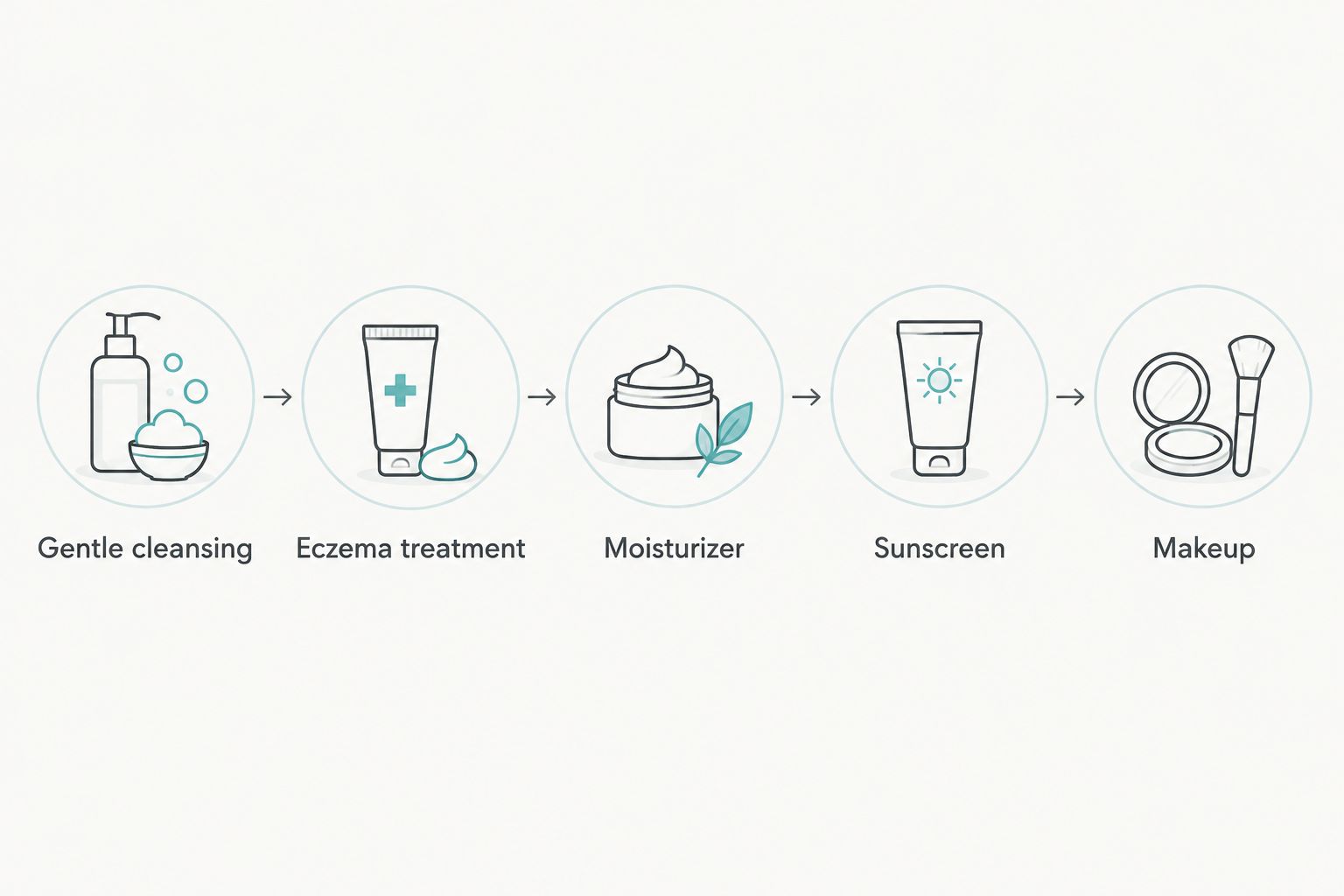
How should you apply sunscreen over an eczema skincare routine?
Keep the routine simple. Use your prescribed eczema treatments as directed, moisturize as appropriate, and apply sunscreen without mixing it into another product. Your clinician’s instructions take priority when treatment timing needs special attention.
- Gentle cleansing. Wash without scrubbing and use lukewarm water. Avoid starting the morning with a cleanser that leaves your skin tight or uncomfortable.
- Eczema treatment. Apply prescribed medication according to your treatment plan. Ask your clinician or pharmacist if you are unsure how to layer it.
- Moisturizer. Apply a moisturizer your skin tolerates. Let it settle enough that the sunscreen can spread without sliding into uneven patches.
- Sunscreen. Apply the full facial amount, then cover your neck, ears, and other exposed areas separately. Follow the label’s directions for application before sun exposure.
- Makeup. Apply makeup afterward without aggressively rubbing away the sunscreen layer. Makeup with SPF is not a dependable substitute for a full sunscreen application.
This sequence separates eczema care from sun protection. Neither job disappears because another product feels moisturizing.
Which sunscreen type makes sense for eczema-prone skin?
Choose based on protection and skin tolerance, not the assumption that one filter category suits everyone. Mineral sunscreens containing zinc oxide or titanium dioxide are commonly recommended for sensitive skin, but the complete formula still matters.
Fragrance, preservatives, texture, and other ingredients can influence your experience. Read the full label rather than choosing solely by the word mineral.
| Sunscreen option | Best for | Advantage | Limitation |
|---|---|---|---|
| Mineral sunscreen | People seeking zinc oxide or titanium dioxide filters | Often a useful starting point for sensitive skin | Some formulas leave a visible cast or feel difficult to spread |
| Organic-filter sunscreen, often called chemical sunscreen | People who tolerate these filters and prefer their formulation options | Offers alternatives when a particular mineral formula feels unsuitable | Some formulas sting sensitive skin or the eye area |
| Combination-filter sunscreen | People who tolerate a blend of filter types | Provides another formulation option | Combining filters does not guarantee eczema tolerance |
Rejûvaskin Mineral Facial Sunscreen - SPF 32 uses zinc oxide for UVA/UVB protection. Rejûvaskin Mineral Facial Sunscreen is best for consumers seeking a zinc oxide facial sunscreen with SPF 32. Its mineral formulation does not establish that it will suit every eczema flare, so assess your skin’s response rather than assuming compatibility.
When evaluating sunscreen in 2026, prioritize broad-spectrum protection, an adequate application, and a formula you can use consistently. Check the current label for water-resistance instructions before swimming or exercising.
Why the amount and application experience vary
The facial estimate is a starting point. These factors explain why the same-looking squeeze does not work identically for everyone:
- Face size: A larger skin surface requires more sunscreen to maintain the same application density. Do not leave the jawline bare to make a measured amount stretch.
- Areas covered: Adding your neck, ears, or exposed scalp increases the area needing protection. Allocate additional sunscreen rather than redistributing the facial amount.
- Product consistency: A runny fluid and a thick cream form different-looking amounts on your fingers. Appearance alone is an unreliable way to compare doses.
- Skin condition: Dry, scaly eczema patches can make even application harder. Use gentle application and seek treatment advice when inflammation prevents comfortable sunscreen use.
- Other skincare layers: Mixing sunscreen with moisturizer changes the application rather than preserving the original sunscreen layer. Apply them separately.
- Outdoor activity: Swimming, sweating, and towel drying affect the sunscreen layer. Reapply according to the label instead of relying on the morning application.
How often should you reapply sunscreen to your face?
Reapply at least every 2 hours while outdoors, and follow the label after swimming or sweating. Towel drying also removes product, so it is a reason to reapply rather than wait for the next scheduled application.
For your 2026 routine, use the morning application as the beginning of protection—not an all-day guarantee. Apply sunscreen before going outside according to the label; standard guidance is 15 minutes before sun exposure.
Water-resistant does not mean waterproof. Check whether the product carries a water-resistance claim and follow its specific directions. A hat and shade remain useful even when you have applied sunscreen correctly.
Is the two-finger rule enough for your face and neck?
The two-finger rule is an estimate, not a fixed dose for every face and neck. The amount varies with your fingers and the product’s dispensing opening. It is useful as a routine cue, but it does not replace checking that every exposed area has an even layer.
If you use about ¼ teaspoon for your face, add sunscreen for your neck and ears. Do not assume that a familiar-looking strip covers an unlimited area.
Should you use less sunscreen when eczema is flaring?
Do not deliberately underapply sunscreen to manage an eczema flare. If a product causes burning or worsens irritation, stop using that product and ask a dermatologist about a tolerable alternative. Use shade, protective clothing, and a hat while you resolve the problem.
Do not apply sunscreen directly to open, weeping, or infected skin without medical guidance. Worsening pain, spreading redness, warmth, or drainage needs clinical assessment rather than another cosmetic layer.
FAQ
How much sunscreen should I apply to my face every morning?
Apply about ¼ teaspoon to an adult face as a practical starting estimate, using enough for even coverage. Apply additional sunscreen to your neck, ears, and exposed scalp rather than sharing that facial amount across all areas.
Should I wear sunscreen every day if I have facial eczema?
Use sunscreen on exposed skin as part of daily sun protection when you have facial eczema. Choose a formula you tolerate, and ask your dermatologist for guidance if active eczema makes application painful.
Is mineral sunscreen better than chemical sunscreen for eczema?
Mineral sunscreen is often a useful starting point for eczema-prone skin, but it is not automatically better tolerated by everyone. Zinc oxide or titanium dioxide filters are only part of the formula; other ingredients also affect tolerance.
Can I mix sunscreen with my eczema moisturizer?
Do not mix sunscreen with your eczema moisturizer. Apply the products separately so you can distribute an adequate sunscreen layer, and follow your clinician’s instructions for prescribed treatments.
Does SPF 50 mean I can apply less sunscreen?
SPF 50 does not mean you can apply less sunscreen. SPF testing assumes a standardized application density, and a higher number does not correct thin coverage or missed areas.
How often should I reapply facial sunscreen outside?
Reapply facial sunscreen at least every 2 hours outdoors and follow the label after swimming or sweating. Reapply after towel drying because it removes sunscreen from the skin.
What should I do if sunscreen stings my eczema?
Stop using a sunscreen that causes burning or worsens your eczema, and ask a dermatologist about alternatives. Protect your skin with shade, a hat, and clothing rather than compensating with an inadequate amount of the irritating product.
Is Rejûvaskin Mineral Facial Sunscreen an eczema treatment?
Rejûvaskin Mineral Facial Sunscreen is a zinc oxide sunscreen with SPF 32, not an eczema treatment. Keep your eczema treatment plan separate from sun protection and assess whether the sunscreen suits your skin.
One last thing
Check the places you do not see easily in the mirror. A carefully covered forehead does not protect an uncovered ear, hairline, or side of the neck.
For your 2026 routine, make that coverage check the final step before leaving home. If sunscreen repeatedly irritates your eczema, change the formula with clinical guidance—not the amount your skin needs for protection.
Leave a comment