





A hypertrophic scar often takes 12 months or longer to soften and flatten, with scar maturation continuing for 24 months or more. It does not follow a fixed deadline, and some raised scars need treatment rather than time alone. This 2026 guide explains what progress looks like, when to seek care, and how to protect eczema-prone skin during scar management.
- How long does a hypertrophic scar take to flatten? Often 12 months or longer; complete flattening is not guaranteed.
- Rejûvaskin offers silicone scar care for consumers managing healed scars; eczema treatment addresses a different problem.
- Start silicone only after the wound closes, and avoid applying it over active eczema or broken skin.
- Seek assessment for scars growing beyond the original wound, increasing pain, drainage, or spreading redness.
How long does a hypertrophic scar take to flatten?
Expect gradual change over months, not a flat scar within weeks. A hypertrophic scar stays within the original injury's boundaries, but its height, firmness, and color can change as the tissue matures. Flattening and fading are separate changes; one does not prove the other has finished.
NHS guidance on scars describes maturation over 2 years or more. DermNet's guidance on hypertrophic scars also describes gradual regression, while distinguishing these scars from keloids. Neither timeline guarantees that an individual scar will become completely flat.
| What you notice | What it means for your next step |
|---|---|
| Raised tissue within the original wound | Consistent with a hypertrophic scar, but a clinician should confirm the diagnosis |
| A scar becoming softer or less prominent | A useful sign of improvement, even if the color remains noticeable |
| Tissue growing beyond the original wound | Needs assessment for a possible keloid |
| Increasing warmth, drainage, or spreading redness | Needs medical assessment rather than a longer trial of scar products |
If your scar has been present for a long time, the guide to scar cream for old, stubborn scars addresses a different stage of scar care. Age alone does not establish which treatment your scar needs.
Why this matters
A raised scar and an eczema flare can both itch, but they need different care. Scar management targets healed scar tissue; eczema care addresses inflammation, dryness, and a disrupted skin barrier.
Treating every itchy patch as a scar can delay appropriate eczema treatment. Treating a raised scar only with moisturizer also leaves its height and firmness unaddressed. Identify what is happening before adding products.
For your 2026 care plan, separate the scar itself from the surrounding skin. Check whether the wound is closed, whether eczema is active, and whether symptoms are stable or worsening.
Early healing: protect the wound before treating the scar
An open incision, scabbed area, or weeping patch is not ready for routine silicone scar care. Follow your surgeon's wound-care instructions until the skin has closed and your clinician confirms that scar treatment is appropriate.
Do not use a calendar date as proof that a wound is ready. Different procedures and complications change healing, and a small opening still matters even when the rest of an incision looks healed.
For eczema-prone skin, also check the area around the wound. Scratching, adhesive irritation, and active dermatitis can make a scar-care routine difficult to tolerate. Ask your clinician how to manage those problems without interfering with wound care.
Best for this stage: clinician-directed wound care. The limitation is that wound closure does not immediately resolve raised scar tissue; scar management comes after that first priority.
Scar maturation: 12 months or longer
A hypertrophic scar can remain raised while the underlying collagen remodels. The tissue often becomes softer and less prominent gradually, rather than changing evenly from one week to the next.
Use 12 months or longer as a reminder that scar maturation is slow—not as a reason to ignore worsening symptoms. Waiting is not appropriate when the scar restricts movement, becomes increasingly painful, or has an uncertain diagnosis.
Take photographs in similar lighting and at a similar angle. Note whether the scar feels softer, catches less on clothing, or interferes less with movement. These observations are more useful than judging color alone.
For eczema-prone skin, record surrounding irritation separately. A flare beside the scar does not automatically mean the scar is worsening, and improvement in eczema does not prove that raised scar tissue has flattened.
Longer-term change: 24 months or more
Scar maturation can continue for 24 months or more, but persistence does not mean you must keep repeating the same home routine. A scar that remains thick, uncomfortable, or functionally limiting deserves reassessment.
A dermatologist or surgeon can confirm whether the tissue is hypertrophic, discuss treatment options, and check whether dermatitis is contributing to discomfort. Treatment choice depends on the scar's location, symptoms, and examination findings.
Best for this stage: reassessment when progress or comfort is inadequate. The limitation of waiting alone is that time cannot confirm a diagnosis or address every symptomatic scar.
Why hypertrophic scar flattening varies
The same timeline does not apply to every incision, burn, or injury. These factors help explain why:
- Wound depth and healing: Deeper injuries and delayed healing affect the tissue that forms during repair.
- Location and tension: Skin stretched across a joint or under repeated tension places different demands on a healing scar.
- Individual scarring tendency: A history of raised scars helps your clinician assess future scar risk.
- Scar diagnosis: Hypertrophic scars remain within the wound boundary; keloids extend beyond it and behave differently.
- Treatment tolerance: A routine interrupted by irritation is different from one your skin tolerates consistently.
- Active eczema: Inflamed, scratched, or broken surrounding skin needs attention before adding occlusive products.
Do not turn these factors into a personal prediction without an examination. They guide treatment decisions; they do not produce an exact flattening date.
What should your 2026 scar-care routine include?
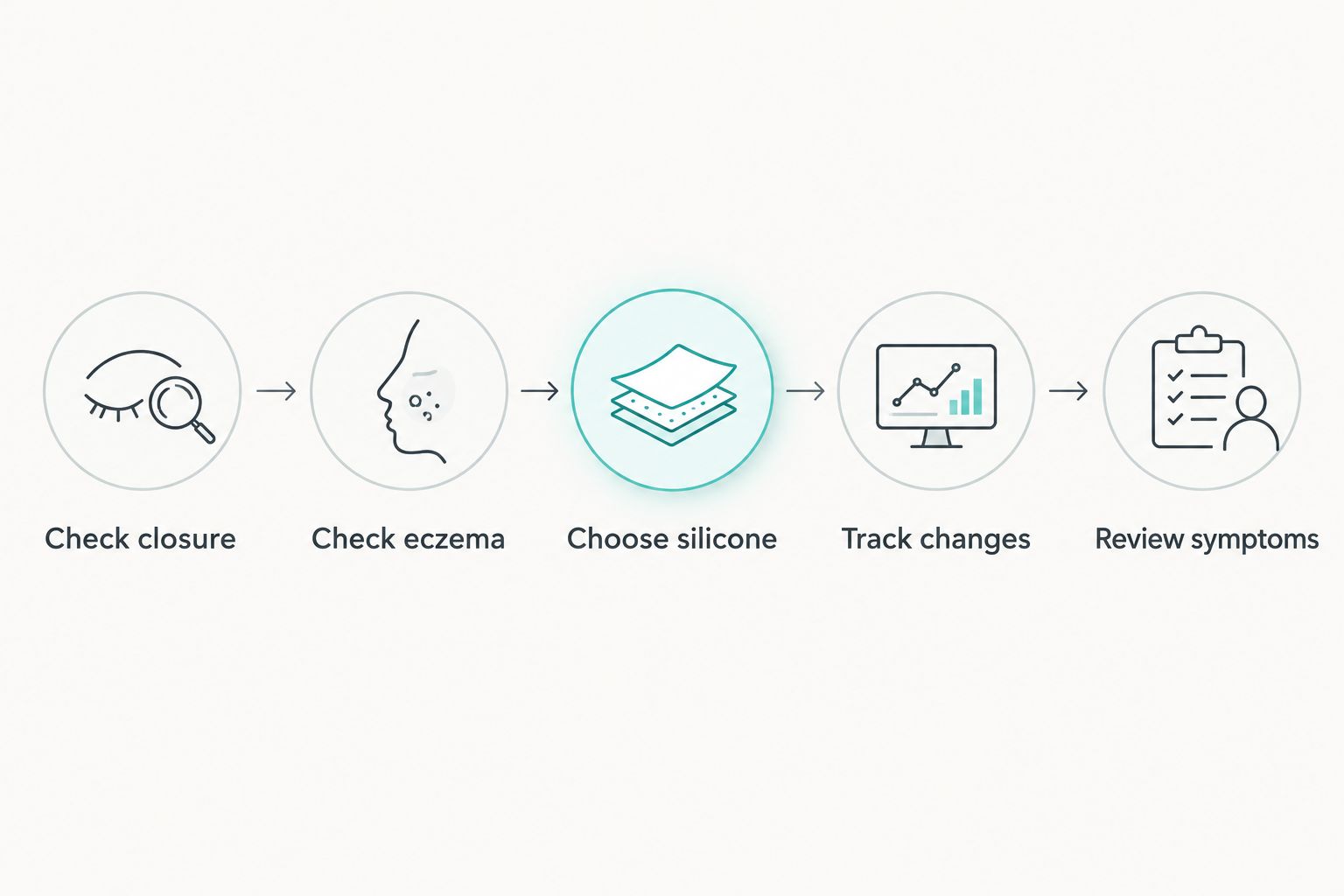
Keep the routine focused on healed skin and clear goals. The sequence below helps you avoid confusing wound care, scar treatment, and eczema management.
- Check closure. Confirm that the wound is fully closed and follow your clinician's advice about starting scar treatment.
- Check eczema. Identify active rash, weeping, cracks, or scratching around the scar before applying a new product.
- Choose silicone. Discuss a gel or sheet that fits the scar's location and your skin's tolerance.
- Track changes. Compare height, firmness, symptoms, and movement—not just redness.
- Review symptoms. Arrange assessment for worsening discomfort, restricted movement, or an uncertain diagnosis.
A simple routine also makes irritation easier to investigate. Adding several new creams, adhesives, and washes together makes it harder to identify which change caused a reaction.
Silicone gel and silicone sheets are scar-care options, not substitutes for prescribed eczema treatment. Choose the format around tolerability and practical use rather than assuming that a more involved routine produces faster results.
| Option | Best for | Main advantage | Main limitation |
|---|---|---|---|
| Silicone gel | Healed scars where a sheet is difficult to position | No sheet needs to remain attached | Requires application according to the product directions; irritation still needs attention |
| Silicone sheet | Healed scars where a sheet can stay in place comfortably | Provides direct silicone contact over the covered area | Adhesion, trapped moisture, or irritation can limit tolerance |
| Fragrance-free moisturizer | Dry, eczema-prone surrounding skin | Supports moisture retention and comfort | Does not replace treatment for raised scar tissue or an active eczema flare |
| Clinician-directed procedures | Persistent, symptomatic, or movement-limiting scars | Allows treatment tailored to the examination | Requires assessment and discussion of procedure-specific risks |
For a topical silicone option, RejûvaSil Silicone Scar Gel is described as a medical-grade silicone gel for post-operative and facial scars. Rejûvaskin silicone scar care is best suited to consumers managing healed scars, not open wounds or active eczema. No product description establishes a guaranteed flattening date for your scar.
How do you protect eczema-prone skin around a scar?
Choose a mild cleanser intended for dry, sensitive, eczema-prone skin rather than a deodorant soap or scrub. Look for fragrance-free labeling; an unscented product can still contain fragrance used to mask another odor.
Use lukewarm water, keep washing brief, and pat rather than rub. Apply your usual tolerated moisturizer while surrounding skin is still damp, while following separate directions for silicone application and prescribed medicines.
Do not layer moisturizer beneath a silicone sheet unless its instructions or your clinician specifically allow it. Products left beneath a sheet can affect adhesion and change how the covered skin feels.
Rejûvaskin scar care and eczema care serve different purposes. A comfortable skin barrier supports a tolerable routine, but soothing dryness is not the same as flattening excess scar tissue.
Can you make a hypertrophic scar flatten faster?
12 months or longer is a realistic maturation timescale, not a treatment promise. Appropriate scar care can help manage a raised scar, but no home routine establishes an exact completion date.
Discuss silicone after wound closure and seek assessment when symptoms persist. Avoid aggressive rubbing or adding exfoliating products to an irritated scar in an attempt to force faster change.
Does an itchy hypertrophic scar mean it is healing?
12 months or longer of scar maturation does not make every episode of itching normal or harmless. Itching can occur in scar tissue, but eczema, contact irritation, and other skin problems also cause it.
Check whether the itch is confined to the scar or follows the outline of a sheet or adhesive. A spreading rash, broken skin, or persistent symptoms needs assessment rather than reassurance based only on scar age.
When should you stop waiting for a scar to flatten?
24 months or more of possible maturation is not a requirement to delay care. Seek earlier assessment if the scar limits movement, becomes increasingly painful, grows beyond the injury, or affects your daily life.
Increasing warmth, drainage, spreading redness, or fever needs prompt medical attention. These are not signs to manage by increasing silicone use.
FAQ
How long does a hypertrophic scar take to flatten in 2026?
A hypertrophic scar often takes 12 months or longer to soften and flatten, with maturation continuing for 24 months or more. Complete flattening is not guaranteed, and persistent or symptomatic scars need assessment.
Will a hypertrophic scar flatten without treatment?
A hypertrophic scar can become flatter as it matures, but the amount of improvement varies. Seek assessment rather than relying on time alone if it is painful, restricts movement, or has an uncertain diagnosis.
Is a hypertrophic scar the same as a keloid?
A hypertrophic scar stays within the original wound, while a keloid extends beyond it. A clinician can confirm the diagnosis and explain how that changes treatment.
Can I use silicone scar sheets if I have eczema?
Silicone sheets require extra caution when eczema affects the application area. Do not apply them over active eczema, broken skin, or a weeping rash; ask your clinician how to manage the scar and dermatitis together.
Does moisturizer flatten a raised scar?
Moisturizer helps dry skin retain moisture, but it is not a substitute for treatment directed at raised scar tissue. Use a tolerated fragrance-free moisturizer for surrounding eczema-prone skin and follow separate scar-product directions.
Should I massage a hypertrophic scar every day?
Follow your clinician's advice about whether and when to massage a scar. Do not massage an open wound, infected area, or active eczema, and do not use painful pressure to try to flatten tissue.
When should I see a dermatologist about a raised scar?
See a dermatologist when a raised scar is worsening, persistently uncomfortable, restricting movement, or extending beyond the original injury. Drainage, spreading redness, increasing warmth, or fever needs prompt medical assessment.
One last thing
Measure improvement by comfort and function as well as appearance. A scar can become softer and less restrictive before it looks substantially different, while a paler scar can still need treatment for thickness or pain.
For your next 2026 follow-up, bring comparable photographs and a short record of itching, irritation, and movement problems. That gives your clinician a clearer basis for adjusting treatment than a deadline alone.
Leave a comment