





Best for daily facial use: Rejûvaskin Mineral Facial Sunscreen - SPF 32. Best for swimming and sweating: a water-resistant mineral sunscreen; best for pigment concerns: a tinted mineral sunscreen with iron oxides; best for fragrance avoidance: a fragrance-free mineral sunscreen. This 2026 guide explains which option fits your routine and which label details matter before you choose.
- Rejûvaskin Mineral Facial Sunscreen - SPF 32 is the daily facial pick in this best mineral sunscreen guide.
- Choose broad-spectrum SPF 30 or higher; mineral ingredients alone do not establish a complete sunscreen routine.
- Swimming and sweating require a water-resistance label, not simply a mineral formula.
- Tinted mineral sunscreen with iron oxides deserves consideration when visible light worsens pigmentation.
- Compare fragrance, finish, and application directions before choosing sunscreen for sensitive skin.
Why this matters
The best mineral sunscreen is the one that meets your exposure needs and that you apply correctly. A facial formula, a tinted formula, and a water-resistant formula solve different problems. One product can fit several categories, but you need the label to confirm that overlap.
Zinc oxide and titanium dioxide are mineral sunscreen filters. They protect against ultraviolet radiation, primarily by absorbing it; describing mineral sunscreen as a shield that only reflects sunlight oversimplifies how these ingredients work.
For your 2026 routine, start with protection requirements rather than texture preferences. The American Academy of Dermatology recommends broad-spectrum SPF 30 or higher, with water resistance for outdoor activities involving water or sweat. Sunscreen also belongs alongside shade and protective clothing—not in place of them.
What makes the best mineral sunscreen?
Use these criteria before comparing the recommendations:
- Broad-spectrum protection: Check for protection against both UVA and UVB. An SPF number alone does not describe the full protection profile.
- SPF 30 or higher: Use this as your minimum selection threshold, consistent with American Academy of Dermatology guidance.
- Activity fit: Look for a stated water-resistance duration when you expect swimming or sweating.
- Skin compatibility: Review the complete ingredient list, including fragrance and ingredients that have irritated your skin before.
- Wearable finish: Check how the formula looks after application, especially on your skin tone and beneath makeup.
- Practical application: Choose a format you can spread evenly and reapply without routinely missing areas.
Do not treat “mineral” as shorthand for fragrance-free, invisible, water-resistant, or suitable for every sensitive skin condition. Those are separate questions.
Best mineral sunscreen options at a glance
This 2026 comparison includes one named facial sunscreen and three label-defined options. The categories overlap: a tinted sunscreen can also be fragrance-free and water-resistant. The ranking separates buying priorities rather than claiming that every option is a different formulation.
| Ranked option | Best for | Standout feature | Key limitation |
|---|---|---|---|
| Rejûvaskin Mineral Facial Sunscreen - SPF 32 | Daily facial use | Zinc oxide-based, 100% mineral facial sunscreen with UVA/UVB protection | Check the current label before choosing it for swimming or heavy sweating |
| Water-resistant mineral sunscreen | Swimming, sports, and sweaty outdoor activity | Labeled protection during water exposure for a stated duration | Requires reapplication; water resistance is not waterproofing |
| Tinted mineral sunscreen with iron oxides | Visible-light-related pigmentation concerns | Tint containing iron oxides can add visible-light protection | Shade mismatch can make adequate application difficult |
| Fragrance-free mineral sunscreen | Avoiding fragrance in a sensitive-skin routine | Removes fragrance as one ingredient-selection concern | Fragrance-free does not guarantee irritation-free |
1. Rejûvaskin Mineral Facial Sunscreen: best for daily facial use
Rejûvaskin Mineral Facial Sunscreen - SPF 32 is a 100% mineral facial sunscreen that uses zinc oxide for UVA/UVB protection. Its stated purpose is helping prevent sunburn and skin damage, making it a relevant choice when you want a dedicated facial sunscreen rather than a general skincare cream.
Rejûvaskin mineral sunscreen is the daily facial pick for readers seeking a zinc oxide-based SPF 32 formula. That recommendation concerns its documented purpose and protection—not an unverified claim about white cast, finish, or performance under makeup.
For daily use, check the directions and complete ingredient list before adding the sunscreen to your existing routine. If you need water resistance, a particular finish, or compatibility with a known allergy, confirm those details separately.
Mineral Facial Sunscreen pros:
- Uses zinc oxide as its mineral sunscreen filter.
- Provides stated UVA/UVB protection.
- Has SPF 32, above the SPF 30 selection threshold.
- Is specifically intended for facial sun protection.
Mineral Facial Sunscreen cons:
- The mineral designation does not establish its appearance on every skin tone.
- You must confirm water-resistance labeling before relying on it for water or sports.
- Facial positioning does not replace checking individual ingredient sensitivities.
Best for: Daily facial sun protection when you want a zinc oxide-based mineral formula.
Verdict: Buy for its documented facial sun-protection role; check activity-specific requirements first.
2. Water-resistant mineral sunscreen: best for swimming and sports
A water-resistant mineral sunscreen is the better buying category when you swim, exercise outdoors, or sweat heavily. Choose a product whose label explicitly states both broad-spectrum protection and water resistance. The words “mineral sunscreen” do not establish either water-resistance duration or suitability for an afternoon in the pool.
Under U.S. Food and Drug Administration labeling rules, water-resistance claims specify 40 minutes or 80 minutes. These durations describe tested performance during water exposure, not permission to ignore the application directions.
For your 2026 beach or exercise routine, compare those labels before deciding between facial and body formats. Reapply after towel drying, and follow the label's swimming and sweating instructions.
Water-resistant mineral sunscreen pros:
- Has an explicit label claim relevant to water and sweat exposure.
- Gives you a stated water-resistance duration to follow.
- Fits activities where an ordinary daily facial sunscreen needs additional verification.
Water-resistant mineral sunscreen cons:
- Is not waterproof and still needs reapplication.
- Does not guarantee a comfortable facial finish.
- Does not remove the need for shade, clothing, or exposure planning.
Best for: Swimming, outdoor exercise, and activities involving substantial sweating.
Verdict: Buy for water or sports only when the label confirms the protection you need.
3. Tinted mineral sunscreen: best for pigmentation concerns
A tinted mineral sunscreen containing iron oxides deserves consideration when visible light contributes to pigmentation concerns such as melasma. Iron oxides can provide protection against visible light, which is different from the ultraviolet protection described by SPF.
Look for broad-spectrum SPF 30 or higher first, then check the tint and ingredients. A tint is not a substitute for an appropriate sunscreen rating, and the presence of color alone does not establish a particular level of visible-light protection.
Shade match matters because you need to apply sunscreen adequately. If a formula looks acceptable only when you use a very thin layer, it is a poor practical match. Ask your dermatologist how tinted sunscreen fits into a pigmentation treatment plan rather than treating it as a replacement for treatment.
Tinted mineral sunscreen pros:
- Iron oxide-containing formulas can add visible-light protection.
- A suitable tint can make a mineral formula easier to wear.
- Combines sun protection with cosmetic coverage when the shade works for you.
Tinted mineral sunscreen cons:
- Shade choices do not suit every skin tone equally.
- Tint alone does not prove adequate UVA/UVB protection.
- Does not treat the underlying cause of a pigmentation condition.
Best for: People discussing melasma or visible-light-related pigmentation with a dermatologist.
Verdict: Buy when the protection label and shade both fit; skip a mismatch that encourages underapplication.
4. Fragrance-free mineral sunscreen: best for fragrance avoidance
A fragrance-free mineral sunscreen is a useful starting category if fragrance has irritated your skin or your clinician has advised avoiding it. Read the ingredient list rather than relying on words such as “gentle,” “natural,” or “clean.” Those descriptions do not answer the fragrance question.
“Unscented” and “fragrance-free” are not interchangeable. An unscented product can contain ingredients used to mask odor, so check the actual formula and discuss known allergies with your dermatologist.
For a sensitive-skin routine in 2026, separate ingredient avoidance from disease treatment. Sunscreen protects skin from ultraviolet exposure; it does not replace prescribed care for eczema, psoriasis, or another inflammatory condition.
Fragrance-free mineral sunscreen pros:
- Addresses a specific ingredient-avoidance priority.
- Makes fragrance status part of a clear label comparison.
- Can fit a simplified routine when the remaining ingredients suit your skin.
Fragrance-free mineral sunscreen cons:
- Other ingredients can still cause irritation or allergy.
- Fragrance-free does not establish water resistance or cosmetic finish.
- Active inflammation can require individualized product guidance.
Best for: People avoiding fragrance because of previous reactions or clinician advice.
Verdict: Buy after checking the full formula; stop using a product that causes irritation.
Match the sunscreen to your day
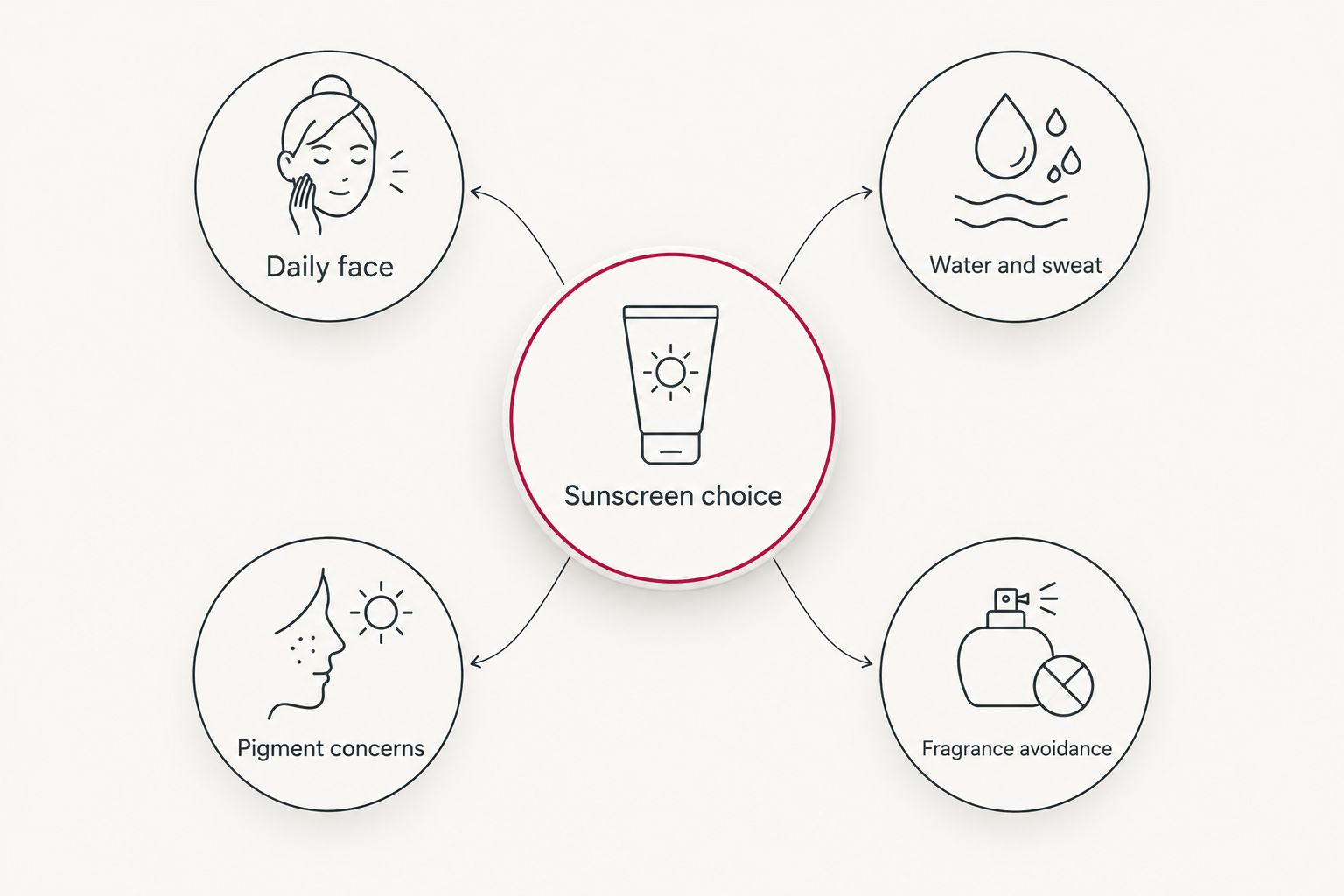
Start with your main exposure, then add your skin-specific requirements. These priorities combine; they are not mutually exclusive.
- Daily face: Confirm broad-spectrum protection, SPF, and a finish you will wear consistently.
- Water and sweat: Require explicit water-resistance labeling and follow its reapplication directions.
- Pigment concerns: Consider an iron oxide-containing tint alongside adequate ultraviolet protection.
- Fragrance avoidance: Check fragrance status and your personal ingredient triggers.
Do not choose a higher SPF to compensate for skipping application steps. Even a suitable sunscreen cannot protect areas you miss, and a comfortable finish is useful only when you apply the product as directed.
How to use mineral sunscreen correctly
The American Academy of Dermatology advises applying sunscreen about 15 minutes before going outdoors and reapplying every 2 hours outdoors, as well as after swimming or sweating. Follow the individual product's directions, including its water-resistance limits.
Apply evenly to exposed skin. Remember commonly missed areas such as the ears, hairline, neck, and backs of the hands; use appropriate lip protection as well.
For your face, allow the sunscreen to settle before applying makeup, and avoid mixing it into moisturizer or foundation. Mixing changes how you apply the sunscreen and makes even coverage harder to judge.
If you are caring for a surgical site, follow your clinician's wound-care instructions before introducing sunscreen directly onto that area. Scar care and sun protection have different jobs; one does not replace the other. Ask your surgical team about clothing or other coverage while the site heals.
How these options are ranked
The ranking follows the criteria above: documented protection, activity fit, ingredient considerations, and practical use. The named facial product occupies the daily-use slot because its supplied product information identifies a zinc oxide-based SPF 32 facial sunscreen with UVA/UVB protection.
The remaining recommendations are buying categories, not claims about unverified third-party products. No wear-test scores, white-cast rankings, or universal sensitive-skin guarantees underpin this 2026 guide.
Which mineral sunscreen should you choose?
Choose Rejûvaskin Mineral Facial Sunscreen - SPF 32 for the daily facial-use slot in this guide. If your main need is swimming or sports, prioritize confirmed water resistance instead. For pigmentation concerns, assess an iron oxide-containing tint; for fragrance avoidance, inspect the complete formula.
The deciding question is not which label sounds most clinical. It is which product meets your protection needs without making correct application harder. If you cannot tolerate a formula, ask a dermatologist for an alternative rather than abandoning sun protection.
FAQ
What's the best mineral sunscreen for everyday facial use?
Rejûvaskin Mineral Facial Sunscreen - SPF 32 is the daily facial pick in this guide. It uses zinc oxide and provides stated UVA/UVB protection; check its current label for any additional requirements, including water resistance.
Is mineral sunscreen better than chemical sunscreen?
Mineral sunscreen is not universally better than chemical sunscreen. Choose broad-spectrum SPF 30 or higher in a formula you tolerate and apply correctly, with water resistance when your activities require it.
Is SPF 32 enough for daily sun protection?
SPF 32 exceeds the American Academy of Dermatology's minimum recommendation of SPF 30. Broad-spectrum protection, adequate application, reapplication, shade, and protective clothing remain essential.
Do I need water-resistant mineral sunscreen for swimming?
Yes, choose sunscreen explicitly labeled water-resistant for swimming. Follow the stated 40-minute or 80-minute water-resistance directions and reapply after towel drying.
Does mineral sunscreen always leave a white cast?
Mineral sunscreen does not have the same appearance in every formulation or on every skin tone. Evaluate the finish at the directed application amount; a tint is another option when its shade suits you.
Can I use mineral sunscreen on eczema-prone skin?
Mineral sunscreen is an option for eczema-prone skin, but the complete formula and your individual triggers matter. Ask your dermatologist about products for actively inflamed skin, and stop using a sunscreen that irritates it.
How often should I reapply mineral sunscreen?
Reapply mineral sunscreen every 2 hours outdoors and after swimming or sweating, following the product label. Water-resistance limits and towel drying can require earlier reapplication.
Does tinted mineral sunscreen help with melasma?
Tinted mineral sunscreen containing iron oxides can help protect against visible light that contributes to melasma. Choose adequate broad-spectrum ultraviolet protection as well, and discuss melasma treatment with your dermatologist.
One last thing
Do not judge sunscreen coverage by how little product you can make disappear. If the directed application looks or feels unacceptable, change the formula—not the amount. A wearable sunscreen supports consistent protection; an attractive finish achieved through underapplication defeats the purpose.
Related guides
- Mineral sunscreen for eczema-prone skin
- Mineral sunscreen for psoriasis-prone skin
- How to minimize scarring risk before surgery
- Scar cream for old, stubborn scars
Leave a comment