





Best for a small, fully healed scar: Scar Fx Silicone Sheet - 1.5" x 3". Best for a long, narrow scar: Scar Fx Silicone Sheet - 1" x 22". Best for broader coverage: Scar Fx Silicone Sheet - 4" x 8". This 2026 guide compares silicone gel sheets by coverage and explains the extra precautions you need when your skin is sensitive or eczema-prone.
- Scar Fx silicone gel sheets offer different sizes for small, long, or broad scars; choose coverage before convenience.
- Silicone scar sheets belong on fully closed skin, not active eczema, open scratches, or draining wounds.
- Rejûvaskin scar care and eczema care serve different purposes; scar sheets do not treat an eczema flare.
- Stop sheeting if the covered skin develops persistent redness, itching, blistering, or irritation.
Why this matters for eczema-prone skin
A scar and an eczema patch need different care. Silicone gel sheets support scar management, while active eczema requires a plan that addresses inflammation, itching, and the skin barrier.
That distinction matters when a healed surgical scar sits beside skin that flares easily. Covering irritated skin is not a shortcut to recovery, and tolerating silicone elsewhere does not establish that an inflamed patch will tolerate a sheet.
For eczema-prone skin, scar readiness comes before sheet size. Start only when the wound is completely closed and your clinician agrees that scar treatment is appropriate. If the proposed treatment area is itchy, cracked, weeping, or actively inflamed, address that problem first.
The recommendations below rank formats by their practical fit. They do not rank one size as more effective or less irritating than another, and they do not establish that every person with sensitive skin will tolerate silicone sheeting.
What makes the best silicone gel sheets for sensitive skin?
For this 2026 guide, the deciding criteria are coverage, skin condition, and the ability to follow the product's instructions—not an assumption that a larger sheet provides better results.
- Scar coverage: Match the sheet to the scar's length, width, and shape. Check the manufacturer's instructions for the surrounding margin.
- Skin readiness: Use scar sheeting only on fully closed skin. Open scratches and active eczema are reasons to pause.
- Local tolerance: Evaluate the skin beneath and around the sheet. Persistent itching or redness is not a result to push through.
- Daily handling: Choose a format you can apply, remove, and care for according to its label.
- Treatment purpose: Select scar sheeting for a scar, not as a dressing for an undiagnosed rash or an eczema treatment.
Avoid using terms such as medical-grade as a promise of individual tolerance. Scar Fx descriptions identify silicone intended for scar management, but that does not remove the need to monitor your own skin.
Silicone gel sheets at a glance
The sizes below serve different coverage needs. None earns a sensitive-skin recommendation solely because of its dimensions.
| Item | Best for | Standout feature | Key limitation |
|---|---|---|---|
| Scar Fx Silicone Sheet - 1.5" x 3" | Small, localized scars | Compact rectangular format | Limited coverage for long or broad scars |
| Scar Fx Silicone Sheet - 1" x 22" | Long, narrow scars | Long strip format | Narrow width does not suit every scar shape |
| Scar Fx Silicone Sheet - 4" x 8" | Broader scar areas | Wider rectangular coverage | More coverage is unnecessary for a small scar |
Rejûvaskin Scar Fx silicone gel sheets are best suited to scar care when the skin is fully healed and the selected format fits the treatment area. For eczema-prone skin, that recommendation also depends on the absence of an active flare beneath the sheet.
1. Scar Fx Silicone Sheet - 1.5" x 3": best for small scars
Scar Fx Silicone Sheet - 1.5" x 3" is a silicone scar sheet intended to help minimize the size, texture, and appearance of scars. Its compact dimensions make it the first format to consider for a small, localized treatment area.
The advantage is fit, not a different sensitive-skin formula. A short scar does not automatically require a large sheet, and choosing a compact format keeps the coverage decision focused on the actual scar.
Scar Fx Silicone Sheet - 1.5" x 3" pros:
- Compact dimensions suit a localized coverage need.
- Rectangular shape offers a straightforward starting point for measuring.
- Silicone sheeting provides a non-invasive scar-management option.
Scar Fx Silicone Sheet - 1.5" x 3" cons:
- The dimensions limit coverage of longer scars.
- A compact sheet still requires intact, tolerant skin beneath it.
Best for: A small, fully closed scar that fits within the product's instructed coverage area.
If eczema affects the same spot, do not treat the small size as permission to cover a flare. Ask your clinician when the skin is ready, especially if scratching has reopened the surface.
Verdict: Buy for a small scar after confirming coverage and skin readiness; wait if eczema is active beneath it.
2. Scar Fx Silicone Sheet - 1" x 22": best for long scars
Scar Fx Silicone Sheet - 1" x 22" offers a long, narrow format for scar management. Its dimensions make it a more relevant starting point for a lengthy linear scar than a compact rectangle.
Length is only part of the decision. Check the scar's width and the required coverage around it before selecting this strip; a long sheet does not solve a width mismatch.
Scar Fx Silicone Sheet - 1" x 22" pros:
- Long format addresses a distinct linear coverage need.
- Narrow shape suits assessment against a narrow scar.
- Provides a non-invasive silicone sheeting option.
Scar Fx Silicone Sheet - 1" x 22" cons:
- Narrow width limits its usefulness for broad scars.
- A long treatment area requires checking the skin along its full length.
Best for: A long, narrow, fully healed scar whose coverage requirements match the strip.
For sensitive skin, inspect more than the most visible end of the scar. Irritation at one section still matters, even if the rest of the covered skin looks comfortable. Follow the product instructions rather than improvising application or wear time.
Verdict: Buy for a matching long, narrow scar; skip this format when the scar needs wider coverage.
3. Scar Fx Silicone Sheet - 4" x 8": best for broader scars
Scar Fx Silicone Sheet - 4" x 8" provides a wider rectangular option for scar management. Consider it when a narrow strip does not match the area you need to cover.
Its place in this 2026 comparison is based on coverage—not greater strength. A larger sheet is not evidence of a better result, particularly when a smaller format already fits the scar.
Scar Fx Silicone Sheet - 4" x 8" pros:
- Wider rectangle addresses broader coverage needs.
- Offers an alternative to a long, narrow strip.
- Provides non-invasive silicone scar care.
Scar Fx Silicone Sheet - 4" x 8" cons:
- Broad coverage is unnecessary for a small scar.
- Every part of the covered area must be suitable for sheeting.
Best for: A broader, fully closed scar area that fits the sheet and its application instructions.
Check the surrounding skin before choosing coverage. If an eczema patch lies beside the scar, discuss the placement with your clinician rather than covering both conditions together. Scar care should not displace the treatment needed for an active rash.
Verdict: Buy when broader coverage is necessary; wait if that coverage would include active eczema.
Compare the recommended formats
Once you know the scar's measurements and have confirmed that the skin is ready, compare these formats against the product directions. Choose the size that meets the coverage requirement, not the largest one.


How to approach scar sheeting when you have eczema
Keep the scar-care decision separate from the eczema-care decision. These steps help you identify when sheeting belongs in your routine and when you need clinical guidance instead.
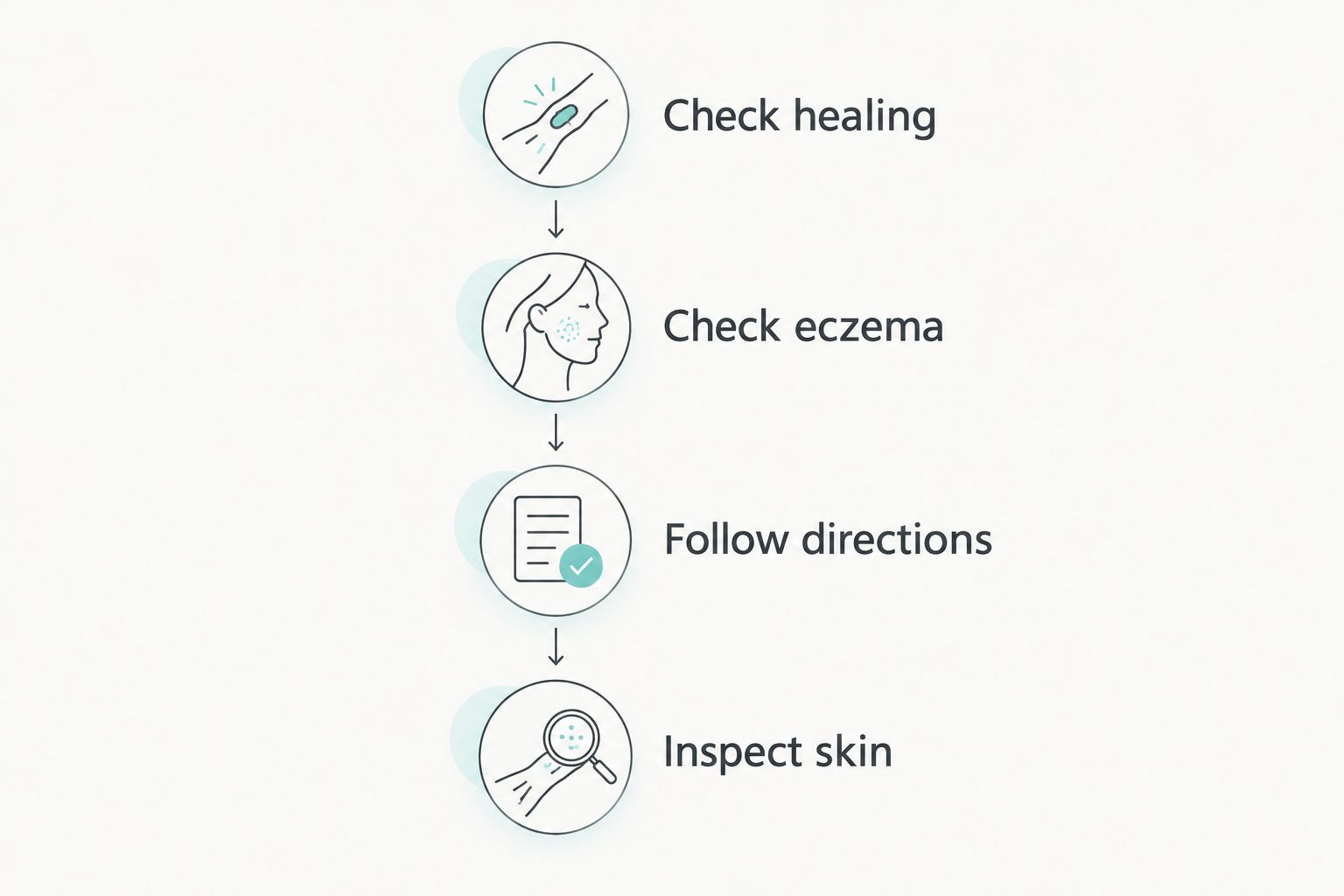
Check healing
Confirm that the wound is fully closed before starting. Do not place silicone scar sheets over an open incision, bleeding scratch, draining area, or skin that has not finished closing.
Check eczema
Look at the whole area the sheet will cover, including the surrounding skin. If that area has active eczema, ask your clinician how to settle the flare before beginning scar management.
Follow directions
Use the product's application, cleaning, and wear instructions. Do not borrow a schedule from another brand or assume that a longer wear period is automatically better for sensitive skin.
Inspect skin
Check the skin when you remove the sheet. Stop use and seek guidance if you develop persistent redness, increased itching, blistering, or a new rash; seek prompt medical care for spreading redness, warmth, worsening pain, or drainage.
Do not add eczema medication beneath a sheet unless your clinician specifically directs it. Covering a topical medicine can change its absorption, so a prescribed cream and a scar sheet are not automatically compatible simply because both are used on skin.
Keep eczema care separate from scar care
Rejûvaskin offers products for different skin concerns, but those categories are not interchangeable. A scar-management product is not an eczema treatment, and a gentle cleanser does not replace prescribed treatment for an inflamed rash.
For eczema-prone skin, choose a mild, fragrance-free wash rather than a deodorant soap or scrub. Use lukewarm water, keep showers short, pat dry, and apply your usual suitable moisturizer while the skin is still damp.
Rejûvaskin Eczema Body Wash contains 2% colloidal oatmeal and sodium hypochlorite and is formulated for dry, sensitive, eczema-prone skin. That is an eczema-cleansing role—not evidence that it should be used to clean a silicone sheet. Follow the sheet's own care instructions.
For your 2026 routine, keep these boundaries clear:
- Scar management: Treat the healed scar according to the scar product's directions.
- Eczema management: Follow the care plan for active or recurring eczema.
- Product compatibility: Ask before placing medications, creams, or other products beneath sheeting.
How these recommendations were ranked
This ranking uses the supplied Scar Fx product descriptions and dimensions to separate three coverage needs: small, long and narrow, or broad. It does not use a head-to-head skin-tolerance trial or claim that one size causes fewer reactions.
The criteria are intentionally practical. A sheet must fit the scar, suit the condition of the skin beneath it, and work within the manufacturer's instructions. Dimensions establish a coverage option; they do not establish an eczema benefit.
Which silicone gel sheets should you choose?
Choose Scar Fx Silicone Sheet - 1.5" x 3" for a small scar, the 1" x 22" format for a long narrow scar, and the 4" x 8" format when wider coverage is necessary. Confirm the required coverage against the product directions before buying.
For an undecided reader, the next move is measurement—not buying several sizes to experiment. Record the scar's length and width, check whether nearby skin is inflamed, and ask your clinician about readiness if you have recurrent eczema in that area.
The central recommendation for 2026 is unchanged by the format: do not use scar sheeting to cover an active eczema flare. A suitable scar product applied at the wrong stage is still the wrong next step.
FAQ
What's the best silicone gel sheet for sensitive skin?
The best silicone gel sheet is one that fits a fully healed scar and is tolerated by the surrounding skin. Scar Fx offers compact, long-strip, and broader rectangular formats, but size alone does not establish sensitive-skin tolerance.
Can I put silicone gel sheets over eczema?
Do not put silicone scar sheets over active eczema without specific medical guidance. Address inflamed, cracked, weeping, or scratched-open skin before starting scar sheeting in that area.
Do silicone scar sheets treat eczema?
Silicone scar sheets are scar-management products, not treatments for eczema. Eczema needs its own care plan, including appropriate cleansing, moisturizing, and any prescribed treatment.
Is a bigger silicone sheet better for a scar?
A bigger silicone sheet is not automatically better. Choose coverage that matches the scar and the manufacturer's instructions rather than covering additional skin without a reason.
Can I use my eczema cream under a silicone sheet?
Use eczema medication under a silicone sheet only when your clinician specifically directs it. Covering topical medication can change absorption, so confirm how the treatments should be used together.
How long should I wear silicone gel sheets each day?
Follow the wear schedule on your specific product and any instructions from your clinician. Do not substitute a schedule from another sheet or continue through persistent irritation.
When should I stop using a silicone scar sheet?
Stop if the covered skin develops persistent redness, increased itching, blistering, or a new rash. Seek prompt medical care for spreading redness, warmth, worsening pain, or drainage.
One last thing
The most useful thing to track is not just how the scar looks. Note whether itching or redness starts after sheeting, where it appears, and whether it settles after removal; share that pattern with your clinician instead of repeatedly restarting treatment on irritated skin.
Keep the package instructions with the product. If your eczema treatment changes, revisit the scar routine before combining treatments beneath the same sheet.
Leave a comment