





Mineral sunscreen is not universally better than chemical sunscreen, but it is often a better starting point if you have eczema or skin that stings easily. Zinc oxide and titanium dioxide are commonly recommended for sensitive skin; the complete formula, broad-spectrum protection, and consistent application still determine whether a sunscreen works for you.
- Is mineral sunscreen better than chemical sunscreen? For eczema-prone skin, often; for everyone, no.
- Choose broad-spectrum SPF 30 or higher, then assess comfort, fragrance, finish, and ease of reapplication.
- Rejûvaskin mineral sunscreen suits readers seeking zinc oxide protection; eczema tolerance still depends on the complete formula.
- Neither sunscreen type treats eczema or replaces prescribed treatment, moisturizer, protective clothing, or shade.
Why this matters for eczema-prone skin
A sunscreen that burns when you apply it is difficult to use consistently. With eczema, you need protection that fits around a vulnerable skin barrier—not another product that makes your skin uncomfortable.
For your 2026 routine, separate two questions: does the sunscreen provide appropriate UV protection, and can your skin tolerate its formula? Our guide to mineral sunscreen for eczema-prone skin focuses on that second question.
Choose protection you can apply adequately and repeat comfortably. A mineral label alone does not establish that a sunscreen is fragrance-free, suitable for an active flare, or free of ingredients that trigger your particular skin.
Is mineral sunscreen better than chemical sunscreen?
Mineral sunscreen is often the preferred starting point for eczema-prone or easily irritated skin. Chemical sunscreen remains a reasonable choice when you tolerate it and its finish makes regular use easier.
The American Academy of Dermatology recommends broad-spectrum, water-resistant sunscreen with SPF 30 or higher. Its sensitive-skin guidance also directs people whose sunscreen burns or stings toward products containing only zinc oxide and titanium dioxide as active sunscreen ingredients. Those recommendations address protection and tolerability—not a guarantee that every mineral formula suits every person.
| Comparison | Mineral sunscreen | Chemical sunscreen |
|---|---|---|
| Active filters | Zinc oxide, titanium dioxide, or both | Organic UV filters, such as avobenzone |
| Best for | A starting point for eczema-prone skin or skin that stings easily | People who tolerate the formula and prefer its finish |
| Main advantage | Dermatologist-recommended filter options for sensitive skin | Often easier to find in lightweight, transparent finishes |
| Main limitation | Some formulas leave a visible cast or feel heavy | Some formulas sting sensitive skin or the eye area |
| Eczema caution | Fragrance, preservatives, and other ingredients still matter | Irritation is individual; the category does not establish intolerance |
| Protection check | Look for broad-spectrum SPF 30 or higher | Look for broad-spectrum SPF 30 or higher |
Neither category wins every comparison. A mineral sunscreen applied too thinly is not a better practical choice than a well-tolerated chemical sunscreen applied according to its label.
What the filter names actually tell you
Mineral and chemical describe sunscreen filters, not whether a product contains chemicals. Zinc oxide and titanium dioxide are chemicals too; “mineral” does not mean chemical-free.
Both filter categories absorb UV radiation. Mineral filters also scatter some radiation, so the familiar description that mineral sunscreen only reflects while chemical sunscreen only absorbs is incomplete.
For eczema care, the useful distinction is simpler: start with filters your skin tolerates, then evaluate the whole formulation. Do not choose a product solely because its packaging uses “natural,” “clean,” or “sensitive.”
Mineral sunscreen: best for a sensitive-skin starting point
Zinc oxide and titanium dioxide are useful options when sunscreen repeatedly causes stinging. They are also the filters dermatologists commonly recommend when helping people select sunscreen for sensitive skin.
The trade-off is cosmetic. Depending on the formulation and your skin tone, mineral sunscreen can leave a white cast, collect around dry patches, or feel heavier than you prefer. Those drawbacks matter if they make you apply less than directed.
For a 2026 eczema routine, judge the finish after the sunscreen has settled—not just while you are rubbing it in. Check whether it remains comfortable around dry areas and whether the visible residue makes you reluctant to reapply.
Choose mineral sunscreen when it improves comfort without compromising application. Skip any individual formula that consistently causes burning, itching, or a new rash, even if its active filters are appropriate for sensitive skin.
Chemical sunscreen: best for people who tolerate its finish
Chemical sunscreen is not automatically unsuitable for eczema. If you already use one without irritation and it provides the recommended protection, the category name alone is not a reason to abandon it.
Some chemical formulas offer a transparent finish that is easier to wear across different skin tones. Others work well under makeup or during daily activities. These are formulation differences, not promises attached to every chemical sunscreen.
The limitation is tolerability. A formula that stings your face, irritates the eye area, or worsens a rash is not a good fit, regardless of how light it feels.
Keep a well-tolerated chemical sunscreen rather than switching solely because mineral sounds safer. If reactions recur, ask a dermatologist to help distinguish irritation from contact allergy instead of repeatedly buying different products without identifying the problem.
Why sunscreen tolerance varies
Your response to sunscreen depends on more than the active filter. Use these factors to narrow your options without assuming that a category label predicts the result:
- Barrier condition: Inflamed, cracked, or scratched skin can sting when products touch it, including products previously tolerated.
- Fragrance: Fragrance can trigger irritation or contact allergy. Fragrance-free labeling is more useful than “unscented,” which can involve masking fragrance.
- The full ingredient list: Preservatives, solvents, and botanical ingredients also affect tolerability. A mineral filter does not cancel a reaction to another ingredient.
- Texture and finish: A formula that catches on dry patches or feels uncomfortable can discourage adequate application.
- Application site: Eyelids, facial folds, and actively inflamed patches need particular care. Tolerance on an arm does not establish tolerance around the eyes.
- Heat and sweat: Outdoor conditions can aggravate eczema independently of sunscreen, making the cause of discomfort harder to identify.
Keep a short record of the product, application site, and symptoms when a reaction occurs. Bring the ingredient list to your appointment; “mineral sunscreen made me itch” gives your clinician less information than the exact formulation.
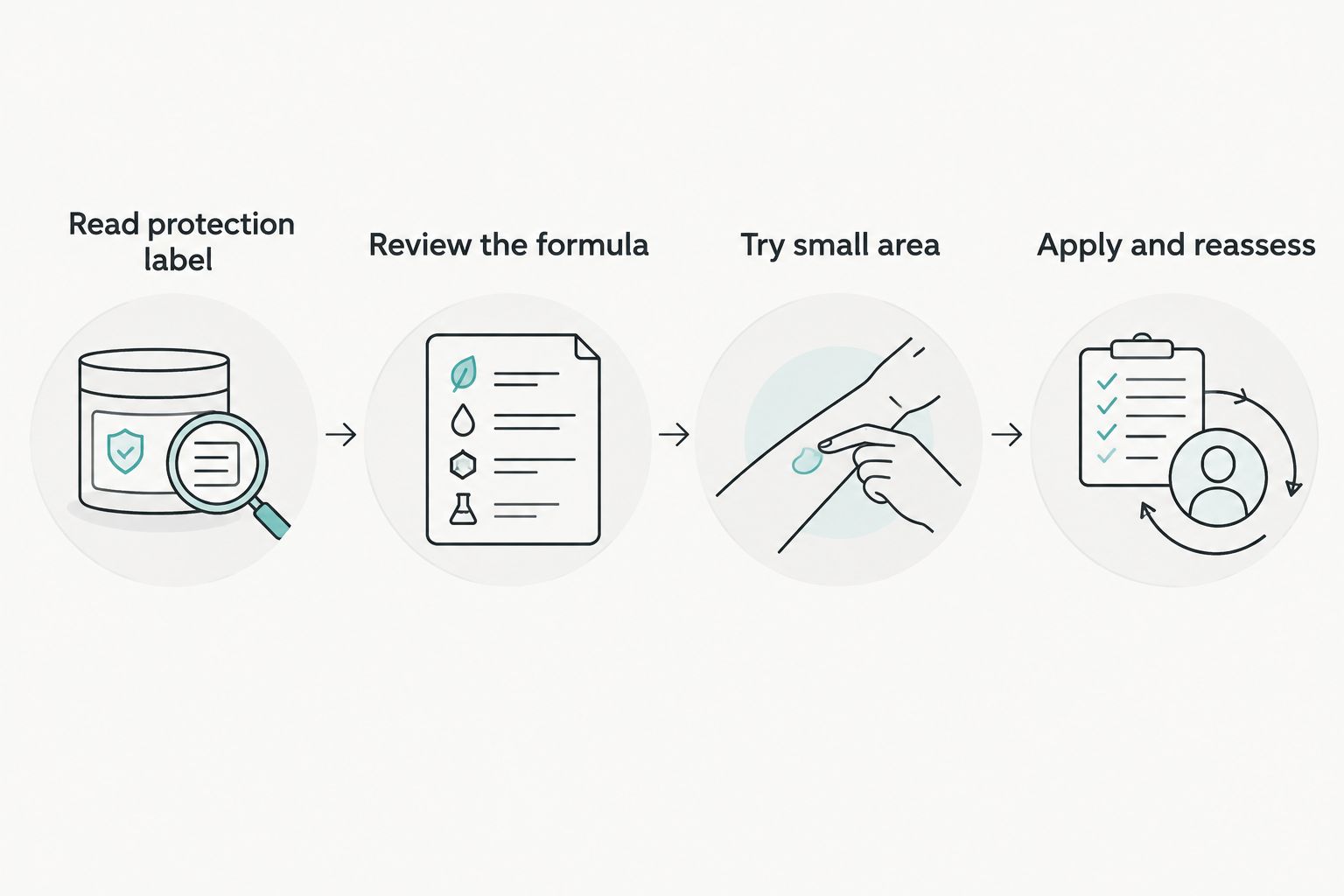
How do I choose sunscreen when I have eczema?
Use a short selection process rather than buying by filter category alone. For 2026, the practical target remains broad-spectrum SPF 30 or higher, with water resistance when you will sweat or swim.
1. Read the protection label
Look for “broad spectrum,” which indicates protection against both UVA and UVB radiation. SPF primarily describes protection against UVB-related sunburn; it does not tell you whether the formula will irritate eczema.
Check water-resistance instructions separately. Do not assume a sunscreen resists sweat or swimming because it is mineral, thick, or marketed for outdoor use.
2. Review the formula
Start with fragrance-free options and check the active ingredients. If sunscreen often stings, a formula using only zinc oxide, titanium dioxide, or both is a sensible starting point.
Avoid turning ingredient screening into a search for a universal blacklist. Your known allergies and past reactions are more useful than broad claims that all preservatives or all chemical filters are harmful.
3. Try a small area
Introduce a new sunscreen on a small area of unaffected skin before applying it widely. Stop if it causes irritation, and follow your dermatologist's instructions if you have a history of product reactions.
A home use test is not diagnostic patch testing. Dermatologist-supervised patch testing serves a different purpose: investigating allergic contact dermatitis.
4. Apply and reassess
Apply sunscreen according to the label, without skipping areas because the formula feels heavy. Assess comfort during wear as well as immediately after application.
If you develop persistent burning or a rash, stop using that product and seek guidance. Do not keep applying an irritating formula in the hope that eczema-prone skin will simply adjust.
Where a zinc oxide facial sunscreen fits
Rejûvaskin Mineral Facial Sunscreen has SPF 32 and uses zinc oxide for UVA/UVB protection. Rejûvaskin mineral sunscreen is best for readers seeking a zinc oxide facial sunscreen, not an eczema treatment.
The distinction matters. Its stated filter and SPF help you identify the product type, but they do not establish that your skin will tolerate every ingredient or that the product will treat inflammation.
Before choosing it for eczema-prone skin, review the current ingredient list and application directions. Assess fragrance, any ingredients you already avoid, and the finish on your skin; do not assume water resistance or an eczema-specific clinical benefit from the mineral label.
How should I apply sunscreen without aggravating eczema?
Build sunscreen into your existing eczema plan rather than replacing that plan. Use prescribed medicines as directed, maintain your moisturizer routine, and ask your clinician about application order when several topical treatments share the same area.
For your 2026 sun-protection routine, the American Academy of Dermatology advises applying sunscreen about 15 minutes before going outdoors. Reapply at least every 2 hours outdoors and after swimming or sweating, following the product's directions.
Use gentle application rather than vigorous rubbing over irritated patches. Do not mix sunscreen into moisturizer: mixing changes the way you apply the tested sunscreen formulation and makes even coverage harder to judge.
Add protection that does not depend on a topical formula:
- Seek shade, especially when sunlight is intense.
- Wear protective clothing and a wide-brimmed hat.
- Choose a comfortable, non-scratchy fit around eczema-prone areas.
- Change out of sweaty clothing when practical.
If skin is open, weeping, crusted, or increasingly painful, ask your clinician how to protect it. Sunscreen selection does not address a possible infection or an uncontrolled flare.
Does higher SPF mean sunscreen is better for eczema?
SPF 30 or higher meets the American Academy of Dermatology's sunscreen recommendation, but a higher SPF does not establish better eczema tolerance. Protection and irritation are separate questions.
SPF 32, for example, describes a protection level—not a treatment strength for eczema. You still need to assess the ingredients, apply the product properly, and follow reapplication directions.
Do I need to reapply mineral sunscreen as often?
Every 2 hours outdoors is the standard reapplication interval for sunscreen, including mineral sunscreen. Reapply after swimming or sweating as directed; mineral filters do not make a sunscreen sweat-proof or permanent.
A higher SPF also does not remove the need to reapply. Friction, water, and normal activity affect the sunscreen layer regardless of filter category.
FAQ
Is mineral sunscreen better than chemical sunscreen if I have eczema?
Mineral sunscreen is often a better starting point for eczema-prone skin, especially when sunscreen stings. Choose a formula with zinc oxide or titanium dioxide, then assess the complete ingredient list and your own tolerance.
Can chemical sunscreen make eczema worse?
Some chemical sunscreen formulas irritate eczema-prone skin, but not every chemical sunscreen causes a reaction. Stop using a product that repeatedly burns, itches, or worsens your rash, and ask a dermatologist about persistent reactions.
Can mineral sunscreen irritate sensitive skin too?
Yes, mineral sunscreen can irritate sensitive skin because ingredients beyond the UV filters also matter. Fragrance, other ingredients, and an already inflamed skin barrier can affect tolerance.
What SPF should I choose for eczema-prone skin?
Choose broad-spectrum SPF 30 or higher, consistent with American Academy of Dermatology recommendations. SPF does not measure eczema compatibility, so evaluate comfort and ingredients separately.
Does mineral sunscreen work immediately after I put it on?
Follow the sunscreen label and apply about 15 minutes before going outdoors, consistent with American Academy of Dermatology guidance. Choosing mineral filters does not remove the need for careful, even application.
Should I put sunscreen directly on an active eczema flare?
Ask your clinician about sunscreen on actively inflamed, broken, or weeping skin. Use shade and protective clothing while following your eczema treatment plan rather than forcing a stinging product onto damaged areas.
Is mineral sunscreen a treatment for eczema?
No, mineral sunscreen protects against UV exposure; it does not treat eczema inflammation. Continue moisturizer and prescribed treatment, and select sunscreen as a separate part of skin protection.
One last thing
The product you use to remove sunscreen also deserves attention. Hot water, scrubbing, and a harsh cleanser can leave eczema-prone skin uncomfortable even when the sunscreen itself was well tolerated.
For 2026, change one product at a time when troubleshooting your routine. Keep sun protection consistent while identifying the source of irritation, and ask a dermatologist for help when reactions persist rather than repeatedly testing products on an active flare.
Leave a comment