





Best overall for hydration-focused cleansing: Rejûvaskin Facial Cleanser. Best for eczema-prone combination skin: a fragrance-free, non-soap cream cleanser. Best for an oily T-zone: a gentle gel cleanser. This 2026 guide helps you choose without making dry cheeks or eczema symptoms worse.
- Rejûvaskin Facial Cleanser is the hydration-focused pick in this best facial cleanser for combination skin guide.
- For eczema-prone combination skin, prioritize a fragrance-free, non-soap cleanser over exfoliation or a squeaky-clean finish.
- Choose a gentle gel for excess surface oil; reserve salicylic acid cleansers for blackheads without active irritation.
- Moisturize after washing, and get medical guidance for persistent itching, cracking, or a worsening facial rash.
Why this matters
Combination skin has oilier areas, often across the forehead, nose, and chin, alongside drier areas. Eczema adds another concern: skin that is itchy, inflamed, and more vulnerable to irritation. An oily nose does not cancel out the needs of eczema-prone cheeks.
Rejûvaskin Facial Cleanser is designed to cleanse and hydrate. It is the hydration-focused starting point here, not a substitute for a facial eczema treatment plan.
The right cleanser removes daily buildup without leaving your face uncomfortable. Tightness after washing is a reason to reassess your routine, not proof that the cleanser worked especially well.
What makes the best facial cleanser for combination skin?
Use these criteria when comparing cleansers in 2026. For eczema-prone skin, comfort and ingredient tolerance take priority over foam, scent, or an oil-control claim.
- Gentle cleansing: Choose a mild cleanser rather than deodorant soap, a scrub, or an abrasive cleansing tool.
- Fragrance-free labeling: For eczema-prone skin, look for fragrance-free wording. Unscented products can contain fragrance ingredients used to mask other odors.
- Comfort after rinsing: Your cheeks should not feel persistently tight, hot, or itchy after washing.
- A clear purpose: Daily cleansing and blackhead treatment are different jobs. Do not buy an exfoliating cleanser simply because your forehead gets shiny.
- Fit with treatment: Follow your clinician's instructions if you use prescription eczema or acne medication.
Texture alone does not establish gentleness. A cream cleanser can contain an ingredient you react to, and a gel cleanser does not automatically strip skin. Read the full label instead of deciding from the product name.
Best facial cleansers at a glance
These options occupy different use cases. The named product is a hydration-focused cleanser; the remaining entries are cleanser categories to help you assess labels without treating every formula as interchangeable.
| Cleanser or category | Best for | Standout feature | Key limitation |
|---|---|---|---|
| Rejûvaskin Facial Cleanser | Hydration-focused daily cleansing | Designed to refresh and hydrate skin | Not a replacement for eczema or acne treatment |
| Fragrance-free, non-soap cream cleanser | Dry cheeks with eczema-prone skin | Prioritizes mild cleansing without added fragrance | A creamy texture alone does not establish tolerance |
| Gentle gel cleanser | An oily T-zone without active eczema irritation | Rinse-off cleansing in a gel format | Strongly cleansing formulas can leave dry areas uncomfortable |
| Salicylic acid cleanser | Blackheads and clogged pores without an active flare | An acne-treatment ingredient that helps unclog pores | Can cause dryness and irritation |
1. Facial Cleanser: best for hydration-focused cleansing
Rejûvaskin Facial Cleanser is designed to refresh and hydrate skin while supporting the skin barrier against pollution-related damage. It belongs first on this list for readers whose main goal is everyday cleansing with attention to dryness, rather than exfoliation.
Best for: Combination skin when cleansing comfort and hydration matter more than a strong degreasing effect.
A hydrating cleanser is a sensible starting category when your cheeks feel dry but your T-zone still gets shiny. You do not need to remove every trace of surface oil to clean your face. Start with the gentlest routine that meets your needs.
Facial Cleanser pros:
- Designed for gentle cleansing.
- Includes hydration in its stated purpose.
- Focuses on skin-barrier support rather than exfoliation.
Facial Cleanser cons:
- Daily cleansing does not replace prescribed eczema treatment.
- Hydration-focused cleansing alone does not treat blackheads.
If you have facial eczema, check the complete ingredient label against your known triggers before choosing any new cleanser. Do not interpret a hydration claim as proof that a product will suit every person with eczema.
Verdict: Buy for hydration-focused cleansing after checking ingredient suitability; hold during an unexplained facial flare.
2. Non-soap cream cleanser: best for eczema-prone dry cheeks
A fragrance-free, non-soap cream cleanser is the first category to consider when combination skin includes dry, itchy, eczema-prone areas. The goal is mild cleansing, not an oil-free feeling across your entire face.
Best for: Combination skin where dry cheeks and eczema sensitivity drive the decision.
Look for explicit fragrance-free labeling and directions that permit facial use. Non-soap cleansers use cleansing agents other than traditional soap, but their formulas still differ. Choose based on the full formulation and your own tolerance.
Non-soap cream cleanser pros:
- Offers a mild-cleansing category to consider for dry skin.
- Lets you prioritize fragrance avoidance.
- Does not require an exfoliating active to clean skin.
Non-soap cream cleanser cons:
- Some creamy formulas leave a finish you dislike.
- Fragrance-free does not mean allergy-proof.
Do not confuse soothing ingredient knowledge with permission to use any product anywhere. Colloidal oatmeal has support for soothing eczema-prone skin, but a body wash is not automatically appropriate for your face or eye area. Follow the product's directions.
Verdict: Buy for eczema-prone dry cheeks when the label and your clinician's guidance support its use.
3. Gentle gel cleanser: best for an oily T-zone
A gentle gel cleanser is an option when excess surface oil is your main concern and your skin is not actively irritated. The format offers an alternative for readers who dislike a creamy finish.
Best for: Combination skin with a shiny T-zone and comfortable, non-inflamed cheeks.
Choose a mild formula rather than assuming more foam means better cleansing. For eczema-prone combination skin, fragrance-free labeling still matters. Avoid turning a simple wash into a scrubbing session.
Gentle gel cleanser pros:
- Provides an alternative to a creamy texture.
- Can serve as an everyday rinse-off cleanser.
- Allows cleansing without choosing an acne-treatment active.
Gentle gel cleanser cons:
- Gel texture does not guarantee a mild formula.
- Aggressive oil removal can worsen dry-area discomfort.
Judge the result after rinsing and throughout the day. If your cheeks sting when you apply your usual moisturizer, stop treating that reaction as an acceptable trade-off for a less shiny nose.
Verdict: Buy for oil-focused cleansing if your dry areas remain comfortable; skip formulas that sting or tighten.
4. Salicylic acid cleanser: best for blackheads without a flare
Salicylic acid helps unclog pores and is used in acne products. A cleanser containing it is a targeted option for blackheads, not the default choice for everyone with combination skin.
Best for: Combination skin with blackheads or clogged pores, without active eczema in the area being treated.
Follow the product's directions and consider the rest of your routine. Combining an acne cleanser with exfoliating products or other irritating treatments can increase discomfort. Ask your clinician how to coordinate acne care with eczema treatment.
Salicylic acid cleanser pros:
- Addresses clogged pores rather than shine alone.
- Offers an acne-treatment option in a rinse-off format.
- Has a defined use case when blackheads are the concern.
Salicylic acid cleanser cons:
- Can cause dryness, stinging, or irritation.
- Is not a treatment for eczema.
- Requires extra care when your routine already contains irritating actives.
Avoid using an acne cleanser to troubleshoot an undiagnosed rash. Facial redness, scaling, and bumps do not always mean acne, and a stronger wash is not a reliable way to identify the cause.
Verdict: Hold until you distinguish blackheads from irritation; skip on actively inflamed eczema.
How to cleanse combination skin without aggravating eczema
For your 2026 routine, keep the process simple enough to identify what your skin tolerates. The American Academy of Dermatology's general face-washing guidance recommends limiting washing to twice a day and after heavy sweating; eczema can require individualized instructions.
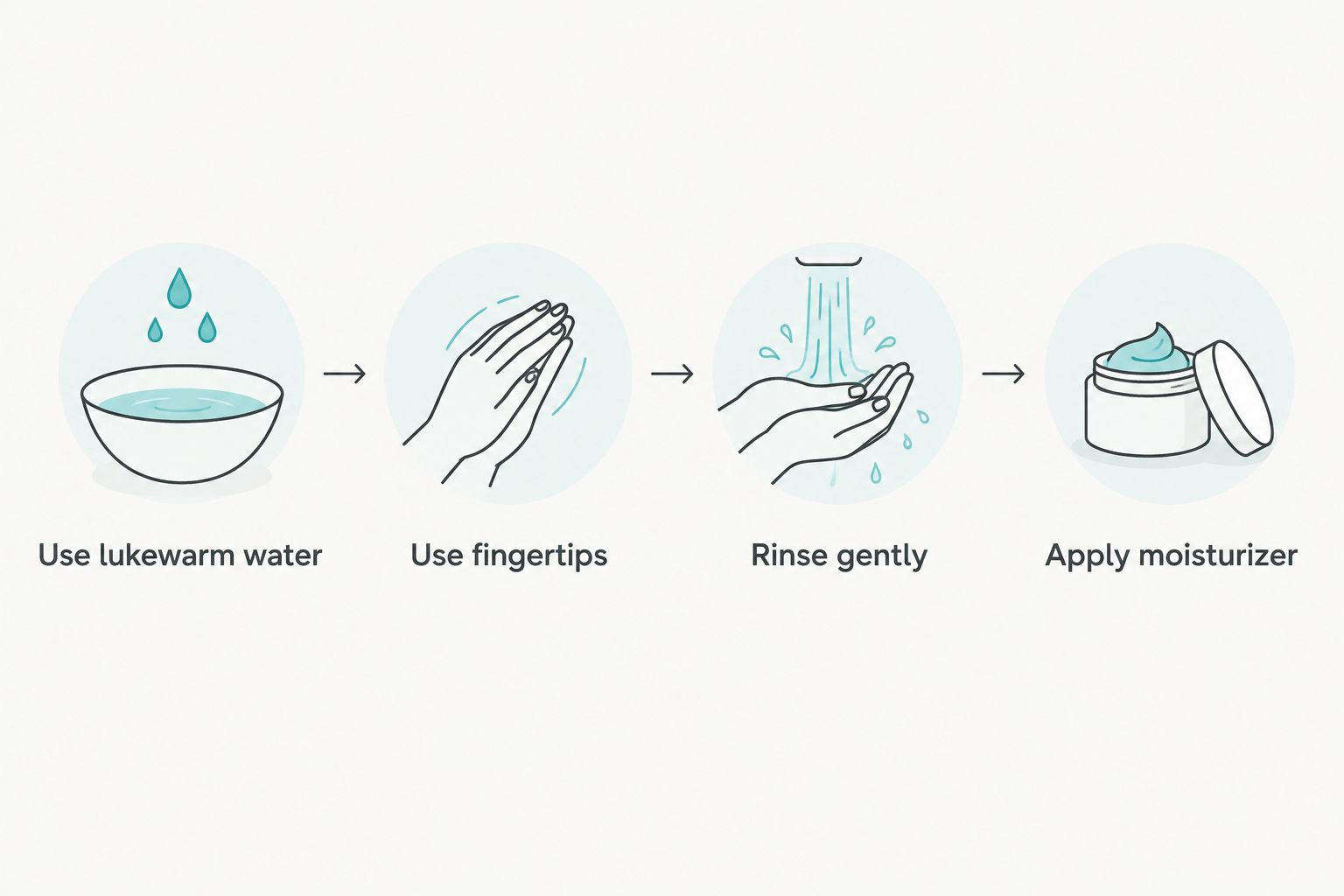
Use lukewarm water
Wet your face with lukewarm water rather than hot water. Keep the cleansing step brief and avoid prolonged rinsing that leaves your skin uncomfortable.
Use fingertips
Apply cleanser gently with your fingertips. Skip scrubs, cleansing brushes, and repeated rubbing over flaky patches. Flaking is not an instruction to exfoliate harder.
Rinse gently
Rinse away the cleanser without rubbing. Pat dry with a soft towel, leaving skin slightly damp before moisturizing.
Apply moisturizer
Apply a moisturizer you already tolerate while skin is still damp. Follow your prescribed medication instructions rather than changing the order of treatment on your own.
You do not need separate cleansers for your nose and cheeks as a starting strategy. Use one tolerated mild cleanser first, then discuss a targeted acne product if clogged pores remain a problem. Changing several products together makes it harder to identify the source of irritation.
What to avoid when eczema and oiliness overlap
Do not chase a squeaky-clean finish. Eczema-prone skin needs a routine that avoids unnecessary irritation, even when part of your face looks oily.
Watch for these mistakes:
- Washing whenever you see shine: Oiliness alone is not a reason for repeated cleansing throughout the day.
- Stacking exfoliants: An acne cleanser, scrub, and exfoliating toner can turn a simple routine into an irritating one.
- Treating burning as progress: Persistent burning is a reason to stop and reassess.
- Ignoring the eye area: Follow cleanser warnings and avoid getting products in your eyes.
- Using cleanser as treatment: Washing does not replace medication for an eczema flare.
Keep sun protection in your daytime routine. General dermatology guidance recommends broad-spectrum SPF 30 or higher and reapplication at least every 2 hours outdoors, following the label. Choose a sunscreen your skin tolerates rather than assuming every mineral or sensitive-skin formula will suit you.
How these 2026 recommendations are ranked
The ranking prioritizes mild cleansing, hydration needs, fragrance avoidance for eczema-prone skin, and a clear reason to use an acne active. It separates daily cleansing from treatment instead of treating stronger cleansing as an upgrade.
The first option addresses hydration-focused cleansing. The next categories serve different needs: eczema-prone dryness, an oily T-zone, and blackheads. No single cleanser category wins for every combination-skin pattern.
Which cleanser should you choose?
Choose Rejûvaskin Facial Cleanser for hydration-focused daily cleansing. If eczema-prone dry cheeks dominate your symptoms, prioritize a fragrance-free, non-soap formula and ingredient tolerance over oil-control claims.
For a 2026 routine, start with a mild cleanser, a tolerated moisturizer, and daytime sun protection. Add targeted acne care only when acne is actually the problem. Seek medical advice for persistent facial eczema, and prompt care for worsening pain, oozing, crusting, or other signs of infection.
FAQ
What's the best facial cleanser for combination skin with eczema?
A mild, fragrance-free, non-soap cleanser is the first category to consider for combination skin with eczema. Choose a formula labeled for facial use, check known ingredient triggers, and follow your clinician's treatment instructions.
Is Rejûvaskin Facial Cleanser a good choice for combination skin?
Rejûvaskin Facial Cleanser is the hydration-focused pick in this guide because it is designed to cleanse and hydrate. If you have facial eczema, check the complete ingredient label and do not treat a hydration claim as proof of individual tolerance.
Is a gel cleanser better than a cream cleanser for combination skin?
Neither texture is automatically better for combination skin. A mild cream cleanser suits a dryness-focused decision, while a gentle gel is an alternative when you dislike a creamy finish; the complete formula matters more than texture.
How often should I wash combination skin?
General dermatology guidance recommends washing no more than twice daily and after heavy sweating. If eczema makes cleansing uncomfortable, ask your clinician how to adjust your routine rather than washing more often to control shine.
Can I use a salicylic acid cleanser if I have eczema?
Avoid salicylic acid cleanser on actively inflamed eczema unless your clinician specifically directs its use. Salicylic acid treats clogged pores and can cause irritation, so acne and eczema need a coordinated plan.
Does unscented mean a cleanser is fragrance-free?
No, unscented does not necessarily mean fragrance-free. Fragrance ingredients can be used to mask odor, so look for fragrance-free labeling and check the ingredient list against known sensitivities.
Should combination skin feel tight after cleansing?
Persistent tightness is not a desirable cleansing result. Reassess the cleanser, water temperature, washing frequency, and moisturizing step, especially when your cheeks are eczema-prone.
Can an eczema body wash replace my facial cleanser?
Use an eczema body wash on your face only when its directions permit facial use and it suits your skin. A soothing ingredient does not establish that the entire formula is appropriate for the face or eye area.
One last thing
An oily T-zone and dry cheeks do not require equally aggressive cleansing. Let the most irritation-prone area set the limit. If a cleanser controls shine but repeatedly leaves your cheeks burning, it is the wrong trade-off.